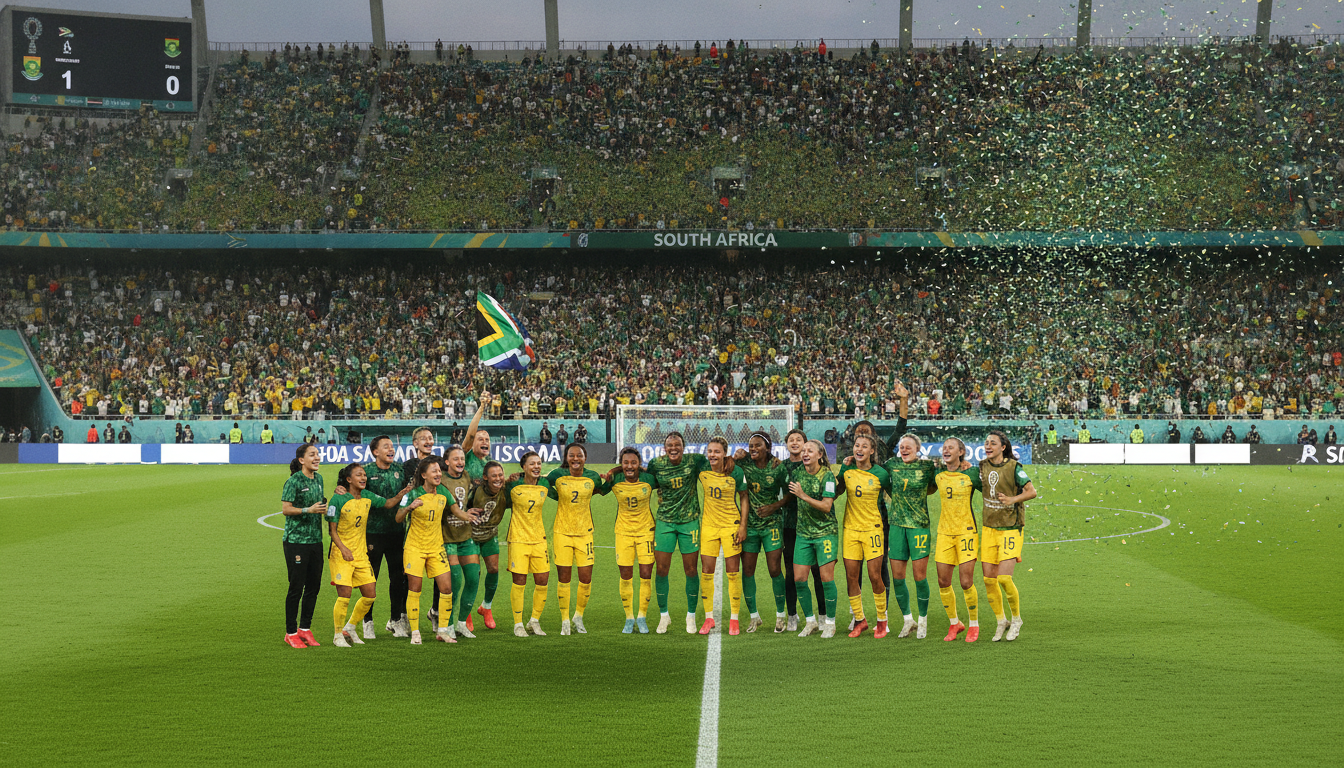
South Africa World Cup 2026: Bafana Bafana Return After 16 Years with Knockout Ambitions
South Africa return to the World Cup in 2026 after a 16-year absence, with Hugo Broos’ organised squad drawn in Group A and realistic hopes of reaching the knockout stage in the expanded tournament.

Return to the global stage
South Africa’s qualification for the 2026 FIFA World Cup marks the end of a 16-year wait since their last appearance as hosts in 2010. The national side, commonly known as Bafana Bafana, secured their place at the finals by topping a demanding CAF qualifying group and now prepare for matches in Mexico City and other venues. This campaign represents South Africa’s fourth World Cup showing, following tournament appearances in 1998, 2002 and 2010.
The timing of the opening match adds narrative weight to the return, with Bafana Bafana set to face hosts Mexico on June 11, 2026 — the same calendar date as the memorable 2010 opener that ended in a 1-1 draw. That historical echo has added urgency to preparations and has focused attention on how South Africa will translate recent continental progress into results on football’s biggest stage.
Hugo Broos’ tactical overhaul
Since his arrival, head coach Hugo Broos has reshaped South Africa into a more cohesive and defensively disciplined unit. Broos, the Belgian coach who previously led Cameroon to the 2017 Africa Cup of Nations title, has emphasised structure, collective responsibility and a balance between defensive solidity and quick transitions. The team that qualified is built around a compact backline, a controlling midfield presence and a willingness to attack in numbers when opportunities appear.
Broos’ system relies less on individual brilliance and more on coordinated movement and set-piece organisation, traits that have delivered strong showings in recent Africa Cup of Nations tournaments. That approach has also fostered a tight-knit squad culture, with players citing unity and shared purpose as central to their recent improvement.
Road to qualification
South Africa sealed qualification by finishing top of their CAF group ahead of Nigeria, Rwanda, Benin, Zimbabwe and Lesotho, a result that underlined the side’s consistency across a demanding qualifying calendar. The campaign combined important away results with resolute home performances, and the team’s defensive record was a key factor in securing the group lead. Progress through qualification has been framed as proof that South Africa can compete with established African powers when they execute the coach’s game plan.
Domestic club success has reinforced the national team’s depth, with Mamelodi Sundowns’ continental triumphs and Orlando Pirates’ recent domestic haul contributing to a healthier player pool. Those club-level achievements have supplied players with experience in high-stakes matches and continental competition, helping them adapt to pressure situations that are likely to come at the World Cup.
Group A draw and schedule
South Africa have been drawn into Group A alongside hosts Mexico, South Korea and the Czech Republic, a bracket viewed as competitive but broadly navigable. The group offers a mix of styles: Mexico’s traditional attacking play, South Korea’s pace and pressing, and the Czech Republic’s organised European structure. Navigating this blend will require tactical flexibility and pinpoint execution across three fixtures spaced through June.
The opener against Mexico on June 11, 2026, is the tournament’s first match and a unique opportunity for an upset that would dramatically enhance South Africa’s prospects. The three-group matches conclude with a meeting against South Korea on June 25, which many identify as a potentially decisive clash for qualification into the Round of 32, particularly under the expanded 48-team format where multiple third-placed teams can advance.
Head-to-head context and key fixtures
Historical matchups add context to the group ties and supply talking points ahead of each contest. South Africa arrive unbeaten against Mexico at senior level, a small but significant record that includes a draw in 2010 and a prior victory, offering both confidence and narrative build-up for the opening game. Their meeting with the Czech Republic will reopen a link that dates back to a single senior international played in 2000, a fixture that South Africa have set as a target for points against a European opponent.
The group schedule places a premium on the timing and order of results, with a positive opening day outcome likely to shift pressure onto Mexico as hosts. Conversely, any early setback would force South Africa into a more aggressive posture against the Czech Republic and South Korea, emphasising the importance of squad management and in-match decision-making across the group stage.
Key players who can decide matches
Leadership from goalkeeper Ronwen Williams will be central to South Africa’s hopes, with the captain’s shot-stopping, organisation and experience making him one of the continent’s standout custodians. Williams has been a consistent performer for both club and country and his reliability between the posts could be decisive in tight World Cup encounters. His role as an on-field leader will extend beyond saves, influencing defensive discipline and transition play.
Teboho Mokoena anchors the midfield and provides the creative and distributional qualities required to control tempo and unlock stubborn defences. His vision on the ball, range of passing and set-piece delivery make him a focal point for Hugo Broos’ tactics and a likely target for opponents’ tactical plans. Beyond those two, South Africa can draw on a mix of domestic and overseas-based talent that has stepped up during qualifying, offering options in wide areas and on the bench for in-game tactical shifts.
Expanded format and real knockout chances
The expansion of the World Cup to 48 teams increases the mathematical possibilities for teams like South Africa to progress beyond the group stage. With the top two teams from each group advancing alongside several third-placed teams, finishing among the best third-placed sides offers a realistic pathway if results are achieved in at least two matches. For Bafana Bafana, this structure means that strategic point accumulation and goal difference management could be as important as outright victories.
South Africa’s route to a first-ever knockout appearance will likely depend on a positive result against Mexico, strong control in the midweek fixtures and seizing chances against South Korea or the Czech Republic. The coaching staff will be tasked with balancing conservative defensive priorities against the need to secure enough points, and squad rotation will become a tactical lever across a compressed tournament schedule.
Tactical scenarios and preparation priorities
Preparation for the group stage has focused on defensive organisation, set-piece routines and quick transitions to exploit space behind opposing full-backs. Broos has sought to instill discipline without stifling attacking instincts, aiming for a unit capable of absorbing pressure and launching efficient counters. Training camps have emphasised cohesion, with match simulations intended to replicate the intensity and atmospherics of major tournaments.
Fitness management and psychological readiness are priorities given the travel and environmental variables the team will face in Mexico. The coaching and medical teams must preserve peak condition across the three group matches while grooming a tactical plan that can be adapted to in-game developments. Emphasis on recovery protocols and situational planning — such as how to approach matches when holding a lead or chasing an equaliser — will likely define South Africa’s tournament rhythm.
South Africa will carry continental momentum into the World Cup, having forged a pack mentality and tactical identity under Broos. The combination of experienced leaders, domestic club form and a manageable group draw leaves them with a practical path to the knockout rounds. A strong start against Mexico and careful management of the subsequent fixtures will be key to converting aspiration into historic progress for Bafana Bafana.