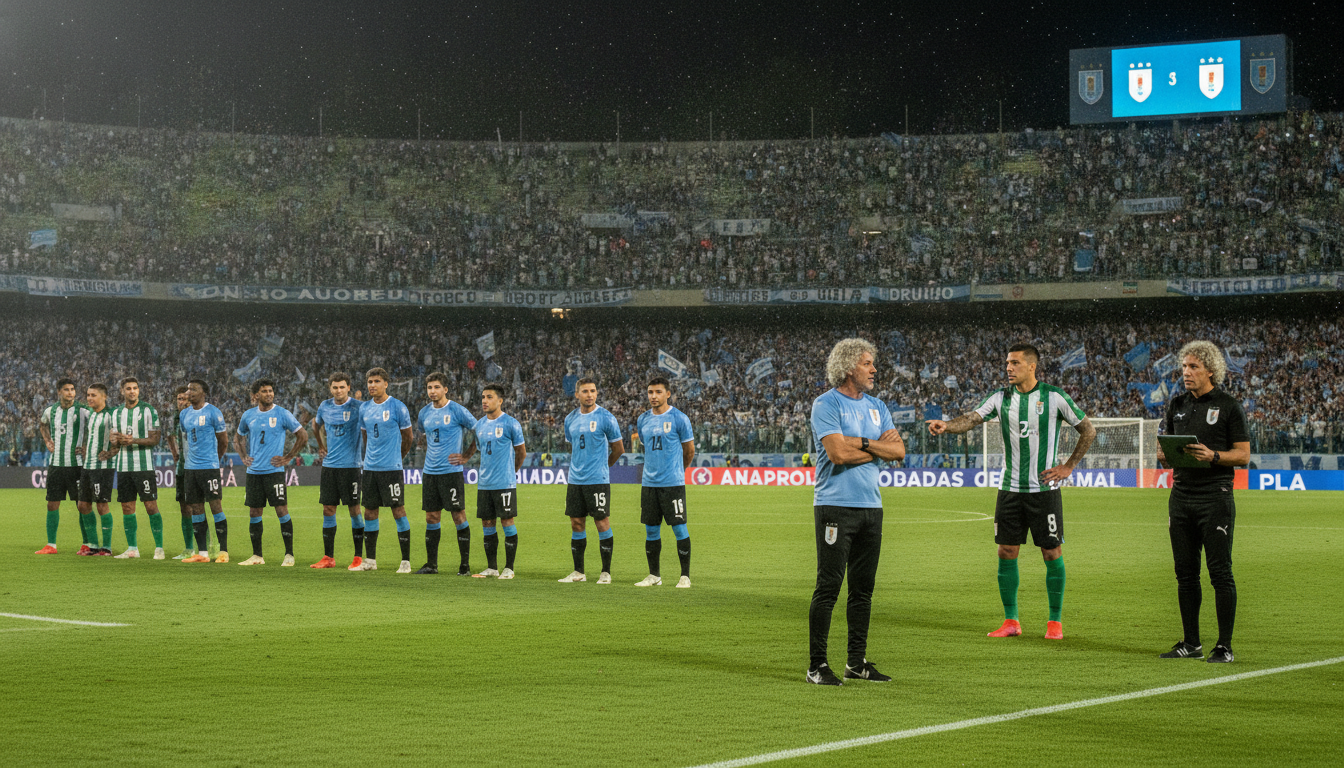
Uruguay vs Cape Verde lineups confirmed as Bielsa makes two changes for Miami showdown
Uruguay vs Cape Verde lineups confirmed in Miami — Bielsa makes two changes as Uruguay seek response, while Cape Verde make three switches after Spain draw


Uruguay have confirmed their starting XI for tonight’s Group H clash in Miami, with the Uruguay vs Cape Verde lineups showing two enforced adjustments as Marcelo Bielsa looks for a swift response following a 1-1 draw with Saudi Arabia. The changes see Juan Sanabria and Agustín Canobbio drafted into the side, while Guillermo Varela keeps his place at right-back. Cape Verde make three alterations from their famous goalless draw with Spain, and veteran goalkeeper Vozinha retains his place between the posts.
Confirmed starting lineups
Uruguay will deploy a 4-2-3-1 with Fernando Muslera in goal and a back four of Varela, Cáceres, Olivera and Sanabria. The double pivot of Ugarte and Bentancur will sit in front of the defense to protect the center and launch transitions. Ahead of them, Canobbio, Valverde and Araújo will support Viñas as the lone forward tasked with stretching Cape Verde’s backline.
Cape Verde line up in a 4-1-4-1 structure with Vozinha as captain and goalkeeper, flanked by Moreira, Pico, Borges and Lopes Cabral. Pina sits as the single pivot shielding the defense, while Arcanjo, Mendes, Monteiro and Rodrigues form a compact attacking quartet. Benchimol leads the line up front in a role designed to press and occupy Uruguay’s center-backs.
Bielsa’s tactical adjustments
Marcelo Bielsa’s selection tweaks underline a shift toward balance and control in midfield while keeping width on the flanks. Bringing in Canobbio provides greater pace and one-on-one potential on the left of the attacking trio, while Sanabria’s inclusion at left-back signals a desire for fuller defensive coverage. The Bentancur-Ugarte partnership combines passing range and aggressive ball recovery, giving Uruguay a platform to dominate possession and feed the front line.
Offensively, the coach appears to prioritise structure over raw power by leaving Darwin Núñez out of the starting XI and trusting Viñas to occupy defenders and create space for runners. That decision suggests Uruguay will rely on quick combinations from the wings and midfield arrivals rather than isolated long balls. Bielsa’s substitutions and in-game tweaks will be central if Uruguay are to overturn the initiative and claim all three points.
Cape Verde selection and momentum
Cape Verde arrive in Miami buoyed by morale after holding Spain to a goalless draw, and their selection reflects both experience and fresh legs. The inclusion of Telmo Arcanjo and Garry Rodrigues introduces directness and creative bursts from wide areas, while Benchimol offers an alternative focal point up front. Vozinha’s outstanding performance against Spain ensured the goalkeeper’s place and gives Cape Verde a reliable last line in a high-pressure match.
Head coach Pedro Leitão Brito has chosen a pragmatic lineup that can sit compact without the ball and spring counter-attacks through quick transitions. The blend of seasoned campaigners and younger players aims to keep Spain’s momentum-controlling approach from setting the tempo. Cape Verde’s selection shows intent to remain defensively organized while seeking to exploit spaces left by Uruguay’s more adventurous full-backs.
Midfield battle likely to determine tempo
The contest in central areas will be decisive, with Bentancur and Ugarte set to face Pina and Mendes in a battle for control and first passes. Uruguay’s midfield pair will be expected to press high, recover second balls and feed the attacking trident in short sequences. Cape Verde’s midfielders will need discipline to break Uruguay’s rhythm and arrive late into the box to create scoring angles.
Possession statistics are likely to favour Uruguay given their personnel, but Cape Verde have shown they can withstand pressure when compact and opportunistic on the break. Set-pieces and transitions will be critical moments, and the team that wins the loose ball battles in midfield will have the clearest path to dictate the game. Managers on both sides will be monitoring fatigue and timing of substitutions to influence the marble of midfield control.
Key individual matchups to monitor
Guillermo Varela’s duel with Garry Rodrigues on the right flank promises to be one of the match’s most intriguing single battles. Varela’s defensive stability and overlapping runs will be tested by Rodrigues’ direct dribbling and ability to cut inside. On the opposite flank, Canobbio’s pace against Cape Verde’s left-back could open corridors for Valverde and Araújo to exploit.
Between the sticks, the veteran Muslera versus Vozinha offers a contrast in experience and recent form, with Vozinha’s heroics against Spain still fresh in the memory. The one-on-one confrontations between Uruguay’s forward Viñas and Cape Verde’s central defenders will also shape set-piece strategies and aerial contests. Those individual duels are likely to have outsized influence on the match’s decisive moments.
Group H implications and scenarios
A win for Uruguay would restore momentum after their opening-day draw and provide a crucial boost for their hopes of reaching the knockout stages. Conversely, another dropped point would intensify pressure on Bielsa’s side and complicate the pathway through a competitive Group H. Cape Verde can further enhance their standing with a positive result, capitalising on the confidence gained from their first-game performance.
The wider arithmetic of the group means that goal difference and head-to-head records could become decisive, so both teams will weigh attacking ambition against defensive prudence. For Uruguay, securing a victory is as much about restoring belief as it is about points, while Cape Verde will seek to consolidate their place as a threat capable of upsetting higher-ranked opponents. Coaches will be conscious that tournament fixtures often hinge on small margins and a single moment can alter qualification trajectories.
Bench options and potential turning points
Substitute options could prove decisive as the match progresses, with players like Rodrigo Zalazar named among Uruguay’s substitutes offering a different midfield profile. Zalazar’s appearance could introduce additional structure or creative impetus depending on the game state. Cape Verde’s bench depth also contains players suited to inject energy on the wings or reinforce the defence when protecting a lead.
In-game variables such as early cards, injuries or tactical switches will force both managers to adapt quickly, and the team that reacts better to changing circumstances will have an advantage. Coaches are likely to reserve their most influential substitutes for the final stages, aiming to impact tempo and exploit tired opponents. The timing of substitutions and the selection of specialist players for set-pieces may ultimately decide the result.
Momentum from Cape Verde’s opening draw and Uruguay’s need for a statement response set the stage for a tightly fought encounter in Miami. The confirmed Uruguay vs Cape Verde lineups reveal strategic choices by both coaches that prioritise midfield balance, defensive solidity and measured attacking options. As kick-off approaches, fans can expect intensity, tactical nuance and a match where a single moment could swing Group H’s early narrative.