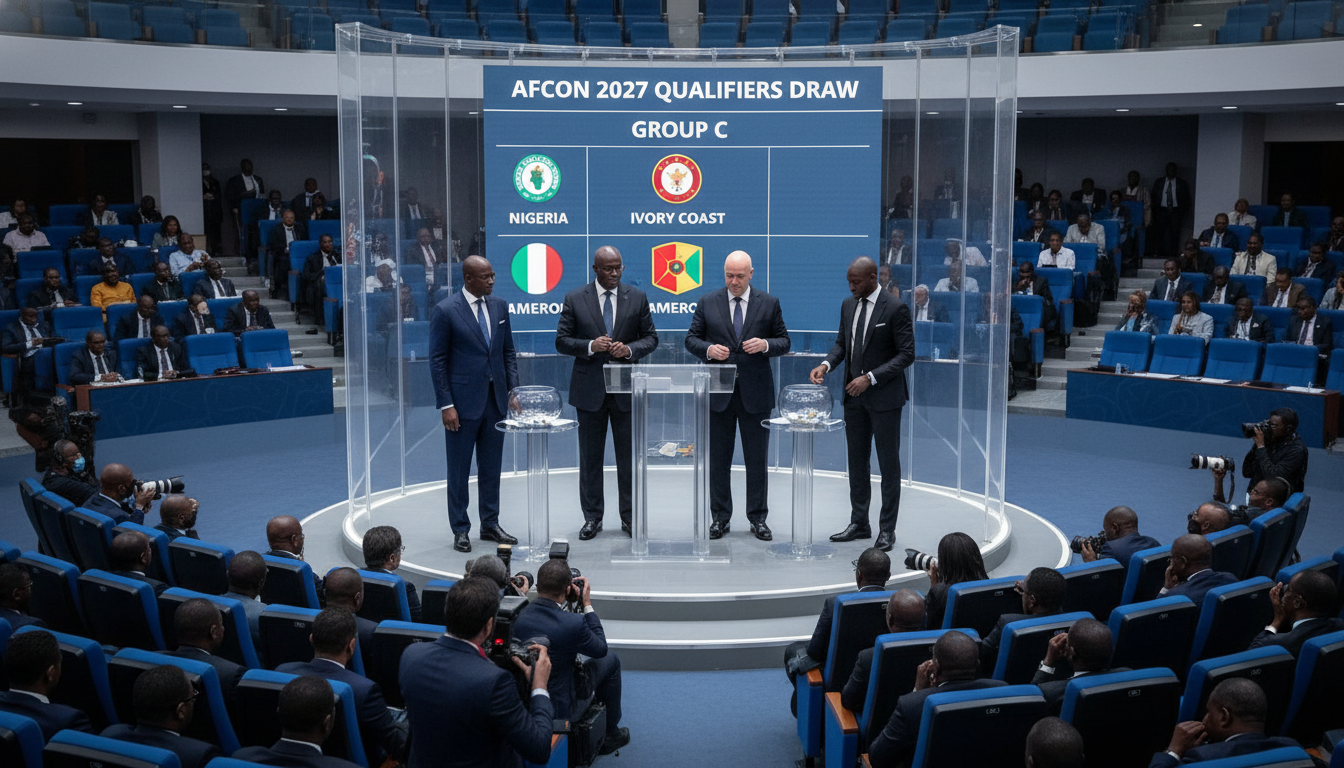
AFCON 2027 qualifiers draw in Cairo pits heavyweights and hosts for a tense road to PAMOJA 2027
Draw in Cairo sets up AFCON 2027 qualifiers drama as Group C emerges as the ‘Group of Death’ and East African hosts prepare for a landmark tournament.


The draw for the TotalEnergies CAF Africa Cup of Nations (AFCON) PAMOJA 2027 qualifiers took place in Cairo, setting the stage for a high-stakes campaign across the continent. The AFCON 2027 qualifiers will see national teams compete for limited places as hosts Kenya, Uganda and Tanzania ready venues and logistics for the largest event on African soil. The ceremony in the Egyptian capital produced several headline groups and prompted immediate reaction from former greats who weighed in on the toughest pools.
Draw Sets Up High-Stakes Paths to PAMOJA 2027
The grouping revealed by the draw has created immediate talking points for coaches, players and national federations. Several established nations landed in groups that promise intense competition, while emerging teams see opportunity to upset the established order. With only two qualification slots at stake in some pools, the margin for error will be small and results across a compressed window of fixtures will carry extra weight.
Federations will now turn to fine-tuning squads, confirming venues and travel plans, and agreeing match dates that balance competitive fairness with commercial and broadcast obligations. Preparations in host countries are also accelerating, as staging responsibilities for PAMOJA 2027 require coordination between football bodies and national governments. The draw has crystallized rivals and routes, forcing strategic responses from both high-profile and lesser-known associations.
Group C Named the Group of Death by Former Stars
Several African football legends singled out Group C as the most daunting section of the qualifiers. The pool includes former champions Côte d’Ivoire and Ghana alongside The Gambia and Somalia, creating a mix of pedigree and unpredictability that pundits said could go down to fine margins. DR Congo great Trésor Mputu described Group C as the "Group of Death," warning that supporters should expect tense and closely contested matches.
Max Gradel, a member of Côte d’Ivoire’s 2015 AFCON Team of the Tournament, acknowledged the group’s difficulty while stressing that his country will approach qualification with professional standards. Former Egyptian goalkeeper Essam El Hadary noted the fine lines that could separate success from failure in such a compact group and highlighted the threat posed by disciplined opponents like The Gambia. The presence of two former continental champions in a four-team pool raises the competitive temperature and suggests a complex tactical battle at each turn.
The configuration also offers narratives of redemption and opportunity for smaller nations. For underdogs such as Somalia, the qualifiers present rare chances to measure themselves against recognized powers and to stake a claim on the continental stage. For established sides, the challenge lies in avoiding complacency and ensuring consistency across home and away ties.
Egypt Confronts a Competitive Path in Group B
The draw placed Egypt in Group B alongside Angola, Malawi and South Sudan, a collection that clubs a mix of tactical profiles and recent international momentum. Essam El Hadary, who won four AFCON titles with Egypt, conceded that the Pharaohs will not have an easy passage and emphasized the work required to secure qualification. He suggested that despite Egypt’s history in the competition, every opponent now poses a genuine threat.
Angola and Malawi have both developed resilient approaches in recent campaigns, and South Sudan’s presence adds an element of unpredictability as newer footballing nations continue to improve. Egypt’s coaching staff will need to balance squad rotation with tactical consistency, particularly when managing fixtures that travel between varying climates and stadium environments. The group is likely to reward compact defensive work and efficient counterattacking football as teams vie for vital points.
National team calendars and domestic league schedules will influence squad selection and preparation time, making managerial choices especially consequential. For Egypt, the qualifiers are an early test of whether the current set-up can translate club form into sustained international results.
Hosts Kenya Uganda and Tanzania Brace for a Landmark Tournament
East Africa will host the AFCON finals for the first time in more than five decades, and the designation of Kenya, Uganda and Tanzania as co-hosts has added momentum to the qualifying process. Organizers and local authorities are accelerating stadium upgrades, security planning, and transport logistics to meet CAF standards for PAMOJA 2027. The scale of the event has triggered economic and infrastructural commitments across the three nations.
Beyond practical arrangements, the co-hosting model aims to deliver a festival of football that engages regional fan bases and showcases East African culture to a continental audience. Local federations are coordinating ticketing strategies, legacy projects, and community outreach to maximize the tournament’s long-term benefits. Successful staging will depend not only on facilities but also on smooth cross-border collaboration, as multiple venues across three countries will be used to accommodate a full AFCON program.
The hosting responsibility changes the competitive calculus for East African teams too, as home advantage in final-stage matches might boost regional football development. National teams in the region face the dual task of raising performance levels on the pitch while contributing to broader delivery objectives off it.
Qualification Stakes and Tactical Implications for Teams
With two slots often available from each group, tactical nuance and game management will prove decisive across the AFCON 2027 qualifiers. Teams drawn into tight pools must emphasize consistency, discipline, and the ability to accumulate points both home and away. Margin-of-error is small when a single draw or unexpected defeat can tilt the balance in groups where styles vary sharply.
Coaches are likely to prioritize robust defensive structures and set-piece efficiency as reliable ways to secure points in hostile environments. Conversely, teams with pace and technical skill will seek to exploit transitional moments and restore control through possession when possible. Travel logistics, player availability due to club commitments, and weather conditions will all play into selection and game plans.
Federations will watch injury management closely, as a spate of absences at key moments can derail qualification ambitions. The cumulative effect of fixture congestion and long journeys across Africa requires careful rotation and medical planning. As a result, depth of squad and the ability to adapt tactics quickly will be prime assets for any side with continental ambitions.
Key Storylines and Players to Monitor During the Campaign
Several narratives will shape interest in the AFCON 2027 qualifiers, from the fate of traditional powers to the progress of emerging football nations. The clash between Côte d’Ivoire and Ghana in Group C will carry historical significance and immediate competitive consequences. Observers will also follow how The Gambia positions itself as a disruptive force and whether Somalia can harness underdog momentum.
Individual player performances will naturally attract attention, particularly those who can influence fixtures in tight margins through creativity, finishing, or leadership. Goalkeepers and defensive midfielders may increasingly determine outcomes in low-scoring affairs, while clinical forwards could turn draws into valuable wins. Coaching appointments and tactical innovations will be scrutinized if they produce results against the odds.
Media coverage and broadcast arrangements will shape public engagement with the qualifiers, and federations will seek to broaden exposure to fans across the continent and the diaspora. The competition promises to deliver compelling story arcs that will feed into the excitement building toward PAMOJA 2027.
The draw in Cairo offered a clear and immediate framework for what lies ahead in the road to PAMOJA 2027, and national teams across Africa will now deploy resources and strategies to secure their place in a historic finals tournament. Preparations on and off the pitch will intensify as federations aim to convert this initial map of rivals into tangible success.