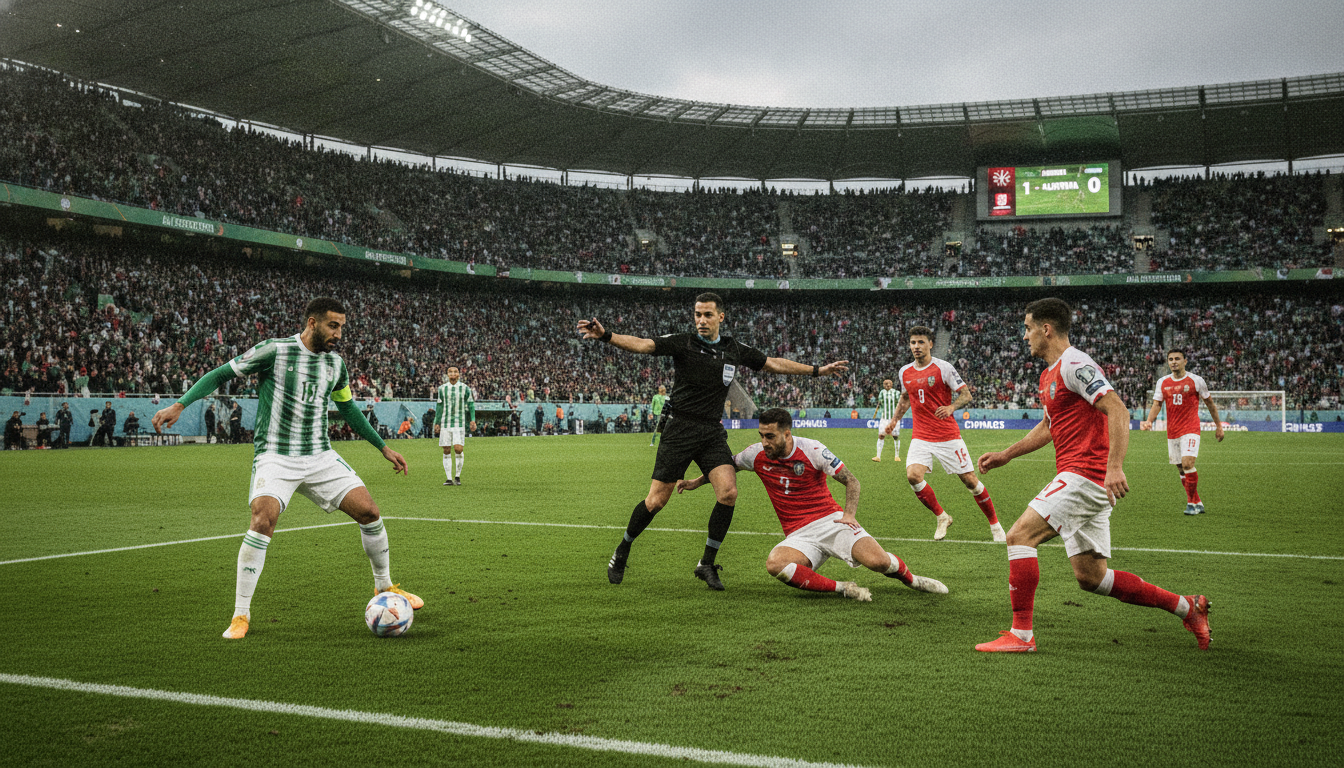
Algeria v Austria revives 1982 controversy as World Cup format fuels strategic final-day calculations
Algeria v Austria rekindles the 1982 ‘Disgrace of Gijon’ as World Cup format changes stoke concern over mutually beneficial outcomes in final group matches.


Algeria will confront Austria in a match that resurrects memories of the 1982 Group stage controversy and highlights fresh questions about competitive integrity at this expanded World Cup. Algeria v Austria is the linchpin for a narrative that stretches from past grievances to present tactical calculations as teams weigh the benefits of definite results against the demands of sportsmanship. The return of third‑place qualification in a 48‑team tournament has amplified the stakes and reshaped what teams can safely accept from a draw. Final group games across the competition have become potential crossroads where measured pragmatism can trump open confrontation.
Historic shadow of the 1982 match in Gijon
The Algerian squad and many of its supporters still recall how the events of 1982 left a bitter legacy in international football. A scoreline between West Germany and Austria eliminated Algeria on goal difference and prompted global outrage at the perceived lack of competitive integrity. The match, widely remembered as the “Disgrace of Gijon,” led governing bodies to change scheduling so decisive group games would be contested simultaneously.
That adjustment was intended to remove incentives for contrived outcomes by keeping teams in the dark about other results until after they finished. Algerian officials lodged formal protests and the episode shaped decades of tournament regulation and public expectation. The memory of that result is now being invoked as Algeria prepares to face Austria, renewing questions about how tournament formats influence competitive behavior.
Format changes and the return of third‑place progression
The expansion to a 48‑team World Cup has reintroduced pathways that allow some third‑placed finishers to advance, complicating what constitutes a safe outcome for teams. With eight of the 12 third‑placed sides progressing, a lower bar has been set for advancement from the group stage than in previous 32‑team tournaments. Four points, in particular, is widely regarded as a strong chance of moving on, which alters the calculus for teams with three points going into final fixtures.
This structure reduces the necessity for teams to press aggressively for a win when a draw might suffice, particularly if goal difference and broader group permutations are favorable. As a result, matchday dynamics that once demanded open play can now encourage conservative tactics, especially in simultaneous fixtures where teams can still monitor other results. Tournament organizers hoped expansion would broaden global participation; an unintended consequence is that final group matches take on a different strategic character.
Scenarios and permutations in the final round
Mathematical permutations are central to how teams approach their last group games, and coaches are increasingly tasked with calculating complex qualification scenarios. Algeria, Austria and several other sides enter the final round acutely aware of the points and goal‑difference thresholds that could send them through. In some groups, a goalless draw or a narrow stalemate will be enough for both teams to reach the knockout phase.
This reality creates the conditions for mutually beneficial outcomes without explicit collusion; teams can simply play to secure a result that meets their minimal requirements. The presence of simultaneous kickoffs reduces, but does not eliminate, the opportunity to engineer outcomes based on prior knowledge. The net effect is a tournament where strategic conservatism in the closing 90 minutes can be a rational competitive choice.
Algeria’s pathway and the emotional weight of revenge
For Algeria, the match against Austria is not just a tactical encounter; it carries historical and emotional resonance that extends beyond the current tournament. Players and supporters see an opportunity for a measure of restitution, even if the modern stakes differ from 1982. On the pitch, Algeria must balance the desire for a definitive result with the pragmatic need to secure enough points to advance, particularly under the third‑place qualification rules.
Coaching staff have emphasized disciplined approach play and awareness of group permutations, while backroom analysts have worked through dozens of scenarios to identify the minimum required outcomes. The psychological element is pronounced: athletes operate with the memory of past wrongs but also with a clear mandate to prioritize qualification. That duality—honoring history while pursuing present success—will shape Algeria’s tactical posture.
Australia and Paraguay’s Santa Clara stalemate possibility
Elsewhere in the group stage, Australia and Paraguay meet in Santa Clara locked on three points after earlier results left both teams capable of advancing with a draw. Each side registered a victory over Turkey and suffered defeat to the United States, placing them in a symmetrical position where a stalemate would likely send both through. The scenario is emblematic of how the tournament’s structure can create matches in which shared benefit is a more rational objective than outright victory.
Coaches and federations are aware of the optics such outcomes produce, but the immediate priority for squads is to secure progression. Playing for a draw is not inherently improper; it is a legitimate tactical choice when it aligns with tournament math. Still, such fixtures invite scrutiny from fans and pundits who fear a repetition of past episodes in which mutual accommodation had the effect of eliminating a third party.
FIFA’s choices and the debate over sporting integrity
Governing bodies face a persistent tension between broadening global participation and preserving the appearance and reality of fair competition. The decision to stage simultaneous final group games was a direct response to historical manipulation, yet format expansions and evolving qualification rules have reopened the debate. Critics argue that tournament architecture must be continually reassessed to avoid incentives that reward passivity over competitive risk.
Supporters of the expanded format point to wider representation and increased revenue streams, noting that more teams gain exposure on football’s biggest stage. Tournament organizers counter that strict scheduling, transparent regulations and an engaged refereeing framework can mitigate most integrity risks. The conversation now centers on whether additional measures are required to protect the tournament’s competitive fabric under the new structure.
Practical measures teams and organizers can take
Teams have adapted by investing in analytic staff capable of parsing the many possible outcomes that could arise from group play. Coaches prepare contingency plans that range from conservative point‑seeking strategies to full‑throttle pushes for victory depending on real‑time developments in other matches. From an organizational perspective, options such as refining tie‑break rules or adjusting the criteria for third‑place qualification could be considered to reduce perverse incentives.
Transparency and clear communication about the rules and their rationale are also part of the solution set. Fans and stakeholders respond better when governing bodies explain the tradeoffs inherent in format choices and the rationale for any subsequent adjustments. That said, there is no easy fix that entirely removes the strategic element of football, which will always reward teams that adapt intelligently to the circumstances they face.
Final group matches in this World Cup have become a stage on which history, mathematics and tactical caution intersect, with Algeria v Austria serving as the most conspicuous example. The game will be watched closely not only for its immediate sporting implications but also for what it signals about the tournament’s ability to balance inclusive participation with the imperative of fair play.