


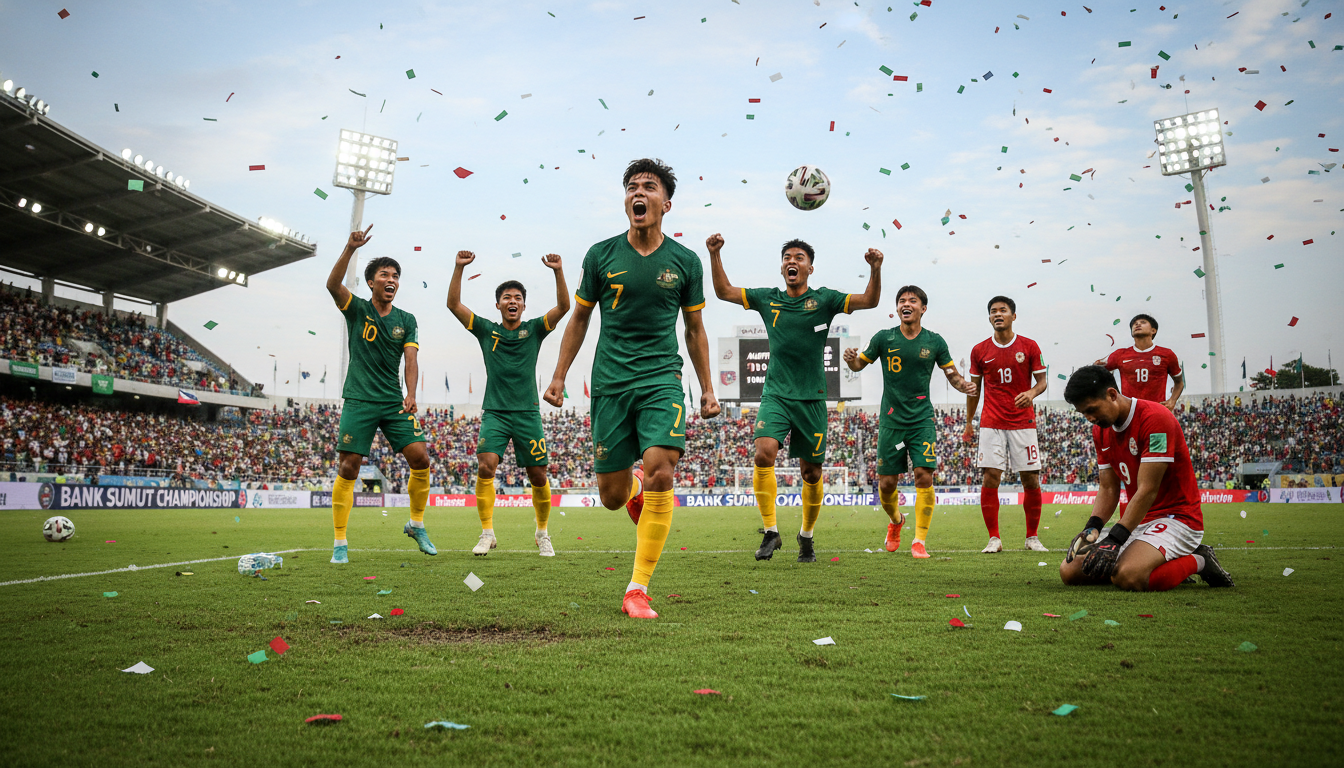
Australia U19 vs Philippines U19: Australia rout Philippines 10-0 in ASEAN U19 Bank Sumut Championship opener
Australia U19 overwhelmed Philippines U19 10-0 in Deli Serdang on June 3, 2026, as Medin Memeti starred with a multi-goal display and Australia announced their Group C intentions.


Australia opened their Group C campaign at the ASEAN U19 Boys’ Bank Sumut Championship with a commanding 10-0 victory over the Philippines at the Sumatera Utara Main Stadium in Deli Serdang on June 3, 2026. The result showcased Australia U19’s attacking depth and clinical finishing, while leaving the Philippines shell-shocked in a match that finished as a one-sided affair. Memin Memeti emerged as the focal point of Australia’s offense, supported by braces from Lawrence Wong and Mathias Macallister and a late penalty from Alexandro Nunes. The comprehensive scoreline immediately positions Australia as favourites to advance from the group, although tournament business remains to be concluded.
Match summary and key moments
Australia established control early and never relinquished it, converting pressure into goals across both halves to build an insurmountable lead. The visitors struck quickly and repeatedly, effectively ending any realistic comeback before the interval. Memeti’s multiple goals provided a consistent cutting edge, while Wong and Macallister added late bursts that compounded the Philippines’ defensive troubles. Alexandro Nunes’ successful penalty further extended the margin and illustrated Australia’s composure from set plays.
The pattern of the game saw Australia dictate tempo through midfield dominance and quick transitions, moving the ball with purpose to create high-quality chances. The Philippines struggled to retain possession under sustained pressure and were often forced into hurried clearances that gifted Australia second opportunities. Defenders for the hosts were stretched wide and caught out of position as Australia exploited space on both flanks. By the final whistle the scoreboard reflected a mismatch in execution and clinical finishing rather than a narrow tactical nuance.
Memeti’s impact and finishing proficiency
Medin Memeti emerged as the standout figure, finishing with a multi-goal haul that carried Australia’s attacking threat throughout the 90 minutes. His movement off the ball and ability to find pockets between the lines repeatedly unsettled the Philippines backline. Memeti combined sharp instincts inside the penalty area with a calmness to convert chances when they arrived, turning opportunities into goals at pace.
Beyond his finishing, Memeti’s involvement created room for team-mates by drawing attention from multiple defenders and opening channels for overlapping runs. His runs in behind and intelligent positioning contributed both to direct goals and to secondary chances for others. The forward’s performance provided an early statement about his readiness for tournament pressure and highlighted Australia’s depth in the attacking third.
Second-half surge and substitute influence
The second half saw Australia maintain intensity and add to their tally with a flurry of late goals that underscored superior fitness and squad depth. Lawrence Wong and Mathias Macallister each scored twice after halftime, taking advantage of a tiring Philippines team and sharper attacking rotations. Those late strikes came in quick succession and left the hosts with little time to respond.
Alexandro Nunes’ penalty conversion midway through the second half was a further example of Australia’s composed execution from set-piece situations. Substitutes also made meaningful contributions by keeping tempo high and offering fresh attacking options that unsettled the defensive structure of the Philippines. The rotation displayed by Australia’s coaching staff kept the team’s intensity elevated while also offering valuable minutes to players who could shape later rounds of the competition.
Philippines vulnerabilities exposed
The defeat exposed a number of defensive shortcomings for the Philippines that will require urgent attention ahead of their remaining group fixtures. Defensive organization frequently broke down under sustained pressure, and attempts to play out from the back were often nullified by aggressive Australian pressing. The midfield struggled to shield the defense effectively, allowing Australia to find pockets of space and progress the ball with minimal resistance.
Attacking productivity for the Philippines was limited; opportunities to transition into offense were few and often poorly executed when they did materialize. Set-piece defending and late-game concentration were particular areas of concern after a string of late concessions. The coaching staff will need to re-evaluate defensive shape, communication, and the team’s ability to manage phases of intense pressure if they are to bounce back in the group.
Tactical analysis and areas to watch
Australia’s approach combined a high-tempo pressing game with quick interchange in the attacking third, creating overloads and isolating individual defenders. The full-backs pushed high to provide width while central midfielders rotated to support forward runs, creating vertical passing lanes that led to clear-cut chances. This tactical balance allowed Australia to exploit both the channels behind the defence and the space between midfield lines.
For the Philippines, successful countermeasures will likely require a more compact defensive block and quicker transitions to relieve pressure. Midfield reinforcement to offer cleaner ball recovery and better protection for the backline could mitigate the risk of similar scorelines in upcoming fixtures. Both teams will also be monitored for set-piece routines and pressing triggers, as those elements proved decisive in shaping the match’s rhythm and outcome.
Group implications and next fixtures
The victory gives Australia an excellent early platform in Group C and signals intent for advancement from the group phase of the ASEAN U19 Bank Sumut Championship. With goal difference now heavily in Australia’s favour, the team can approach subsequent matches with both confidence and tactical flexibility. The emphatic win also raises expectations around rotation and squad management as the tournament progresses.
For the Philippines, the result places immediate pressure on upcoming fixtures to respond with improved defensive resilience and better offensive link-up play. Recovering from such a heavy loss will require adjustments in training and possibly personnel, but there remains time in the group stage to regain momentum. Both teams will now turn attention to their next opponents, with group standings and qualification scenarios beginning to form after this opening round of matches.
The Australian performance in Deli Serdang provided a clear demonstration of clinical finishing and squad quality, while the Philippines were left with a challenging set of questions to address ahead of their next outing.