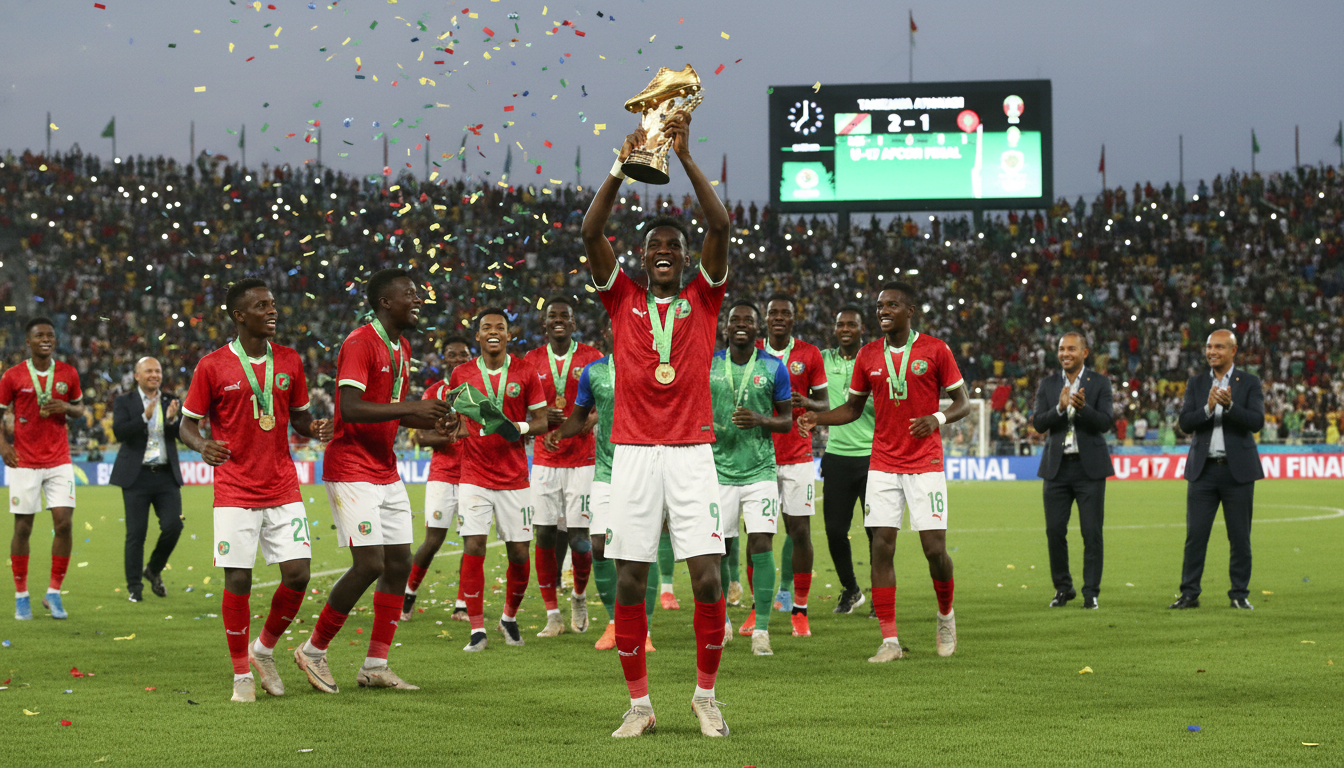
Dismas Shida Athanasi wins Golden Boot as 14-year-old sparks Tanzania’s historic run at CAF U-17 AFCON
Dismas Shida Athanasi wins Golden Boot at CAF U-17 AFCON Morocco 2026; the 14-year-old starred as Tanzania reached their first final and earned World Cup spot.


Dismas Shida Athanasi was confirmed as the Golden Boot winner at the TotalEnergies CAF Under-17 Africa Cup of Nations Morocco 2026 after finishing as the tournament’s top scorer with three goals. The 14-year-old forward emerged as one of the most remarkable stories of the competition, combining youth with decisive attacking contributions that propelled Tanzania to their first-ever CAF youth final. Athanasi’s goals and all-round attacking play were central to the Serengeti Boys’ run in Morocco and helped secure qualification for the FIFA U-17 World Cup. His recognition as the tournament’s leading scorer further underlines the unexpected depth of talent on show in Rabat and across the venues.
Athanasi confirmed as tournament top scorer
Dismas Shida Athanasi finished the competition with three goals to claim the Golden Boot, edging a group of players who ended the tournament with two strikes apiece. Team-mate Ramadhani Mbegelendi joined the leading charts with two goals and two assists, while players from Uganda, Senegal, Ghana and Egypt also featured prominently among the top scorers. The award is notable not only for the raw tally but for what it represents: a teenager standing out in a field of elite youth prospects from across Africa. The Golden Boot cements Athanasi’s place in the tournament narrative and highlights Tanzania’s attacking edge during the event.
Key moments that produced Athanasi’s goals
Athanasi opened his account in the group stage with a composed finish against Mozambique, providing an early indication of his ability to perform on the continental stage. His most eye-catching contribution came in the quarter-final against Algeria, where he scored twice in a dramatic 3-3 draw to force extra time and penalties. Those two strikes under pressure showcased a striker who reads the game well, times runs intelligently and shows composure in the penalty area despite his age. Across the matches, his positional sense and finishing were decisive at moments when Tanzania most needed a forward to convert chances.
Quarter-final drama against Algeria shaped Tanzania’s run
The quarter-final with Algeria was a defining fixture for Tanzania and for Athanasi personally, as the game swung back and forth before finishing level at the end of normal time. Athanasi’s brace played a major role in keeping Tanzania alive, and the Serengeti Boys ultimately progressed after prevailing in a penalty shootout. That victory propelled the squad into the semi-finals and heightened belief within the team that they could compete with the continent’s established youth sides. Coaches and teammates credited the forward for his influence in pivotal matches and for giving the attack a consistent focal point.
Semifinal resilience and the final in Rabat
Tanzania extended their run by defeating Egypt in the semi-final via another shootout, setting up a first-ever CAF U-17 final for the nation in Rabat. The title match against Senegal ended 1-1 after extra time and was decided by penalties, where Senegal prevailed 4-2 to lift the trophy. Despite the defeat, Tanzania’s route to the final included resilient performances across knockout fixtures and demonstrated the team’s capacity to handle high-pressure situations. Athanasi’s contributions throughout the knockout phase ensured he remained among the defining figures of the tournament even as the squad experienced the ups and downs of penalty-decided ties.
Team achievements and East African significance
Tanzania’s run to the final marks a milestone for the country and for East African youth football, delivering a historic campaign that will be celebrated domestically and regionally. The Serengeti Boys not only reached the final for the first time but also secured a place at the FIFA U-17 World Cup, an outcome that will expand opportunities for the players and raise Tanzania’s profile in youth development. The campaign highlighted improved coaching structures, scouting and an emerging generation of players capable of competing at continental level. The combination of collective organisation and individuals like Athanasi provided a compelling case study in how programs can fast-track progress for national youth teams.
Athanasi’s attributes and future prospects
Observers praised Athanasi for a maturity beyond his years, citing his calm finishing, spatial awareness and ability to operate across the attacking third. He demonstrated versatility as a forward, able to drop into pockets of space to link play or lead the line to challenge defenders directly. Athanasi told reporters during the tournament that his long-term ambition is to continue developing and one day play for a major European club, but he repeatedly stressed his present focus on the team’s objectives. The Golden Boot and his performances in Morocco will inevitably draw attention from clubs and scouts, yet his immediate priority appears to remain national team commitments and ongoing development.
Tanzania’s coaching staff and federation officials will now face decisions about how to manage Athanasi’s next steps, balancing competitive exposure with safeguarding his welfare and long-term development. Opportunities for trials, academy placements or moves abroad can accelerate progress but require careful oversight, particularly for a player still only 14. The broader squad will also benefit from increased visibility, with teammates such as Ramadhani Mbegelendi earning plaudits for his goals and assists and contributing to the team’s balance. For Tanzanian football, the outcome in Morocco offers a platform to attract investment, improve youth pipelines and sustain momentum at multiple age levels.
The TotalEnergies CAF U-17 AFCON Morocco 2026 showcased both established powers and emerging nations, and Athanasi’s Golden Boot is a vivid reminder that standout talent can arrive from unexpected quarters. His performances combined goal threat with tactical intelligence, and Tanzania’s collective resilience turned a promising group-stage showing into a continental final appearance. While Senegal took the title after a narrow penalty victory in Rabat, the headlines were shared between champions and the breakout stories that defined the tournament. For East Africa and for Tanzania specifically, Morocco 2026 will be remembered as a breakthrough moment that could have long-term ripple effects for player pathways and international competitiveness.
Dismas Shida Athanasi’s Golden Boot and Tanzania’s historic final run are likely to prompt further scrutiny of the nation’s youth structures and the players who have now been exposed on a global stage. The coming months should reveal how federations, clubs and agents respond to interest in the squad, and whether Athanasi’s progress continues along a trajectory that takes him beyond domestic football. For now, his achievement in Morocco stands as a clear demonstration of individual talent married to a team that exceeded expectations, giving Tanzania a landmark result to build on in the years ahead.