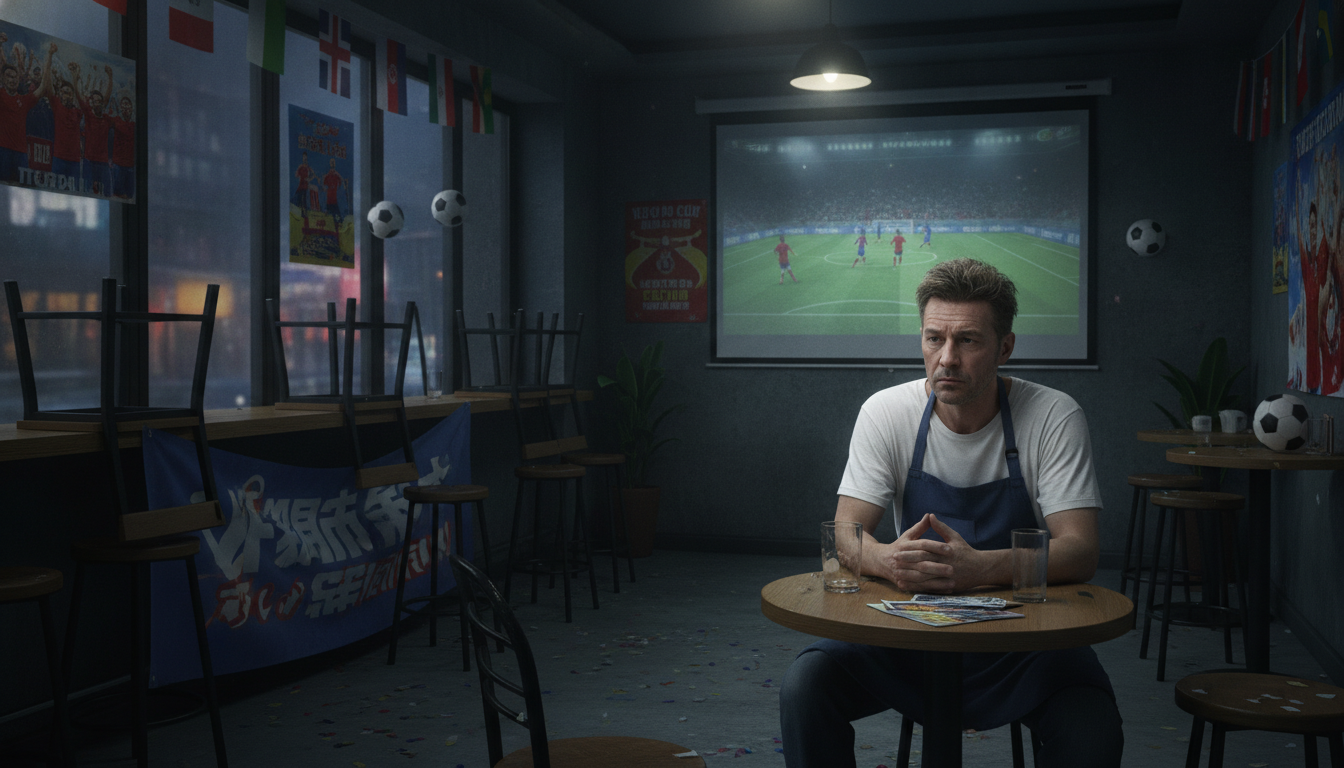
Loneliest Fan at the World Cup Opening Match: Hangzhou Café Owner’s Overnight Wait for Customers
Hangzhou cafe owner screened the World Cup opening match after mass-messaging 4,000 contacts and stocking beer and snacks, but turnout was sparse and quiet.

Zhao Chong, a tea and coffee shop owner near Hangzhou Xiaoshan International Airport, prepared to host a public viewing of the World Cup opening match and promoted the event heavily to local customers and contacts. Despite setting up a projector, buying large quantities of beer and snacks, and sending reminders to thousands of people, he spent the early hours alone before two customers arrived for the tournament’s second fixture. The unexpected silence at his shop during one of the sport’s biggest nights underscores the uncertain economics of small businesses betting on major sporting events.
Owner’s Plan and Early Preparations
Zhao began preparing two weeks in advance, converting his small shop into a temporary viewing space with a projector aimed at attracting early-morning fans. He invested several thousand yuan in stock, putting beer on ice and ordering extra snacks to offer an all-you-can-eat atmosphere if customers arrived. Daily social media reminders and a mass message to roughly 4,000 contacts were part of a deliberate push to generate turnout for an event that typically draws large public audiences.
He also took a hands-on approach to promotion by privately messaging dozens of friends the night before the match and posting online offers to entice like-minded supporters. The morning of the match, Zhao paced outside his shop beside the runway, expecting the crowd he had worked to assemble. His plan reflected a common small-business strategy: leverage national sporting interest to boost footfall and sales in an otherwise quiet location.
Promotions Reached Thousands but Attendance Fell Short
Despite extensive outreach, the campaign failed to convert reach into customers, a result Zhao experienced firsthand when no one showed up for much of the night. The gap between online engagement and in-person attendance is a growing concern for independent retailers who treat social media metrics as a proxy for real-world turnout. Zhao’s experience highlights the limitations of mass messages and online reminders when competing with barriers such as time, travel, and weather.
Local conditions may have contributed to the low turnout; the screening was scheduled for an early hour and took place near an airport runway rather than a central nightlife district. For many potential viewers, traveling to a peripheral location in the middle of the night can outweigh the incentives of free or discounted refreshments. The mismatch between the scale of Zhao’s promotion and the actual audience that arrived is a cautionary tale for other small operators weighing similar gambles.
A Quiet Night Outside the Runway Café
Video and photos shared by Zhao showed a dim, empty exterior as he waited for customers, capturing the solitude of his vigil beside the airport. He told local media he was prepared to offer free-flow beer and unlimited snacks to anyone who showed up, an offer meant to guarantee atmosphere if even a handful of supporters arrived. Instead, the shop remained largely deserted through the early hours, and Zhao kept vigil alone until the morning light.
The scene near Hangzhou Xiaoshan International Airport contrasted sharply with packed bars and public squares in major cities that typically host World Cup viewings. The absence of a crowd transformed what was intended as a communal watch party into a solitary undertaking for the owner. For local businesses, these moments underline the unpredictability of relying on single-event boosts to sustain regular trade.
Social Media Response and Community Reaction
Images and accounts of Zhao’s lone wait spread online after he posted updates and photographs on WeChat, prompting a wave of sympathy and commentary from the local community. Some users praised his dedication and entrepreneurial spirit, while others pointed to the logistical hurdles that hindered turnout, including the inconvenient location and the early start time. The mixed reaction on social platforms reflected both admiration for his effort and recognition of the practical constraints small businesses face.
The story also generated reflections about how people choose to watch major sporting events, with many preferring the comfort of home streaming or larger public venues that promise a guaranteed crowd. Comments on social channels suggested that while interest in the World Cup remains high, viewing habits are fragmenting and require different strategies from business owners who hope to capitalize on sporting calendars. Zhao’s experience became a local example of how online reach does not always translate into physical presence.
Two Customers Arrive for the Second Match and Owner’s Reflection
Morning brought a modest turn in fortunes when two customers finally arrived to watch the tournament’s second match at Zhao’s shop, providing some company after a long night. Photographs posted by Zhao showed the pair seated inside as the projector displayed the game, and he shared a sense of relief that at least a small audience materialized. Their arrival did not erase the earlier disappointment, but it offered a quiet affirmation that small-scale viewings can still find an audience under the right circumstances.
Zhao described his readiness to reward any attendee with free beer and snacks as an act of hospitality as much as marketing, and he said the experience had taught him lessons about timing, location and the limits of digital promotion. He stressed that he would continue to look for ways to build community interest but noted he might adjust future plans to align better with when and where fans actually gather. The episode has become a practical case study for other independent retailers considering similar event-driven strategies.
The early-morning screening experiment in Hangzhou underscores the financial and emotional gambles small business owners take when tying operations to high-profile sporting events. It also points to the evolving nature of fan behavior and how public spaces must adapt to changed viewing preferences. For Zhao, the night was a mix of commitment, quiet expectation and, ultimately, a modest reward when a couple of customers arrived to share the match.