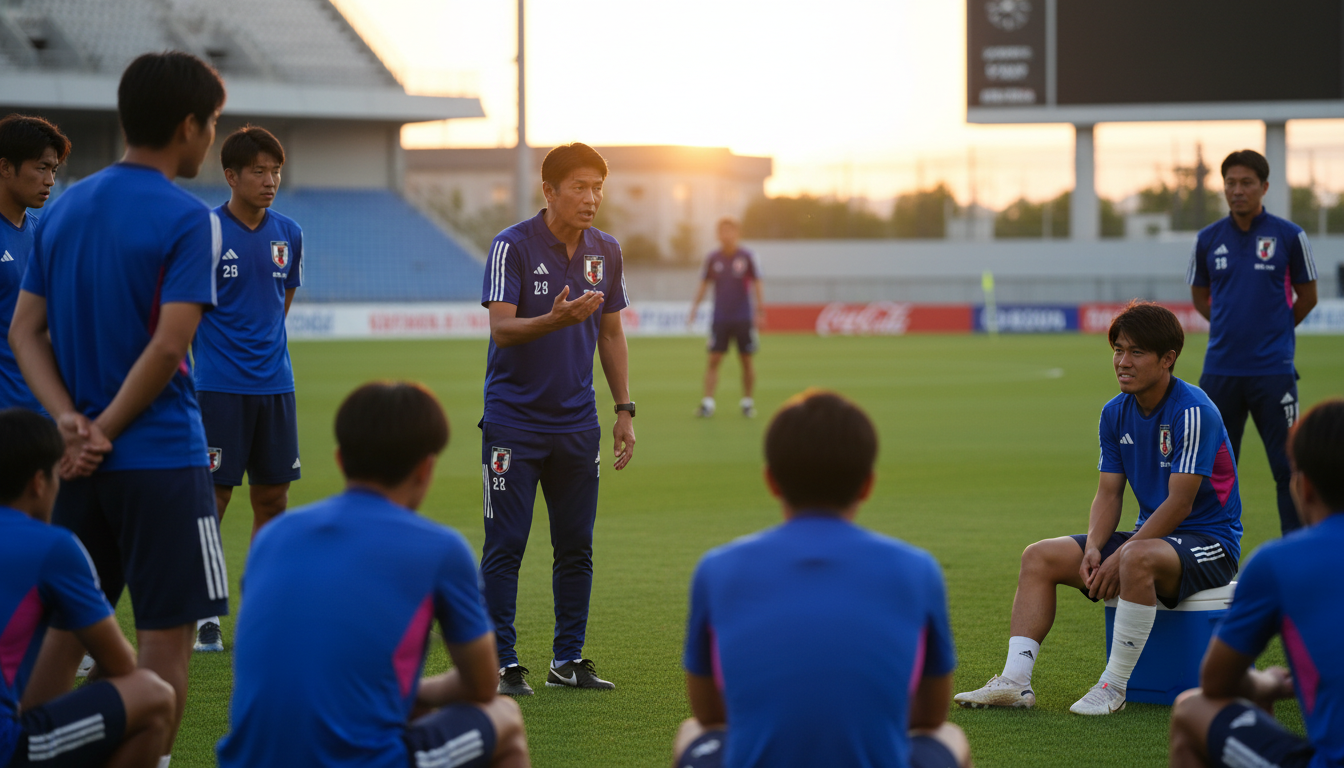
Japan World Cup hopes remain high as Moriyasu backs title charge despite Mitoma blow
Japan coach Hajime Moriyasu says Japan World Cup ambitions are strong after landmark wins over Brazil and England, even as Kaoru Mitoma’s hamstring injury removes a key attacking option ahead of the tournament. The team, which qualified earliest for the finals, will begin its Group F campaign against the Netherlands in Dallas on June 14. Moriyasu pointed to recent victories as evidence his side can advance further than their previous World Cup best of the last 16.

Moriyasu confident Japan can win the World Cup
Moriyasu delivered an emphatic message that Japan will not approach the tournament modestly, arguing recent results justify an expectation to challenge for the title. He framed wins over Brazil and England as watershed moments that have altered the squad’s belief and its international standing. The coach’s comments were nevertheless tempered by realism about squad changes and the need to manage injuries in the run-up to the opening match.
Moriyasu’s public optimism reflects a broader shift in Japan’s approach to world-level tournaments, where psychological momentum is now treated alongside tactical preparation. The manager has balanced praise for his players’ maturity with reminders that the week-to-week demands of tournament football will test depth and resilience. That balance will be critical after the late withdrawal of a prominent attacker.
Kaoru Mitoma ruled out with hamstring injury
Brighton winger Kaoru Mitoma will miss the World Cup after sustaining a hamstring injury in the days before Japan’s final squad was named, a development that immediately altered selection plans. Mitoma’s absence removes one of the team’s most creative and direct wide players, forcing Moriyasu to reconfigure attacking options and rotation patterns. The timing of the injury—occurring less than a week prior to the squad announcement—left little room for contingency planning.
The loss of Mitoma intensifies scrutiny on Japan’s alternatives on the flanks and the role domestic-based players might play in replacing his dynamism. Coach and staff must now decide whether to promote a similar style of winger or to adjust formation and personnel to compensate. Medical staff have described the injury as a hamstring strain that will prevent competitive involvement for the foreseeable tournament window.
Group F draw gives Japan a stern opening against the Netherlands
Japan will face the Netherlands, Sweden and Tunisia in Group F, with the campaign kicking off in Dallas on June 14 against a Dutch side known for technical rigour and attacking threat. That opening fixture represents an immediate litmus test for Moriyasu’s tactical approach and provides little margin for error in a compact group. Sweden and Tunisia offer contrasting challenges: the Scandinavian side’s organization and physicality, and Tunisia’s athleticism and set-piece threats.
Being first to qualify raised expectations at home and internationally, but the draw underlines the difficulty of translating qualifying form into consistent tournament results. Match scheduling and travel logistics across North America will also factor into preparation and recovery. Japan’s ability to manage the opener, both tactically and mentally, could shape its path beyond the group stage.
Squad retains European experience despite Mitoma’s absence
Even without Mitoma, Japan’s roster remains rich in players who ply their trade across Europe, bringing top-level club experience to the national setup. Forwards, central midfielders and defenders with regular minutes in elite leagues will be counted on to assert control in pivotal moments. That collective exposure to high-intensity competitions is the backbone of Moriyasu’s argument that Japan can compete with, and beat, traditional powerhouses.
Coaches will rely on this European-honed professionalism to navigate tournament fixtures where margins are slim and concentration is paramount. The presence of multi-club veterans should smooth the transition to different tactical systems and opposition styles. Individual versatility among those players also gives Moriyasu tactical options to offset the loss of a specific wide threat.
Recent friendlies against Brazil and England fuel belief
Japan’s wins over Brazil and England in recent friendlies were framed by the coaching staff as historic validations of progress, and they have been cited repeatedly to justify elevated expectations. These victories, achieved against opposition with deep World Cup pedigrees, have energized supporters and reinforced internal conviction that Japan can reach new heights. Observers point to improved defensive organization, sharper attacking movements and a willingness to take the initiative as key developments.
While friendlies do not replicate the intensity of tournament elimination matches, they offer valuable data on systems and personnel combinations. Moriyasu has used those games to experiment tactically and to assess player chemistry under pressure. The positive outcomes against top-tier teams have provided a mental template for the Japanese side to draw upon in the tournament’s tense phases.
Tactical adjustments and depth will determine knockout chances
With Mitoma unavailable, Japan’s tactical blueprint will likely emphasize ball retention, central penetration and coordinated pressing to create chances from multiple areas of the pitch. Moriyasu may shift personnel to exploit overloads on one flank or to insert a more compact midfield that protects the backline while facilitating quick transitions. Depth in full-back and wing positions will be tested as substitutions become tactical levers rather than mere injury reactions.
Set pieces and transitional defense are expected to be focal points in Japan’s preparation, given how single moments can decide knockout ties. The coaching staff’s ability to rotate without sacrificing coherence will be pivotal across the congested match calendar. Detailed match planning for opponents like the Netherlands—who possess pace and technical precision—will be crucial in the opening stages.
Japan’s confidence is not a substitute for strategic discipline, and Moriyasu’s leadership will be judged by how well the team adapts when the stakes rise. The balance between maintaining an attacking identity and shoring up defensive responsibilities will likely define whether Japan can finally move past its historic last-16 ceiling.
Japan enter the tournament with a blend of youthful energy and seasoned professionals, and the coming weeks will test whether recent momentum becomes sustained performance. The loss of Kaoru Mitoma is a setback, but the squad’s European experience and the psychological lift from victories over Brazil and England give Moriyasu a substantive platform from which to mount a serious challenge at the World Cup.