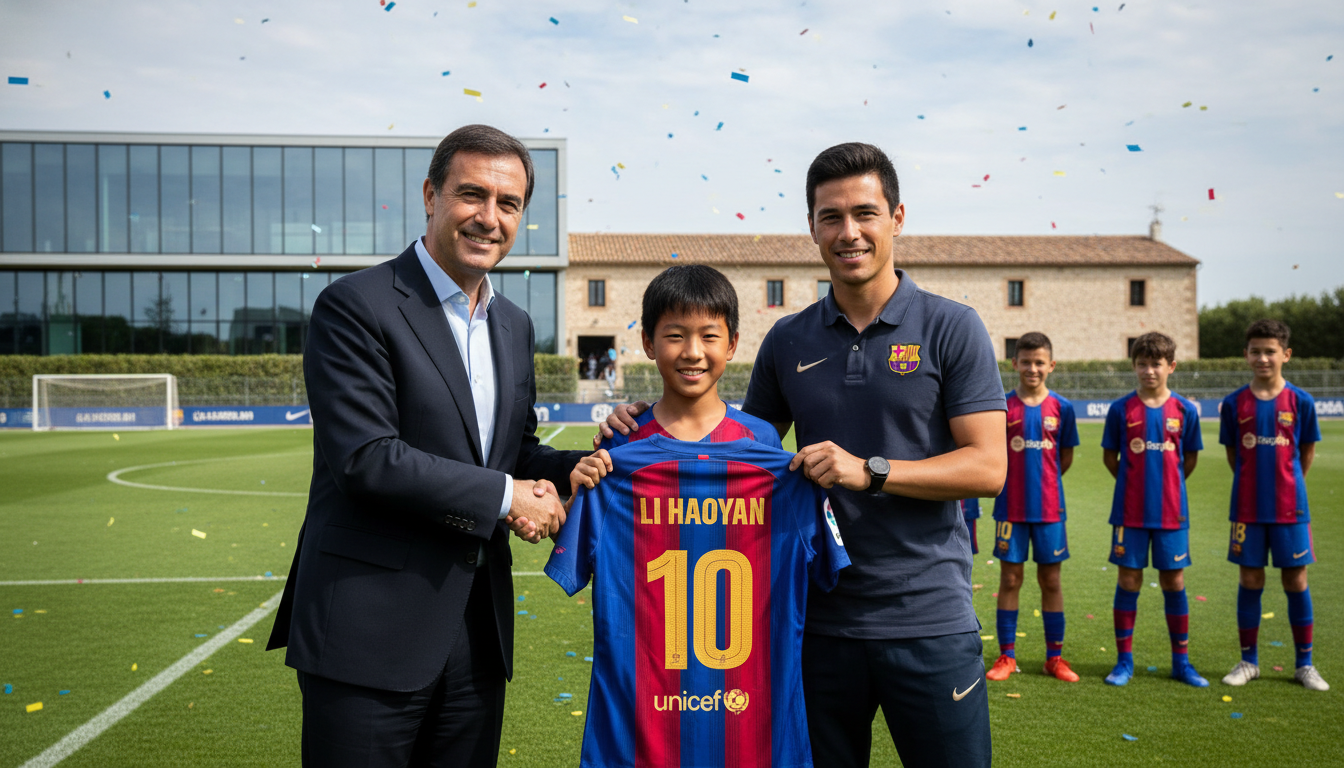
Li Haoyan Becomes First Chinese Player to Join Barcelona’s La Masia at Under-15 Level
China’s Li Haoyan has signed for Barcelona’s La Masia, becoming the first Chinese player in the famed academy and set to join the club’s Cadet B under-15 side next season.


Young Chinese prospect Li Haoyan has become the first player from China to earn a place in Barcelona’s La Masia academy, the club confirmed on Wednesday. The 14-year-old, who currently plays for CF Damm in the División de Honor Catalana Infantil, will move into Barcelona’s Cadet B (under-15) setup ahead of the next campaign. His signing marks a milestone for both the player and a growing trend of Chinese youth talent migrating to elite European academies.
Historic Signing Confirms First Chinese Player at La Masia
Li Haoyan’s move to Barcelona makes him the first Chinese-born player to be formally enrolled in La Masia, the club’s storied youth academy known for producing world-class talent.
Born on January 28, 2012, Li will enter Barcelona’s Cadet B group, the club’s under-15 tier, where he will progress through age-group teams if his development follows the academy pathway. The club’s announcement framed the signing as a development investment, reinforcing La Masia’s international scouting reach.
Barcelona’s decision to recruit Li reflects the club’s continued focus on identifying technically skilled youngsters worldwide, and it highlights the increasing attention European clubs are paying to the Chinese market for promising talent.
Early Years in Dalian and China Football Juniors Program
Li began his football journey in Dalian, training at his father’s grassroots setup, Dalian No 8 Football Club, where foundational skills and local competition shaped his early years.
At age 10 he joined China Football Juniors, an organization founded in 2017 by former journalist and commentator Dong Lu to promote youth development and scouting across the country. Li spent three formative years in Chinese youth systems, winning several age-group competitions that drew attention to his technical and tactical potential.
His selection for China’s national junior under-11 squad in 2023 was an early indicator of national recognition and helped pave the way for his move abroad as he sought stronger competition and development opportunities in Spain.
Adapting to Spanish Youth Football with CF Damm
After relocating to Spain at 13, Li joined CF Damm, a respected Barcelona-area youth club, and competed in the División de Honor Catalana Infantil, the top-tier regional youth league for his age group.
At CF Damm he faced a higher tempo of play and different tactical expectations, which accelerated his physical and technical adaptation. Coaches at CF Damm noted his quick assimilation into the Spanish style, emphasizing ball control, positional play, and quick decision-making.
Playing regularly in a competitive regional league provided Li with exposure to scouts and allowed Barcelona to observe his performances over an extended period before offering a place in their Cadet B squad.
What Joining Cadet B Means for Li’s Development Path
Entry into Barcelona’s Cadet B represents a crucial step in La Masia’s development ladder, where young players receive intensive technical coaching, tactical education, and off-field support.
At Cadet B Li will train under coaches focused on both individual skill refinement and integration into Barcelona’s possession-based system. The academy will likely monitor his physical development alongside technical progress, preparing him to compete for places in Cadet A and, subsequently, Juvenil squads in the coming seasons.
Barcelona’s pathway is structured to offer incremental challenges, match experience, and education, with the club emphasizing a long-term view rather than immediate first-team expectations for players at this age.
Wider Implications for Chinese Football and Talent Pathways
Li’s signing is significant beyond the individual, signaling a potential opening for more Chinese players to enter elite European academies and exposing homegrown systems to new benchmarks of development.
Chinese football authorities and grassroots organizations have prioritized long-term youth development, and a high-profile placement at La Masia offers measurable evidence that pathway ambitions can yield results. Li’s progress will be closely watched by clubs and federations in China as a case study in international talent transitions.
The move may also encourage closer collaboration between Chinese academies and European clubs, fostering scouting networks, training exchanges, and talent identification programs that could accelerate the export of promising young players from China.
Immediate Challenges and Expectations at La Masia
Although Li arrives with a strong domestic and regional record, the transition to Barcelona’s academy system brings new challenges, including intensified competition for places and adaptation to La Masia’s distinct tactical identity.
He will need to adapt to rigorous training schedules, tactical demands that prioritize spatial awareness and quick combination play, and the cultural adjustments of living and studying in a new country. Success will depend on technical consistency, mental resilience, and steady physical maturation over the next two to four seasons.
La Masia’s coaching staff will likely set personalized development targets and provide support in language, education, and welfare to aid Li’s integration off the pitch, recognizing the holistic needs of young international recruits.
Scouting, Development Models, and Future Prospects
Barcelona’s recruitment of Li reflects a broader scouting strategy that balances local talent cultivation with selective international signings, targeting players who fit the club’s technical profile and long-term development plans.
If Li continues to progress through Cadet B and beyond, he could follow the typical La Masia trajectory of moving to higher youth categories and potentially to Barcelona Atlètic or other professional environments when age and readiness allow. His pathway will be measured against both athletic milestones and adaptability to Barcelona’s style of play.
For Chinese football, Li’s trajectory offers a test case for the efficacy of exporting young players to Europe’s elite academies as a method for accelerating elite-level development compared to remaining within domestic systems.
Barcelona’s track record of integrating international prospects varies by individual, and Li’s success will hinge on how effectively he leverages training opportunities, navigates competition, and maintains steady improvement.
Li Haoyan’s signing at La Masia represents a landmark moment for his personal career and for the visibility of Chinese youth players in elite European systems. His progress at Cadet B will be watched closely by clubs, scouts, and development programs on both sides of the continent as a measure of the possibilities and challenges facing young internationals in world-class academies.