Rayo Vallecano vs Crystal Palace: Vallecas Roars as Conference League Final Looms
Rayo Vallecano vs Crystal Palace in the Conference League final is set to be a historic showdown, with Vallecas celebrating Rayo’s advance and a European place at stake. The match pits Iñigo Pérez’s resilient side against Oliver Glasner’s Crystal Palace in a fixture that will decide the Conference League trophy and an additional European qualification berth. Rayo coach Iñigo Pérez urged his players to “play like children” in the build-up, encapsulating the club’s simple, fearless approach ahead of the final. Both teams arrive with selection concerns, but the focus is squarely on the 90 minutes that will determine continental consequences for Spain and England.


Vallecas Celebrates as Rayo Secure Final Spot
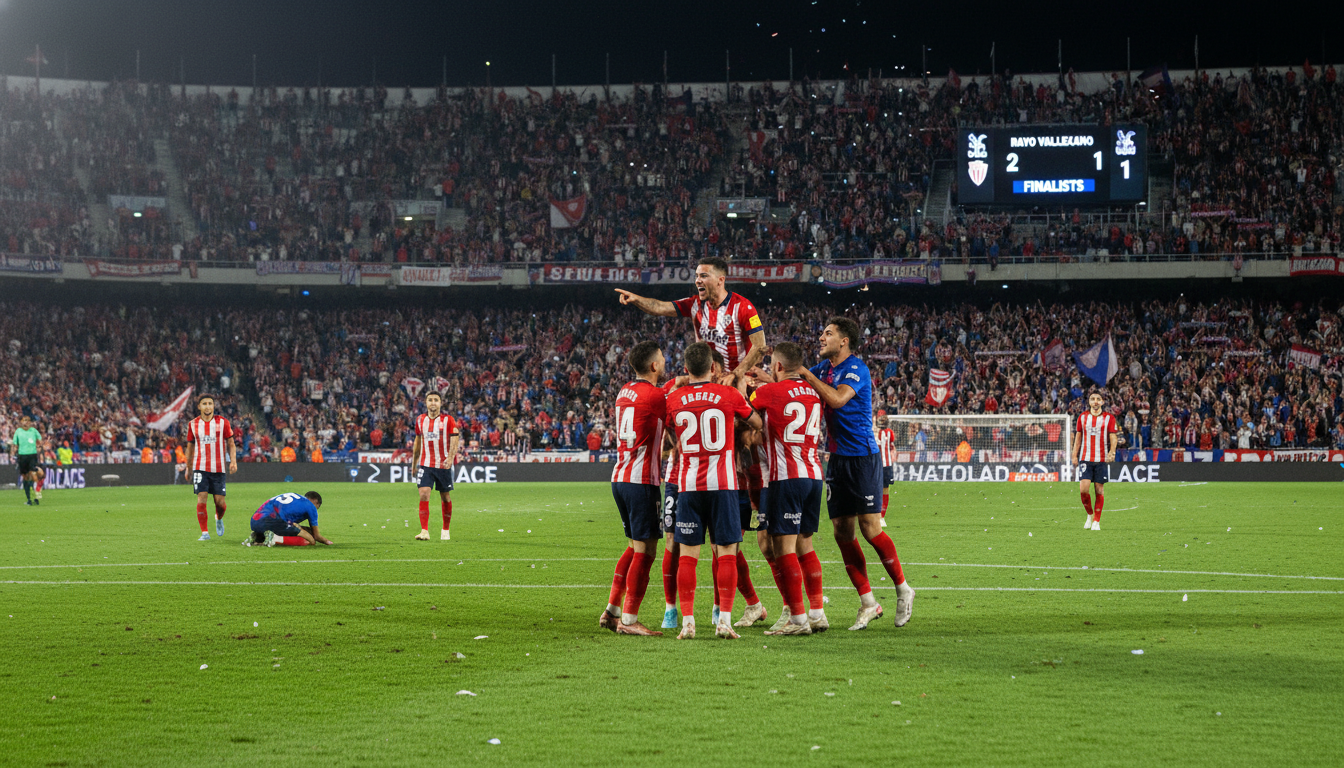
Vallecas has been in jubilant mood since Rayo Vallecano booked their place in the Conference League final, bringing one of the most significant nights in the club’s recent history to the neighborhood. The achievement has energized supporters across Madrid, turning local streets and bars into impromptu celebration zones as fans anticipate the first major European final for the club in years. The mood within the squad has been described as confident yet composed, with players and staff cognizant of the heavier expectations that come with a final. Coach Iñigo Pérez has sought to channel that excitement into focus, asking his players to enjoy the occasion while remaining tactically disciplined.
Rayo’s run to the final has been characterized by grit and collective organization rather than individual stars, a narrative that has endeared the squad to a broad fan base. The club’s success has also spotlighted Vallecas as a community that identifies closely with the team’s underdog spirit and combative style. That connection is expected to be a driving force in the final, with supporters hoping the atmosphere and local pride can help tip the scales. Off the pitch, the occasion has already started to have economic and social effects in the area, from hospitality upticks to increased media attention on the neighborhood.
Crystal Palace Face Form Questions Ahead of Final
Crystal Palace arrive in the final carrying a less buoyant form line, having gone four matches without a victory in recent days. That run has raised questions about momentum and match sharpness ahead of a one-off final where fine margins will decide the outcome. Despite results, Palace possess notable attacking talent in players such as Yeremy Pino and Mateta, as well as defensive strength in Lacroix, offering a balanced squad capable of changing the match on individual quality. Manager Oliver Glasner also faces selection headaches, compounded by the absence of influential figures due to injury.
Injury setbacks to key players such as Doucouré and Nketiah were confirmed during the build-up, forcing Palace to adapt their approach and rely on depth options. The missing influence of those players could alter tactical plans, especially in midfield control and goal threat, areas that are often decisive in finals. Glasner’s ability to refocus the squad and find the right psychological tone will be tested, with the manager needing to steady the dressing room and instill belief despite the recent dip in form. How Palace balance risk and caution against Rayo’s energetic pressing will be central to their game plan.
European Qualification and the Broader Stakes
Beyond the trophy, the Conference League final carries tangible European consequences, with an additional continental berth effectively available to the victor. Spain and England presently field eight fixed representatives each in European competition, and the winner of this final would secure an extra place in the Europa League for their nation. That dynamic elevates the match from a single-club triumph to an event with national ramifications for club football allocation. For both clubs, the prize is therefore twofold: continental silverware and the validation of securing further European competition for their domestic leagues.
The potential redistribution of European places affects planning for next season across both leagues, influencing transfer strategies, financial projections, and preseason objectives. For Rayo, achieving European qualification would represent a significant boost to the club’s profile and resources, while for Crystal Palace it would reinforce the club’s aspirations to establish a stronger continental presence. European placement also carries implications for squad rotation and fixture congestion, considerations that club executives weigh heavily when envisioning competitive schedules for the year ahead. The stakes therefore extend well beyond the celebratory immediate aftermath.
Probable Lineups and Tactical Matchups
Projected lineups suggest contrasting formations and tactical ideas that could shape the final confrontation between Rayo Vallecano and Crystal Palace. Crystal Palace are expected to field a front three with Yeremy Pino and Mateta flanking a central forward, supported by a midfield quartet designed to link defense and attack. Their likely 1-3-4-3 shape provides width and attacking numbers but can leave space in transition if full-backs are caught high. Palace’s defense, marshaled by Lacroix, will need to be alert to Rayo’s quick interchanges and direct runs into the channels.
Rayo Vallecano’s probable 1-4-2-3-1 setup emphasizes a compact midfield with two holding players tasked with screening the back four and initiating forward moves. The wide attacking trio and the lone striker will be expected to exploit Palace’s defensive transitions with pace and angled runs. Rayo’s full-backs are traditionally important in providing width and overlapping support, which could test Palace’s wing-backs and defensive coverage. Tactical discipline from both sides in midfield battles, set-piece management, and the capacity to neutralize individual match-winners will likely determine the flow of the game.
Key Players and Matchups to Watch
Several individual duels will attract attention as potential turning points in the final, starting with Yeremy Pino’s creativity against Rayo’s full-back pair. Pino’s ability to stretch defenses and create overloads on the flank will force Rayo to decide whether to concede space on the outside or invite penetration into central areas. In midfield, Adam Wharton and Kamada could be pivotal in supplying forward passes and dictating tempo for Palace, and their influence will hinge on winning second balls and connecting with the front line. Rayo’s engine players, including Unai López and Óscar Valentín, will be central to disrupting Palace’s rhythm and launching counter transitions.
Defensively, Lacroix’s aerial presence and organizational skills will be tested by Rayo’s varied attack and set-piece routines, while Rayo’s Pathé Ciss and Lejeune will need to communicate effectively to repel Palace’s forwards. The absence of Luiz Felipe for Rayo changes defensive options and could necessitate tactical tweaks from Iñigo Pérez to maintain solidity. Up front, Rayo’s Alemao and De Frutos offer directness and work rate that could unsettle Palace’s backline, adding a psychological edge if they can force early mistakes. Goalkeeper form and composure under pressure will also be decisive, as finals often hinge on single moments from players between the posts.
Final Preparations, Coaching Messages and Mental Approach
Iñigo Pérez’s message to his squad — to “play like children” — has been framed as a call for freedom, innocence and the absence of fear on the big stage. The coach has emphasized simplicity in instruction, encouraging players to trust instincts rather than overcomplicate decisions under final-match pressure. That approach aims to preserve the team’s natural cohesion while ensuring tactical responsibilities remain intact. On the other side, Crystal Palace’s coaching staff will likely stress resilience and game management, particularly given their run of winless results heading into the final.
Both managers must balance tactical clarity with emotional control, especially as the occasion’s magnitude tests player nerves and decision-making. Preparation in the days leading to the match has included fine-tuning set-piece routines, rehearsing transition shapes, and carrying out scenario planning for potential extra-time or penalty outcomes. Psychological readiness — including handling crowd pressure and media attention — will be rehearsed in training to minimize surprises. Ultimately, the team that marries strategic discipline with the freedom to execute will give itself the best chance of lifting the Conference League trophy.
Final predictions are of limited value in a one-off final, but the contest is likely to be closely contested with periods of momentum for each side. Both sides possess enough quality to create clear scoring chances, making concentration and clinical finishing vital. Managers may opt for early substitutions to shift dynamics if a particular matchup proves decisive during the opening stages. Special teams and set-piece execution could become the margin between winning and losing, given the evenly matched nature suggested by recent form and personnel.
Rayo Vallecano vs Crystal Palace will be judged not only on the result but on the ability of both clubs to represent their leagues on the European stage, with the winner securing both a trophy and wider continental benefits. The final offers a rare opportunity for Rayo to etch a new chapter in the club’s history and for Crystal Palace to add silverware and reinforce their European credentials. As preparation concludes and the teams meet on the pitch, the outcome will hinge on tactical nuances, individual moments of quality, and which side best manages the pressure of a European final.
The match at stake promises drama and significance, and as kickoff approaches Vallecas will hold its breath while Crystal Palace prepare to respond on a stage that neither club will forget.