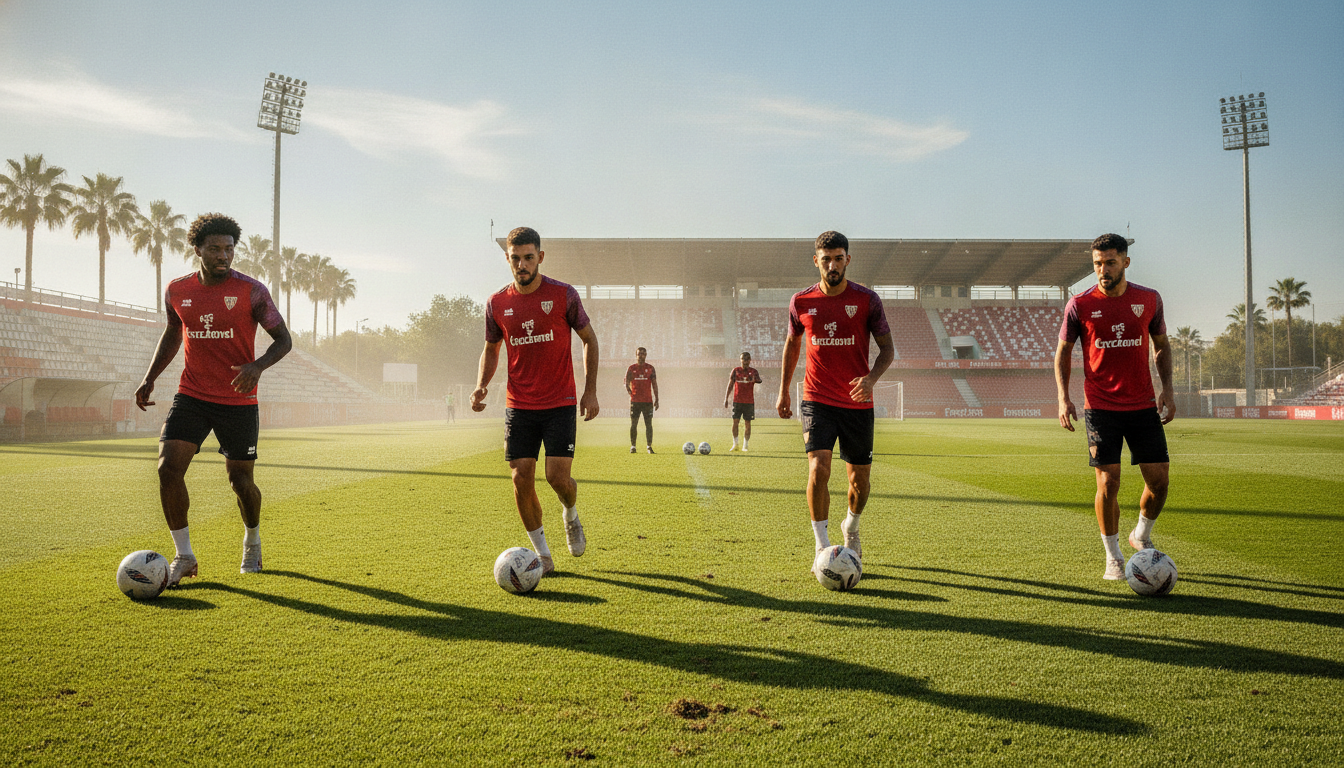
Sevilla preseason accelerated as Navarro secures four early signings ahead of July 6 start
Sevilla preseason ramps up as José Ignacio Navarro finalizes four signings—Jon Guridi, Juan Iglesias, Arouna Sangante and Odysseas Vlachodimos—before training begins on Monday, July 6, 2026.


Sevilla will begin its preseason training on Monday, July 6, 2026, with a markedly different timeline to recent summers as the club moves early to build a stable core. The Sevilla preseason now features four new additions — Jon Guridi, Juan Iglesias, Arouna Sangante and Odysseas Vlachodimos — and the squad could yet see further reinforcement depending on medical and recovery timelines. The expedited planning, led by sporting director José Ignacio Navarro working closely with head coach Luis García Plaza, aims to reduce the late-market scramble that has frequently blighted early-season preparation.
Sevilla to begin preseason on Monday, July 6, 2026
Sevilla confirmed the official start of first-team training for Monday, July 6, 2026, following medical assessments and the completion of initial paperwork for incoming players. The club’s timetable reflects a conscious decision to front-load activity so that new arrivals have maximum time to integrate under Luis García Plaza. Club sources indicate the early schedule was designed to ensure tactical foundations and fitness work are established before competitive fixtures begin.
Sevilla’s decision to open camp on an exact date underscores a strategic shift from reactive to proactive roster management. Players who have completed medicals will join immediately, allowing the coaching staff to implement systems and conditioning programs from day one. The earlier start also gives the club a buffer to manage any lingering fitness or rehabilitation needs for returning or newly acquired players.
Navarro accelerates recruitment with four new signings
Sporting director José Ignacio Navarro has overseen the arrival of four players ahead of the preseason: Jon Guridi, Juan Iglesias, Arouna Sangante and Odysseas Vlachodimos. Three of those moves were completed as free-agent acquisitions while another arrived on loan, showing a mix of low-cost recruitment and strategic squad reinforcement. The signings aim to cover key areas: goalkeeping, defense and midfield resilience.
The club has also kept the door open for further additions, notably monitoring Patrik Mercado’s recovery status before making a final call. Sevilla’s ability to secure multiple targets early gives the coaching staff stability and reduces the need for emergency signings later in the window. The rapid execution of deals reflects Navarro’s priority to provide Luis García Plaza with a coherent group ahead of tactical work.
Comparing recent windows shows a tactical change at Ramón Sánchez-Pizjuán
For much of the last decade Sevilla’s transfer activity often peaked late in the summer window, leaving the roster incomplete as preseason ended. In contrast to seasons where the club arrived at training with minimal new faces, this year’s planning deliberately truncated that uncertainty. The contrast with recent patterns is stark: previous summers frequently saw late bargains or last-minute loans that disrupted early tactical preparation.
Under recent sporting regimes, Sevilla sometimes entered preseason with only one or two confirmed additions or, in some years, with none at all. That approach forced coaches to adapt on the fly and integrate late arrivals into systems already established during camp. The early consolidation now being pursued aims to avoid those pitfalls and give the team greater competitive readiness for the opening days of LaLiga.
2019 summer remains the benchmark for early overhaul
The only comparable acceleration in recruitment during the past decade came in the summer of 2019, when Monchi’s return as sporting director produced an immediate flurry of signings. That window delivered several starters before training began, an approach that helped construct the squad which went on to lift the Europa League. The 2019 precedent remains the most successful example of front-loading recruitment at Sevilla.
While this summer’s four additions do not match the scale of that 2019 overhaul, they represent the most rapid series of arrivals since Monchi’s earlier period. The club believes that combining early signings with disciplined financial management will reproduce the conditions needed for competitive continuity. Sporting leaders cite the 2019 blueprint as a guiding reference while stressing that current market constraints and squad needs require a tailored approach.
Tactical advantages for Luis García Plaza from an early-assembled group
With several spots in goal, defense and midfield already reinforced, Luis García Plaza will have the majority of his initial tactical block available from the first day of training. That continuity allows the coaching staff to install defensive patterns, pressing triggers and goalkeeper-coach routines without missing pieces. Early availability of new signings reduces the risk of mismatches and tactical inconsistency in the opening competitive fixtures.
Having core personnel in place also permits a more measured approach to fitness progression and friendly scheduling. Players who arrive early can adapt to training intensity and integrate into team culture before competitive pressure builds. The benefit extends to youth prospects and fringe players who will face clearer benchmarks and competition for places throughout preseason.
Financial discipline and recruitment mix underpin squad planning
Sevilla’s recent transfer activity highlights a strategic blend of financial prudence and opportunism, with multiple free-agent signings and a loan acquisition securing value while addressing positional needs. The club’s transfer model has shifted toward targeted, cost-effective reinforcements that fit both the budgetary framework and the coach’s tactical blueprint. This shift aims to stabilize long-term finances while keeping the squad competitive across domestic and European campaigns.
Sources within the sporting department emphasize smart scouting, swift negotiations and internal coordination as essential to this approach. By concluding deals early, the club reduces negotiating leverage for rivals and limits last-minute market inflation. The result is a roster constructed with both short-term competitiveness and medium-term sustainability in mind.
How the early plan affects competition and squad dynamics
Early signings can alter preseason dynamics by setting clear pecking orders and accelerating competition for starting roles. New arrivals typically expect to stake claims immediately, and the presence of fresh faces can sharpen existing squad members’ focus during drill work and friendly matches. For Sevilla, integrating four players before July 6, 2026, creates an environment where tactical clarity and internal competition coexist from the outset.
The compressed timetable also places an emphasis on effective communication between the sporting, medical and coaching departments. Coordinated player handovers, rehabilitation protocols and individualized training plans will be necessary to maximize early availability. That coordination is central to ensuring that new additions contribute positively without disrupting squad balance.
Sevilla’s early activity carries implications for rival clubs in LaLiga as well, which may still be ironing out their own summer dealings. By completing multiple signings ahead of the majority of their opponents, Sevilla can start preparation against a relatively settled group and use the early rhythm to their advantage. Opponents that delay recruitment risk entering competitive fixtures with incomplete tactical setups.
The next steps for the club will be clear and measurable: finalize any outstanding medical clearances, calibrate preseason friendlies to test tactical plans and monitor Patrik Mercado’s rehabilitation timetable. How effectively Sevilla translates early planning into on-pitch cohesion will determine whether this accelerated strategy delivers the intended competitive edge.