Sevilla FC protest draws nearly 10,000 fans as supporters demand board resignation
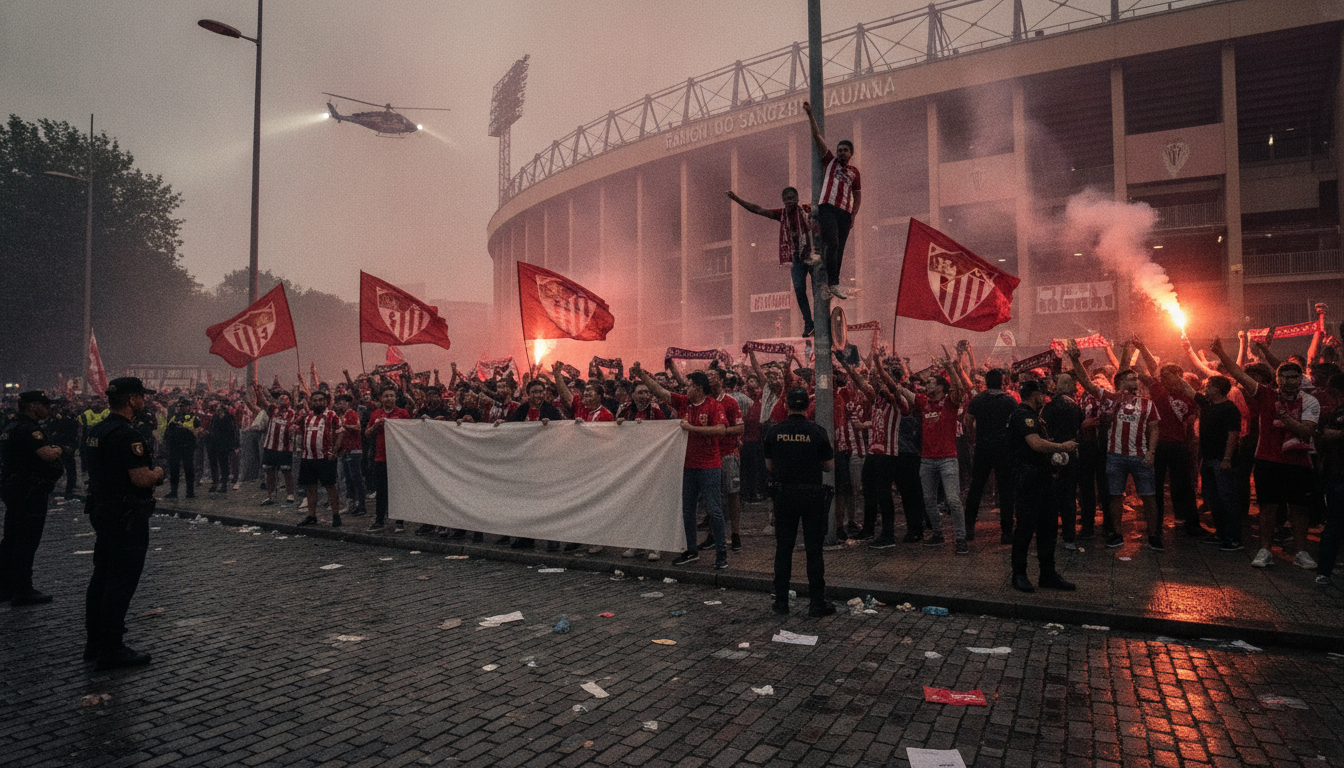
Sevilla FC protest saw almost 10,000 supporters march from Ramón Sánchez-Pizjuán to Puerta de Jerez calling for the board’s immediate resignation amid rising financial and sporting turmoil on Thursday.


Massive march begins at Ramón Sánchez-Pizjuán
Thousands of Sevilla supporters gathered outside the Ramón Sánchez-Pizjuán on Thursday evening to begin a coordinated protest organized under the banner "SOS Sevilla FC."
Organizers and police described the demonstration as peaceful but resolute, with protesters advancing along Avenida Eduardo Dato toward Puerta de Jerez despite summer heat topping 30°C.
Local police estimated the turnout at nearly 10,000 people, a figure cited by several participant groups and reflected in the scale and length of the march.
The demonstration brought together multiple generations of fans, from long-standing season-ticket holders to younger supporters mobilized through social media.
Affinity groups including the Federación de Peñas Sevillistas, Accionistas Unidos and Biris Norte coordinated logistics and messaging, emphasizing a unified demand for change at the club’s highest level.
Marchers carried banners and chanted calls for the board’s immediate resignation, framing the action as a response to years of institutional decline.
Organizers present a manifesto at Puerta de Jerez
The procession concluded at Puerta de Jerez where the manifesto was read aloud by journalist Antonio García Barbeito on behalf of the organizing groups.
The statement urged the principal shareholders to forfeit preferential rights to enable broader participation from the club’s social base and called for an urgent Extraordinary General Meeting to address governance and strategy.
Speakers stressed that the protest was not intended as a one-off event but as the opening of sustained civic pressure to secure a professional "rescue" leadership capable of stabilizing the club.
The manifesto also warned of the risk to Sevilla’s sporting and cultural heritage if immediate corrective steps are not taken, and demanded transparency measures including an independent audit.
Organizers framed their demands around protecting the club’s identity and assets from short-term financial interests, making clear that fans expect concrete timelines and mechanisms for change.
Representatives from Accionistas Unidos communicated that the march marked the start of a campaign combining public demonstration with legal and institutional avenues to press for reform.
Shareholder pact blamed for institutional fracture
Longstanding governance tensions were central to the grievances voiced during the Sevilla FC protest, with critics tracing the collapse in trust to a pact between the major shareholder families.
That governance agreement was originally presented as a way to guarantee stability, but sources inside and outside the club say it has instead entrenched rivalries and blocked transparent decision-making.
The rift among controlling parties has undermined coherent long-term planning and fueled recurring confrontations between the club’s leadership and its fan base.
Protesters and several observers argue the pact has concentrated power in ways that prevent ordinary supporters and minority shareholders from influencing strategic choices.
This institutional deadlock, they contend, has contributed to both sporting underperformance and worsening financial indicators that now constrain operational flexibility.
Calls for revisiting or dissolving the pact featured prominently in the manifesto and in conversations among supporters during the march.
Investor talks linked to Sergio Ramos collapse
Earlier this year, media reports and stakeholder briefings identified Sergio Ramos as a figure connected to a potential investor group that had explored acquiring controlling share packages at Sevilla.
Those discussions ultimately failed to produce a transaction, a development that opponents of the current board say exemplifies missed opportunities to bring new capital and leadership to the club.
The breakdown of that approach, together with a formal statement from club president José María del Nido Carrasco reaffirming the existing board, intensified frustration and helped catalyze the demonstration.
Supporters told organizers that the collapse of the Ramos-linked negotiations exposed structural barriers to investment, including unsettled governance terms and complex shareholder rights.
Accionistas Unidos and other collectives assert that resurrecting credible investor negotiations would require months of legal and financial restructuring, a delay they say the club can ill afford.
The failed talks also hardened public opinion that the current executive has neither a plan nor the mandate to steer the club back to stability.
Sporting decline compounds financial stress
On the field, Sevilla’s recent seasons have been marked by a dramatic reversal from the club’s established European ambitions to a struggle for top-flight safety.
The team narrowly avoided relegation in consecutive campaigns, and frequent managerial changes—several coaches in only a few seasons—have become symptomatic of deeper institutional problems.
This sporting slide has had predictable financial consequences, with the loss of European revenues and a bloated wage bill cited by insiders as primary drivers of mounting debt.
Supporters and analysts say poor transfer planning and short-term squad adjustments have eroded the club’s asset value and competitive standing.
Those decisions have left the club with fewer marketable assets and diminished bargaining power in transfer windows, forcing more frugal roster management and contributing to further on-field instability.
Protesters emphasized that the sporting downturn is inseparable from the governance crisis, arguing that a professional and accountable board is a prerequisite for rebuilding competitiveness.
Limited time to secure new capital before season planning
Organizers and shareholder activists warned that any meaningful sale process or new investment round will require a comprehensive audit and renegotiation of shareholder rights, a procedural timeline of several months.
That timeframe clashes with the immediate need to plan and assemble a squad for the upcoming season, placing the club in a perilous position if solutions are not found quickly.
Accionistas Unidos stressed that prospective buyers are unlikely to commit capital without clarity on governance and a realistic financial forecast.
The protesters’ message underscored that an urgent change in leadership is necessary to prevent further erosion of both sporting prospects and institutional value.
Supporters called for a "Consejo de Salvación"—a temporary, professional board charged with stabilizing finances and opening the club to fresh investment proposals.
The organizing groups signaled readiness to pursue legal avenues and sustained public pressure if voluntary resignations and procedural reforms are not forthcoming.
Sevilla FC faces the immediate challenge of reconciling the need for rapid operational decisions with the longer legal and financial processes required to attract credible new ownership and restore trust.
The demonstration on Thursday has set a new benchmark in the club’s recent history, showing broad-based civic engagement and a strategic shift from episodic protest to organized, sustained oversight by supporters.
How quickly the board and the major shareholders respond will determine whether the club can secure breathing room to rebuild or will be forced into more radical restructuring under duress.
For now, Sevilla’s future hinges on negotiations that must reconcile competing claims of stewardship, financial reality and the supporters’ demand for accountable, transparent leadership.