South Korea World Cup hopes dented after 1-0 loss to South Africa in Monterrey
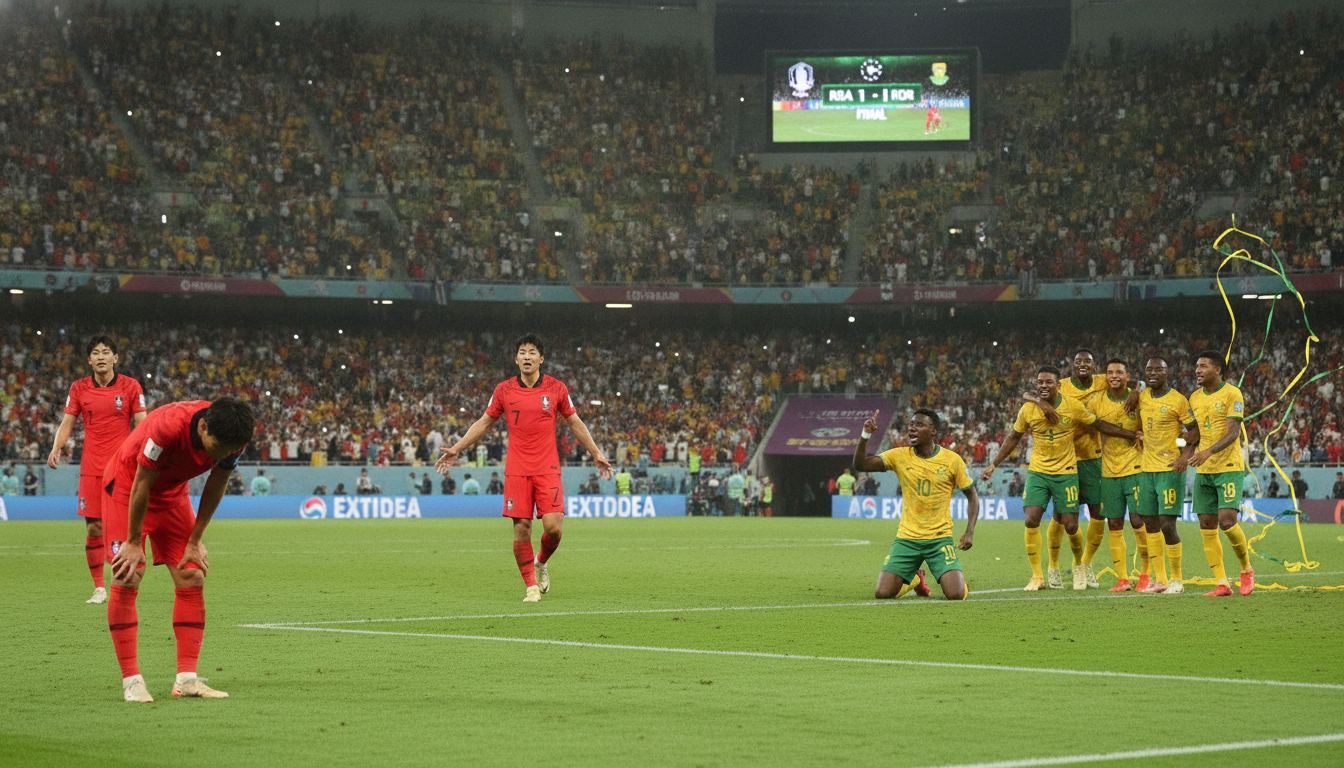
South Korea’s World Cup campaign suffered a major setback as a 1-0 defeat to South Africa in Monterrey left the Taeguk Warriors with only three points and a negative goal difference after three group matches. The result compounded on-field frustrations and sparked a tense exchange in the mixed zone that highlighted simmering nerves within the squad. Captain Son Heung-min later downplayed any internal conflict, insisting the team atmosphere remained intact despite the evening’s turbulence.

Match summary: South Africa’s solitary goal secures victory
South Africa took the lone goal in a match defined by narrow margins and limited clear-cut chances. South Korea struggled to impose themselves consistently in the final third and failed to convert possession into meaningful goal attempts. Defensively the Taeguk Warriors were compact at times but vulnerable to swift transitions that ultimately decided the game.
The scoreline left South Korea with three points from three matches and a minus-one goal difference, a tally that is unusual for a side of their stature but possible to live with under the tournament’s expanded format. The victory gave South Africa a crucial lift while leaving South Korea to reconcile performance with expectations. Monterrey’s humid conditions and the brisk tempo of the contest added to the tactical constraints both teams faced.
Mixed-zone confrontation after the final whistle
Temperatures rose off the field as South African players celebrated while South Korean staff and media gathered in the mixed zone. A brief physical bump between a South African staff member and a Korean player escalated into an emotional exchange, with a South Korean midfielder responding angrily and nearly provoking a scuffle. Team officials from both sides intervened quickly to prevent the incident from developing further.
The episode underlined the raw emotions that follow tightly contested World Cup matches and provided a visible contrast between jubilant visitors and disappointed home-nation supporters. Tournament organizers and team delegations typically manage such encounters carefully, and on this occasion their interventions kept the situation from spiraling. Still, the confrontation added an unwelcome subplot to an already sobering night for South Korea.
Son Heung-min addresses dressing-room atmosphere after delays
Son Heung-min was delayed coming to the mixed zone after being selected for routine doping control, prolonging the period in which questions about team mood circulated. When he finally spoke to reporters he was unequivocal, saying there were no problems with the dressing-room atmosphere and that players remained united. His comments sought to steady public perception and reassure supporters who had watched the team underperform.
The captain’s reassurance was brief and measured, reflecting the tightrope leaders walk in tournament settings between honesty and maintaining collective focus. Son emphasized internal solidarity while acknowledging the disappointment of the result, a posture aimed at resetting the squad’s frame of mind ahead of the remaining group fixture. His status as both a senior player and national icon means his words carry weight inside and outside the dressing room.
Group position leaves qualification prospects fragile
With the loss, South Korea sit on three points and are carrying a minus-one goal difference, a combination that makes their route to the knockout stage precarious. In an expanded 32-team format that offers varied qualification permutations, low point totals can still yield progression, but the margin for error has narrowed considerably. The Taeguk Warriors now require a positive result in their final group match and some favorable outcomes elsewhere to secure advancement.
Coaches and analysts will be working through permutations, but the simplest path is clear: win the final group match to regain control of the situation. Drawing or losing will force reliance on other results and potential tiebreakers, scenarios that add unpredictability and pressure. The next fixture assumes heightened importance, both tactically and psychologically, for a squad that must recover composure quickly.
Tactical assessment: where South Korea fell short
Across the 90 minutes, South Korea showed moments of possession but lacked the sustained incisiveness needed to break a disciplined South African side. The team’s transitions from midfield to attack were often blunt, with final balls failing to find teammates in dangerous positions. On the defensive end, isolated lapses invited counter threats that South Africa capitalized on to secure the decisive advantage.
Coaching staff will likely address secondary runs and movement between the lines as immediate priorities, aiming to create more space for attacking players. Set-piece preparation and delivery may also receive extra attention, offering a controlled environment in which to manufacture opportunities. The performance suggested a need for greater cohesion and urgency; against higher-caliber opponents those deficits could be costly.
Managerial choices and squad management under scrutiny
The defeat intensified scrutiny on recent selections and tactical choices, with questions centering on whether personnel and formation maximized available talent. South Korea’s manager now faces difficult decisions about balancing experienced starters with fresh legs who can inject energy into an attack that has so far struggled to convert chances. Substitution timing and game management will be examined in detail after a display that hinted at reactive rather than proactive planning.
Rotation considerations extend beyond matchday tactics, encompassing fitness, recovery and psychological preparation in the compressed World Cup schedule. The coaching staff will also weigh the impact of disciplinary and off-field incidents on squad unity when deciding on the matchday roster. Preparing a team to perform under mounting pressure requires both clarity of roles and decisive leadership from the bench.
Implications for national expectations and tournament trajectory
The result tempered pre-tournament expectations and raised questions about how far this South Korea side can realistically go in the World Cup. Supporters and commentators will debate whether the team’s talent pool and tactical approach align with the demands of a long tournament. Yet the margins of elite football can be small; a single positive result in the final group match could transform the narrative and restore momentum.
For players, the immediate focus must be on recovery and regrouping, while for federation officials the loss offers a prompt to reassess preparation and contingency planning. Criticism is inevitable in the public arena, but the practical task remains simple: fix the deficiencies revealed in Monterrey and produce a better performance when it matters most. In the final reckoning, World Cup campaigns are shaped as much by response to adversity as by early victories.
South Korea must now move quickly from reflection to action, using the limited time before their final group match to sharpen tactical clarity, address mental composure and recover physically. The team’s leadership will be judged on their ability to convert disappointment into a decisive performance that keeps World Cup ambitions alive.