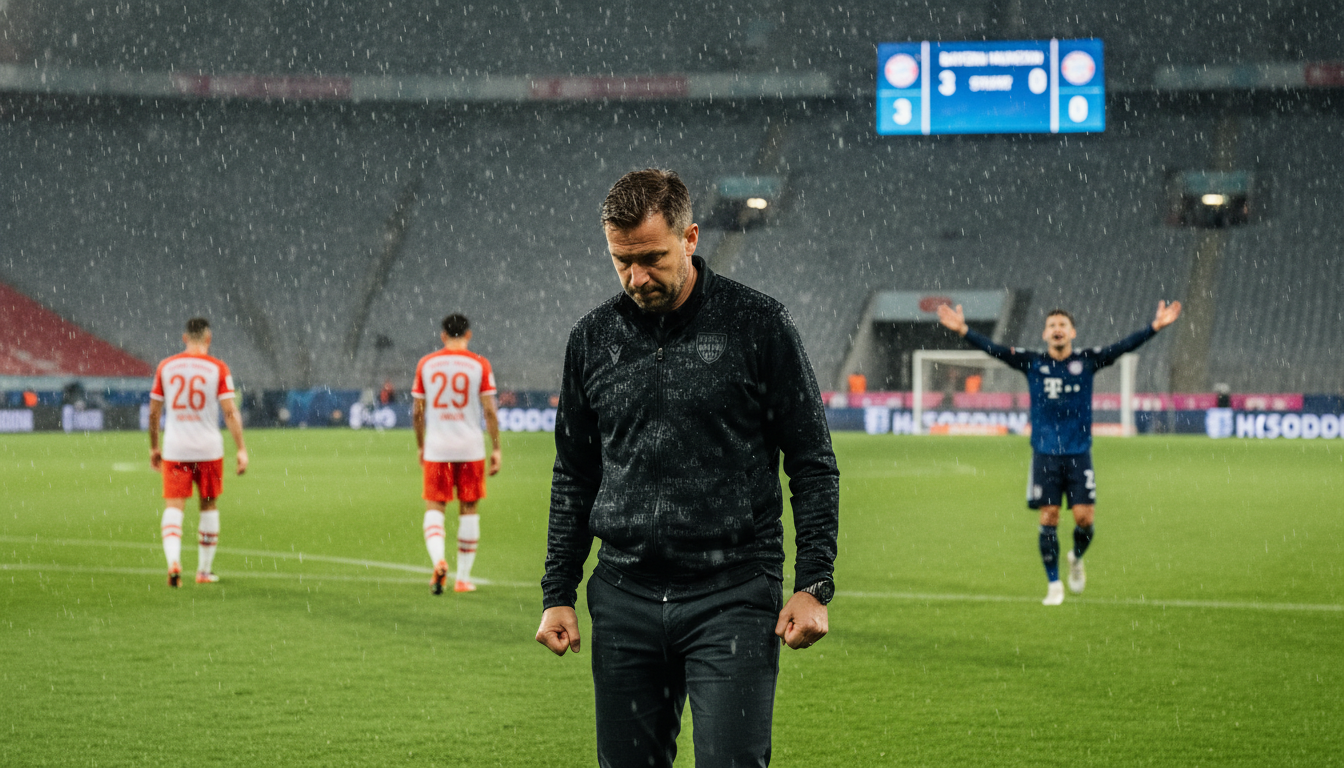
Hoeneß: Stuttgart Disappointed After 3-0 Defeat to Bayern in DFB-Pokal Final
Sebastian Hoeneß rued Stuttgart’s 3-0 loss to Bayern Munich in the DFB-Pokal final, praising his players and goalkeeper Alexander Nübel while pledging to find a way past Bayern.


Strong opening reaction from Hoeneß after DFB-Pokal final
Sebastian Hoeneß admitted he was disappointed after VfB Stuttgart fell 3-0 to Bayern Munich in the DFB-Pokal final in Berlin. The Stuttgart coach said the match was contested to be won, and he highlighted both moments of promise and the failure to convert key opportunities. Hoeneß singled out his squad’s effort across long spells of the game while accepting responsibility for not taking their chances. He vowed the club will keep working toward a day when they can overcome Bayern in major finals.
Bayern’s decisive individuals changed the game
Bayern Munich’s quality proved decisive as Harry Kane and Michael Olise produced match-defining moments that Stuttgart could not counter. Hoeneß acknowledged those individual contributions, describing Kane as the complete package and noting how such moments tilt a final in Bayern’s favor. The visitors’ clinical finishing and timing of decisive plays separated the teams in critical stages. Stuttgart were left to rue a small number of high-quality actions from Bayern rather than a wholesale collapse.
Stuttgart showed resilience and phases of control
Despite the scoreline, Hoeneß insisted his side performed well for significant periods and succeeded in forcing errors from Bayern. The team’s midfield work and moments of ball recovery reflected a tactical plan that had worked at times during the contest. Stuttgart created openings but lacked the composure and final execution to turn those sequences into goals. The coach emphasized that the match provided evidence that his squad can compete with top opposition when they maintain structure and intensity.
Hoeneß singles out Alexander Nübel amid transfer speculation
Hoeneß reserved special praise for goalkeeper Alexander Nübel, calling him a fantastic person and player and noting the strong contribution he made during the campaign. The coach said he had enjoyed working with Nübel and that the club will miss him, comments that underscore speculation over the goalkeeper’s future. Nübel’s form across the season has attracted attention, and Stuttgart now confront the possibility of replacing a key dressing-room figure. Hoeneß’s public admiration framed Nübel as both a sporting and personal loss should a move materialize.
Tactical shortcomings that cost Stuttgart the final
Hoeneß and his staff identified several tactical areas where Stuttgart fell short, most notably the inability to convert transitional moments into clear-cut chances. While Stuttgart won many duels and recovered possession, the side did not capitalize on the spaces created in Bayern’s half. Defensive discipline was generally intact but moments of indecision in the attacking third allowed Bayern to regain control and punish errors. Hoeneß suggested that marginal improvements in decision-making and finishing will be the immediate focus in training.
Lessons from Berlin and the pathway forward
The coach framed the defeat as a painful but instructive experience, one that will be used to accelerate the team’s development rather than define it. Hoeneß said the frustration was natural after contesting a final with the intent to win, yet he remained convinced that Stuttgart will eventually find a way to beat Bayern. The emphasis will be on refining attacking efficiency, sustaining pressure for longer runs, and preparing players mentally for the high stakes of cup finals. Club leaders and coaching staff are expected to analyze the match in detail to extract precise adjustments.
Player morale and season context after the final
Hoeneß attempted to balance immediate disappointment with recognition of the season’s broader achievements and the players’ commitment. He stressed that the squad had celebrated great moments throughout the campaign and will draw on those positives moving into the off-season. Individual performances that stood out, beyond Nübel, will provide a platform on which to build, even as the sting of a 3-0 defeat in a cup final lingers. The coach’s public support aimed to steady player morale and signal continuity in the club’s approach.
Despite the loss, Stuttgart’s run to the final reinforced the club’s progress under Hoeneß and highlighted areas for targeted recruitment and development. The team’s ability to push Bayern at intervals suggests a narrowing gap in certain tactical and physical measures. For supporters, the defeat is disappointing, but the structure and belief conveyed by the manager point to a sustained project rather than a one-off collapse. Hoeneß framed the result as motivation for future campaigns.
Hoeneß also acknowledged the institutional strength Bayern displayed, praising both the players and the club’s broader operation. By singling out Bayern’s high-caliber individuals and the organization that surrounds them, the Stuttgart coach underscored the scale of the challenge his side faces. That recognition did not dilute his optimism; instead, it served as a benchmark for what Stuttgart must aspire to match in personnel, planning, and consistency. The coach’s closing message leaned on patience and hard work.
Immediate next steps for Stuttgart will include a detailed review of the final and a focus on preseason planning that addresses finishing and composure in decisive moments. Coaching staff will likely prioritize scenarios that recreate the transitional phases where Stuttgart could not capitalize, ensuring players practice both the technical and psychological elements required in tight matches. Any squad changes, particularly around goalkeeping or attacking reinforcements, will be considered within a broader strategic context rather than as knee-jerk responses.
The 3-0 scoreline will be recorded as a clear victory for Bayern, but for Stuttgart the match offered a mixture of lessons and reassurance about the club’s direction. Hoeneß’s comments reflected both the immediate pain of defeat and a measured conviction that the team will continue to develop. As the season closes, Stuttgart’s challenge is to turn the frustration of Berlin into longer-term gains that narrow the distance to Germany’s dominant club.
In the short term Stuttgart must manage player recovery and maintain focus while the club evaluates the wider implications of the final for transfers, training priorities, and squad building. Hoeneß’s promise that “eventually we will crack Bayern” set a tone of persistence rather than resignation, and that outlook will shape preparations ahead of the next competitive cycle. The club’s supporters will look for tangible signs of progress as Stuttgart seeks to translate cup final experience into future silverware.