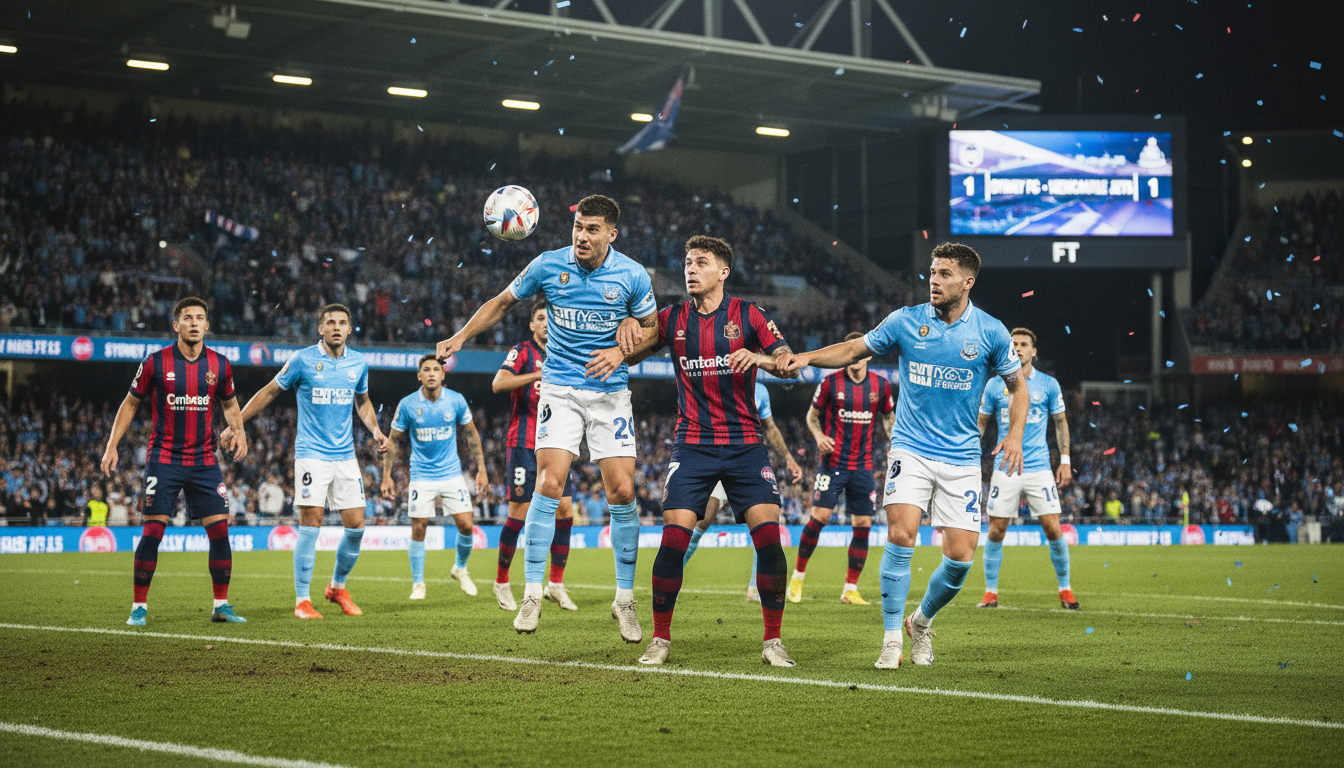
Sydney FC vs Newcastle Jets end 1-1 in A-League semi-final first leg at Allianz Stadium
Sydney FC vs Newcastle Jets finished 1-1 in the A-League semi-final first leg at Allianz Stadium on May 9, 2026, leaving the tie finely poised for the return in Newcastle.


Sydney FC vs Newcastle Jets produced a tense, tactical encounter at Allianz Stadium on Saturday, with an early second-half exchange of goals eight minutes apart leaving the aggregate score level. The draw keeps both sides very much in the hunt for a place in the A-League Men grand final and shifts decisive weight to next Saturday’s second leg at McDonald Jones Stadium. Managers from both clubs will head into the return with selection dilemmas and adjustments to consider after a match that mixed controlled possession with moments of clear-cut transition football.
Early second-half swing sets tone
Sydney FC and Newcastle Jets traded goals within an eight-minute window early in the second half, a sequence that ultimately determined the first-leg narrative. The brief period of open play exposed both teams’ vulnerabilities as they searched for an opening, and the tempo of the game shifted markedly after the goals. From that point, both sides prioritized structure and limited risky forward gambits, mindful of the away-goal dynamics and the short turnaround before the second leg.
Both managers made tactical tweaks as the game wore on, aiming to protect leads or chase parity without overcommitting. The stalemate that followed the goals reflected a mutual awareness of the tie’s balance; neither side wanted to concede a decisive away advantage. The timing of substitutions and the shift to more conservative formations late in the match signaled a chess-like approach to the two-legged contest.
Tactical battle and midfield control
The midfield battle was central to the match’s flow, with both teams trying to assert dominance through possession and pressing triggers. Sydney sought to control the ball in build-up phases, probing for gaps down the flanks and through runners from deep positions. Newcastle, by contrast, looked to exploit transition moments and test Sydney’s defensive shape with quick forward movements.
Pressing patterns and compactness in defensive blocks were evident across both halves as coaches prioritized defensive solidity. When the contest opened after halftime, both teams briefly abandoned conservative posture to seek an advantage, producing the exchange of goals. Afterward, tactical discipline returned as the priority, making the final 30 minutes a study in containment and controlled tempo management.
Standout performances without naming individuals
Several players produced decisive interventions that influenced the game’s balance, whether through key clearances, intelligent positional play, or accurate distribution under pressure. Defensive units from both clubs were tested and responded with moments of resilience, while attacking units generated chances that forced goalmouth scrambles and goalkeeper saves. Midfield contributors on both sides helped link defence to attack and played a crucial role in determining when the game sped up or slowed down.
The match showcased the depth in both squads; substitutes made tangible impacts when introduced, offering fresh legs and renewed tactical shape. That depth will likely be a factor in the second leg, where fatigue and adjustments can amplify the importance of bench contributions. Coaches will review these performances closely when finalizing their plans for McDonald Jones Stadium.
Implications for the second leg in Newcastle
The 1-1 draw leaves the tie delicately balanced ahead of the return fixture at McDonald Jones Stadium next Saturday, where home advantage could prove decisive. Newcastle will return to familiar surroundings with the chance to press for a victory that would send them through, while Sydney must decide whether to adopt a conservative approach to protect away parity or pursue a match-winning plan on opponent soil. The away goal for the visiting side complicates calculations and may shape how both teams approach the opening exchanges in the second leg.
Set-piece work and defending at transitions are likely to be emphasized in training this week, given how critical marginal moments became in the first meeting. Both coaching staffs also face selection questions around fitness, form, and tactical fit, and any suspensions or injuries arising from the first leg will further influence lineups. The short turnaround increases the premium on recovery and tactical preparation, making midweek routines and targeted training sessions essential.
Coaching adjustments and tactical options to watch
Coaches on both sidelines will assess what worked and what didn’t over the 90 minutes, with specific attention to pressing intensity, full-back involvement, and midfield shielding. Adjusting the pressing triggers or changing the width of attacks could open opportunities that were absent in the first meeting. A switch in personnel to bring greater aerial presence or more pace in wide areas is plausible as each manager seeks to exploit perceived weaknesses.
Substitution strategy will again be pivotal; timely and incisive changes could tilt the balance in a tightly contested second leg. Managers may also consider altering formation to create mismatches, especially if one side wants to unsettle the opponent early. Tactical flexibility and the ability to react quickly during the match will be crucial in a fixture where small margins can decide the outcome.
Atmosphere, context and season implications
The semi-final tie is part of a broader A-League Men finals series context that intensifies every week as clubs chase domestic silverware. Saturday’s match at Allianz Stadium drew a crowd eager for competitive knockout football, and the atmosphere reflected significant local interest in the fixture. The result keeps both clubs’ seasons alive and sets up a compelling conclusion to the tie on neutral terms in Newcastle.
Progression to the grand final would carry sporting and financial rewards for the winning club and its players, and it would further shape managerial evaluations at the season’s close. For supporters, the balance of the tie enhances the narrative around momentum and home advantage, promising an electric return match with much at stake. The tie also offers a barometer for each team’s readiness to handle high-pressure knockout football.
Saturday’s draw underlined the fine margins that separate success from elimination in playoff football. The next seven days will be defined by recovery protocols, tactical preparations, and the deliberate honing of set-piece routines that could decide the tie. With the aggregate score level, both Sydney FC and Newcastle Jets remain fully in contention, and the return fixture promises a decisive chapter in their A-League campaigns.
The teams will reconvene for training and tactical review ahead of the second leg, where the outcome will determine who advances toward the grand final.