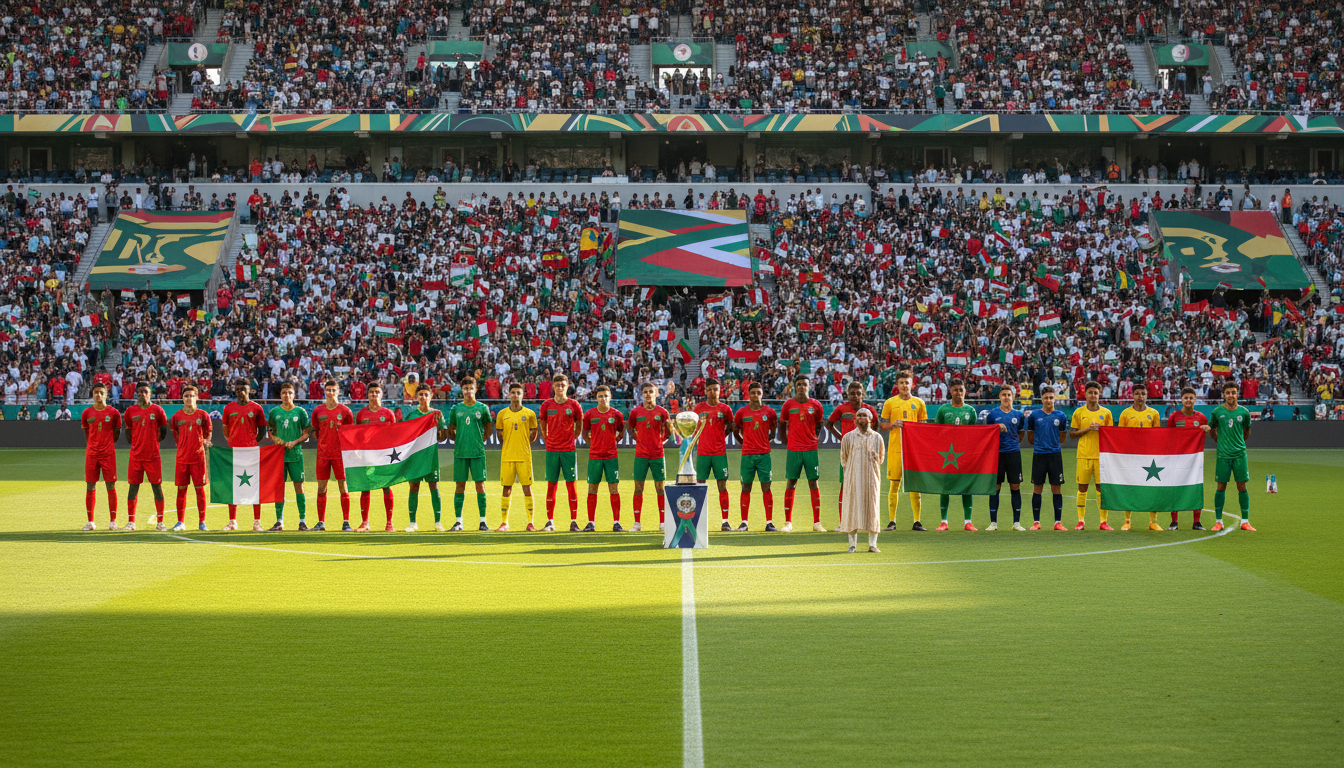
CAF U-17 AFCON Morocco 2026: 16 Nations Compete in Rabat for Continental Title and 10 World Cup Berths
CAF U-17 AFCON Morocco 2026 runs 13 May–2 June as 16 African teams gather in Rabat to contest the continental crown and 10 places at the FIFA U-17 World Cup Qatar 2026.


The CAF U-17 AFCON Morocco 2026 has opened in Rabat, bringing 16 of the continent’s top youth sides to a centrally staged, festival-style tournament from 13 May to 2 June 2026. Morocco enter as hosts and defending champions, aiming to retain the title on home soil while the competition also serves as Africa’s qualifying route to the FIFA U-17 World Cup Qatar 2026. With 10 berths available, every match carries heightened significance for nations chasing both continental glory and global qualification.
Hosts and defending champions set the scene
Morocco arrives in Rabat as the reigning U-17 champions and the tournament favourite on paper, supported by a technically adept squad coached by Tiago Lima Pereira. The hosts will try to harness home advantage across the Mohammed VI Football Complex and larger venues slated for the opening fixture, semi-finals and final. Local expectations are high after Morocco’s success in 2025, and the team’s blend of skill and cohesion positions them as a benchmark for the tournament.
Festival-style format centralises operations
CAF has introduced a festival-style model for the 2026 finals, centralising matches, training sites and team operations at the Mohammed VI Football Complex in Rabat. The concept is designed to streamline logistics, concentrate medical and developmental resources, and foster an intensive environment for player growth. Organisers say the move will create a more vibrant atmosphere and allow teams to focus on preparation in a unified setting.
The festival-style approach also concentrates scouting and media activity, simplifying access for clubs and broadcasters following the event. CAF’s operational objective is to pair competitive scheduling with improved player welfare and talent identification opportunities. Centralisation should reduce travel strain on players and allow referees and technical observers to maintain consistent standards across fixtures.
Tournament format and World Cup qualification mechanics
The competition features 16 teams divided into four groups of four, with the top two teams from each group advancing to the quarter-finals. Those eight quarter-finalists will automatically secure nine of the 10 available African slots for the FIFA U-17 World Cup Qatar 2026, meaning progression past the group stage is the clearest path to global qualification. The remaining two World Cup places will be decided by play-offs contested by the four third-placed teams, adding an extra layer of drama to the closing stages of the group phase.
Match scheduling runs from 13 May through 2 June, with group-stage fixtures giving way to knockout rounds that culminate in the final. The structure intensifies each phase, and with ten World Cup berths at stake the margin for error is small. Teams will balance continental ambitions with the pragmatic need to secure one of the limited World Cup tickets.
Group draw and immediate favourites
Group A pairs Morocco with Tunisia, Egypt and Ethiopia, setting up a high-stakes pool for the hosts in front of home crowds. Group B brings together Côte d’Ivoire, Cameroon, Uganda and DR Congo, while Group C features Mali, Angola, Tanzania and Mozambique. Group D includes Senegal, South Africa, Algeria and Ghana, creating several early-matchups that could decide qualification trajectories.
Several traditional youth powerhouses are expected to push deep into the competition. Mali and Senegal arrive with strong development records and recent regional success, while Cameroon and Ghana carry historical pedigree at youth level. Observers have highlighted Morocco’s balance of creativity and defensive organisation as a central threat, while emerging sides such as DR Congo and Angola could upend expectations.
Players to watch and scouting spotlight
Scouts from major clubs will be in Rabat looking for the next generation of African talent, and a number of names stand out as potential breakout stars. Morocco’s attacking trio – including Adam Bougazir, Rami Loukmani and Ilyan Hadidi – offer pace and technical ability that could define the hosts’ campaign. Senegal’s Souleymane Commissaire Faye arrives as a dynamic attacking midfielder with a proven scoring touch, making him one to follow in Group D fixtures.
Other prospects likely to attract attention include Owen Mukisa and Thomas Ogema of Uganda, Delpierot Ntali of DR Congo, and Pedro Antonio of Angola, each of whom impressed during regional qualifying. Performances at this championship have historically accelerated moves to professional clubs and academies overseas, and the presence of global scouts raises the stakes for young players seeking to make their mark.
Coaching profiles and tactical outlook
A number of prominent coaches and former internationals are on the touchlines, bringing varied tactical approaches to the tournament. Tiago Lima Pereira heads Morocco’s setup and is credited with building the technical foundation that delivered the 2025 title. Ghana’s campaign will be guided by Prosper Narteh Ogum, whose reputation for structured development will test Group D rivals.
Cameroon’s Alioum Saidou and Uganda’s Laryea Kingston combine international experience with regional knowledge, and both teams are expected to be physically imposing and tactically disciplined. The range of coaching philosophies—from possession-based systems to direct, transition-focused attacks—promises contrasting matches that will challenge young players’ adaptability and decision-making.
Debutants, returns and broader legacy
DR Congo will make their first-ever appearance at the U-17 AFCON finals, presenting an intriguing storyline as they step onto the continental stage. Ethiopia’s return to the finals for the first time since 2003 adds historical resonance to the event, while Mozambique and Tanzania seek to build on impressive qualifying campaigns. These narratives broaden the tournament’s competitive and cultural scope, reinforcing the U-17 AFCON’s role as a development platform.
The competition has long been a launchpad for players who later reached Europe’s top leagues and senior international tournaments. For many participants, Morocco 2026 offers a dual opportunity: to pursue a continental trophy and to secure passage to the FIFA U-17 World Cup, where further exposure awaits. CAF and national federations view the championship as a crucial step in talent pipelines and long-term player progression.
Broadcast coverage and global interest
CAF will stream every match live on CAF TV via YouTube, ensuring global digital access to fixtures and highlights. More than 20 international broadcasters have acquired rights, with networks such as beIN Sports, SuperSport, Canal+, Azam TV and SABC Sport among those scheduled to carry matches. Broad coverage aims to reach domestic and international audiences, amplifying exposure for players and strengthening commercial interest in youth development.
The presence of major broadcasters and a concentrated festival model is expected to attract club scouts, agents and talent developers in significant numbers. This convergence creates a pressure-cooker environment where individual performances can fast-track careers, while also offering national teams a platform to showcase the effectiveness of their development programmes.
Morocco’s staging of the CAF U-17 AFCON Morocco 2026 brings a competitive, tightly scheduled championship to Rabat with far-reaching implications for players and federations across Africa. The tournament’s blend of a festival-style setting, World Cup qualification stakes and high-level scouting promises a memorable month of youth football and a fresh crop of players ready to step into the international spotlight.