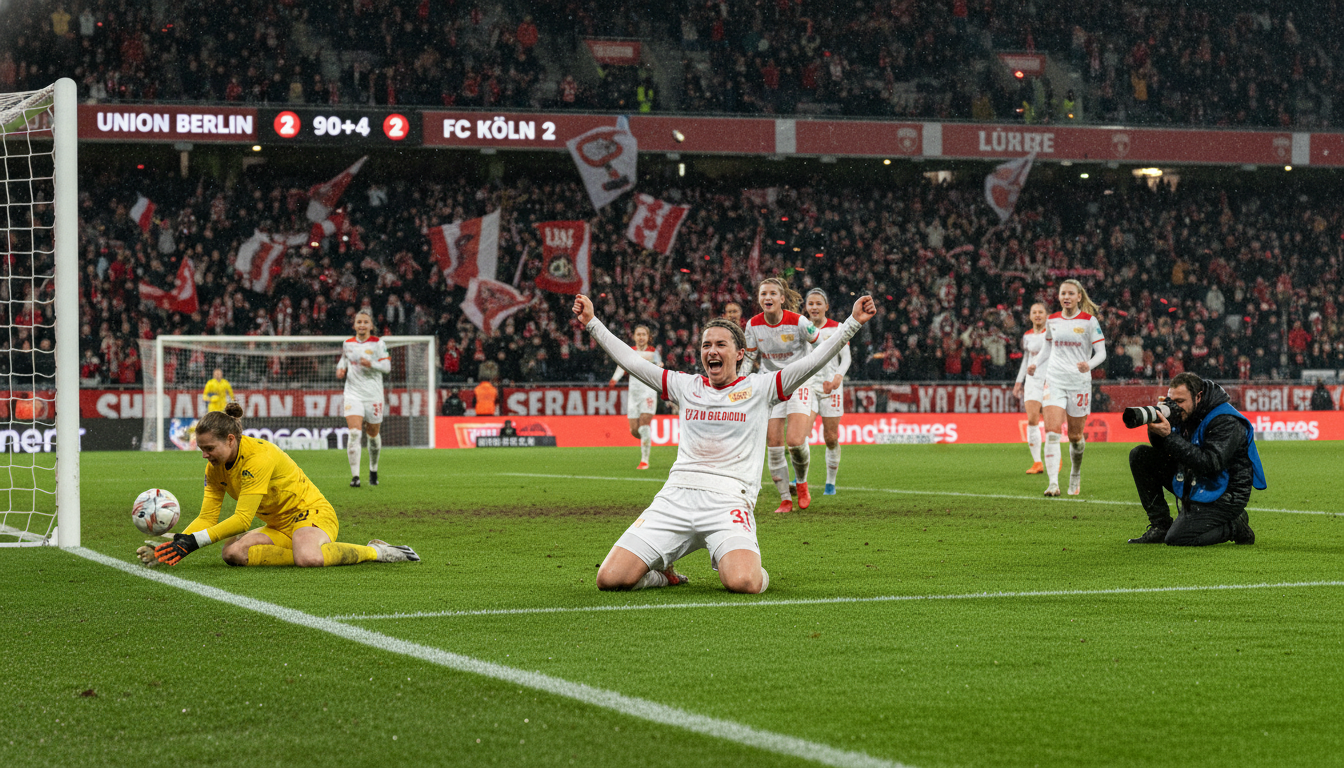
Marie-Louise Eta secures first Bundesliga point as Union Berlin fight back to draw Köln 2-2
Marie-Louise Eta earned her first Bundesliga point as Union Berlin battled back to claim a 2-2 draw with Köln at the Stadion An der Alten Försterei, with Livan Burcu scoring a dramatic late equaliser. The result broke a three-game losing streak and offered a timely morale boost for Eta’s side in the relegation scrap.


Strong start undone but resilience shown
Union Berlin fell behind by two goals in the opening stages, leaving coach Marie-Louise Eta with a rapidly escalating challenge at her first Bundesliga home fixture since taking charge. The visitors’ early dominance exposed gaps in Union’s structure and prompted urgent tactical attention from Eta and her staff. Rather than capitulate, Union gradually wrestled control back through stronger midfield presence and sharper attacking intent as the match progressed.
The point earned at the Stadion An der Alten Försterei halted a run of losses and provided a visible lift in confidence for a squad that has been under scrutiny since Eta’s appointment. The draw also demonstrated that, despite personnel upheaval and a young goalkeeper thrust into the spotlight, Union retain the capacity to respond under pressure.
Bold selection changes spark discussion
Eta made five alterations to the side that started the previous league defeat, a set of decisions that drew immediate attention from supporters and pundits. Long-term defensive figure Leopold Querfeld was omitted from the XI and captain Christopher Trimmel began the match on the bench, while offensive options András Schäfer, Janik Haberer and striker Andrej Ilić were also left out of the starting lineup.
Those choices reflected a clear intent from Eta to shake up a team that had struggled for form, but they also carried risk given the absence of senior figures and the integration of new personnel. Critics questioned the removal of Querfeld from the backline, especially after the club was forced to hand a debut start to rookie goalkeeper Carl Klaus with Frederik Rønnow out for the season.
Tactical adjustments turned the tide
As the first half concluded, it became clear that the initial 3-3-2-2 setup was not achieving the desired control in midfield and cohesion in attack, and Eta responded by refreshing her options in the second half. She introduced Livan Burcu in the 58th minute, a move that shifted the team’s balance and added directness in the final third. Later substitutions, including bringing on Andrej Ilić and reinstating Christopher Trimmel, altered the rhythm and personnel balance further.
A decisive change came in the 67th minute when Stanley Nsoki was replaced by Tim Skarke, and Union reverted to a more conventional 4-4-2 shape that provided improved defensive cover and greater width going forward. Those adjustments helped the home side create more sustained pressure and opened the path for the comeback that followed.
Livan Burcu delivers a dramatic breakthrough
The introduction of 21-year-old German-Turkish forward Livan Burcu proved pivotal as he completed a late finish to level the score, delivering his first Bundesliga goal in the 89th minute. Burcu’s strike was the culmination of growing momentum after Union reduced the deficit via a set-piece in the 73rd minute, and it underscored his emerging threat in the final third. The manner of the goal — an incisive individual action inside a tense closing phase — offered a timely illustration of his composure and finishing ability.
Burcu’s contribution will be judged as more than a consolation; it injected energy into a squad that needed a visible spark and provided a clear reward for the manager’s faith in youth. The young attacker’s performance will likely increase competition for forward minutes and give Eta an additional, dynamic option for the remainder of the campaign.
Goalkeeping and defensive reshuffle tested under pressure
Union’s defensive configuration was reshaped ahead of the match, a gamble that carried consequences when the opening goals arrived and left the backline vulnerable at key moments. The selection of Stanley Nsoki alongside others in a back three, combined with the debut of goalkeeper Carl Klaus, placed an inexperienced pairing under immediate examination against a clinical Köln attack. While the reshuffle ultimately contributed to a shaky start, the reconfiguration later offered the platform for improved solidity after tactical changes.
Klaus’s baptism in the Bundesliga was significant given Frederik Rønnow’s season-ending absence, and although he was tested early he made several important interventions as the match wore on. The return of Christopher Trimmel from the bench also had a stabilising effect; the captain’s presence and later involvement in the build-up work helped steady Union’s play and supplied the assist for a goal that recalibrated the contest.
What the point means for Union’s campaign
The single point will be measured as valuable in the context of a congested lower half of the Bundesliga table, where small margins can determine survival or relegation battles. For Marie-Louise Eta, the result offers tangible evidence that her tactical flexibility and willingness to make bold personnel calls can yield dividends under pressure. Snapping a three-match losing run also reduces immediate momentum losses and gives the coaching staff breathing room to refine selection decisions without the additional strain of consecutive defeats.
However, the draw also exposed issues that will require further attention, particularly defensive cohesion and the balance between experience and youth in key positions. Union must now consolidate this result with consistent performances, and the remainder of the season will test whether Eta’s adjustments can be standardised into a reliable formula for points accumulation.
The match will likely intensify internal debates about squad rotation, the role of emerging talents such as Burcu, and how to manage the goalkeeper position while Rønnow remains sidelined. For the supporters, the late equaliser provided a release of tension and a reminder of the competitive spirit within the team, but it also highlighted the narrowness of margins that Union must navigate to secure safety.
Union’s coaching staff and players will return to training with concrete evidence of what worked and what needs refining, and the outcome against Köln gives them a foundation on which to build. Marie-Louise Eta’s capacity to adapt during the match was on display, and the challenge now is to convert that tactical responsiveness into consistent results over a demanding season stretch.
Union Berlin will take encouragement from the point and the performance of emerging players as they prepare for their next fixtures, with attention now turning to shoring up the backline and sustaining attacking productivity. The balance between risk and reward in Eta’s selections will remain a focal point for discussion, and the coaching team must decide whether to preserve the momentum created by the late comeback or to prioritise stability.
Despite early setbacks in the match, Marie-Louise Eta’s decisions and the squad’s resilience produced a meaningful outcome that may prove influential in Union’s fight to remain competitive. The draw at the Stadion An der Alten Försterei showcased both the vulnerabilities and the potential within the roster, and it offered a vivid demonstration that timely tactical shifts and the emergence of young talent can alter the trajectory of a game.