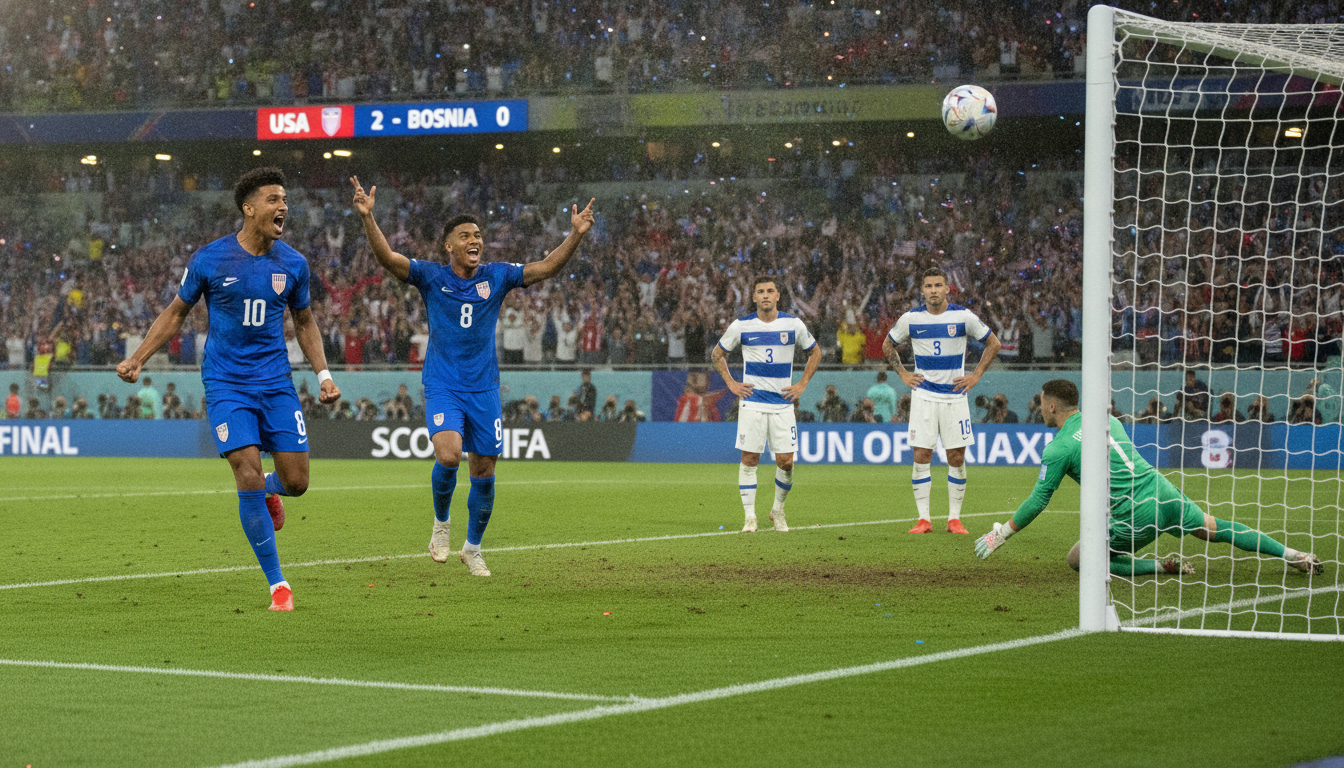
United States beat Bosnia 2-0 to reach World Cup last 16
United States reached the World Cup last 16 with a 2-0 victory over Bosnia in the San Francisco Bay Area, despite going down to 10 men when Folarin Balogun was sent off. Malik Tillman’s late free kick sealed the win and ended a 24‑year wait for a US knockout-stage victory, keeping the United States’ hopes of a deep tournament alive.
Late Balogun strike settles tense first half
Balogun produced the breakthrough just before half‑time, sliding in to finish after sustained pressure from the hosts. The goal rewarded an increasingly physical United States attack that had been probing Bosnia’s crowded defensive lines throughout the first 45 minutes. Prior to the opener, Christian Pulisic and Balogun both forced frantic defensive reactions from Bosnia, with officials disallowing earlier efforts that had unsettled the opposition. The scoreline at the break reflected a tight game that tilted in favor of the United States only in the closing seconds of the half.
Red card changes dynamics but defense holds firm
The match’s rhythm shifted dramatically early in the second half when Balogun received a red card, reducing the United States to 10 men. Rather than cede control, the team regrouped, tightened the lines and adopted a compact, disciplined defensive shape that closed spaces and limited Bosnia’s options. Bosnia increased their intensity and had phases of sustained possession, but they were unable to convert territorial advantage into clear scoring chances. The American backline and midfield connected in short, efficient sequences to blunt Bosnia’s advances and bought time for a decisive late moment.
Tillman free kick sparks Bay Area celebration
With the match finely balanced deep into the second half, Malik Tillman stepped up to convert a set piece that broke Bosnia’s resistance. Tillman’s free kick curled past goalkeeper Nikola Vasilj and into the net, prompting a roar from a partisan crowd decked in red, white and blue. The strike provided breathing room and allowed the United States to manage the closing stages while under numerical disadvantage. Supporters poured emotion into the stadium as the team protected the lead and closed out a historic victory.
Milestone win ends years of frustration against Europe
The result snapped a troubling sequence for the United States, halting a run of 10 straight defeats by European opposition at major tournaments. More significantly, the victory ended a 24‑year drought without a World Cup knockout‑stage win for the U.S. men’s national team. That historical weight was visible in the players’ reactions at full time, with relief tempered by recognition of the task ahead. The milestone will be measured not only in records but in the renewed belief it gives a squad aiming for an extended run at football’s global showpiece.
Tactical resilience under pressure
United States coach and staff reorganized after the dismissal, prioritizing compactness and quick transitions to limit exposure on the flanks. Midfielders dropped deeper to shield the defense while wide players tracked back diligently to cut supply lines into Bosnia’s box. The team’s willingness to run and press in short bursts disrupted Bosnia’s rhythm and prevented them from capitalizing on the extra man. That disciplined approach combined with clinical set‑piece execution ultimately determined the outcome.
Next test: Seattle showdown with Belgium
The win sets up a last‑16 meeting with Belgium in Seattle, a fixture that promises a different tactical challenge and high expectations from both camps. Belgium reached the knockout stage earlier after rallying past Senegal 3-2 after extra time, ensuring a high‑profile clash between two sides with contrasting styles. The United States will enter the tie buoyed by momentum but aware that Belgium’s technical quality and experience will demand precise preparation. Location, atmosphere and recovery plans will all factor into how the hosts approach a match widely viewed as the scoreboard‑defining contest of the round.
Players and leadership praised for collective effort
Christian Pulisic, who described the team’s response as a collective effort, highlighted the mental resilience required to defend a narrow lead with ten men. Multiple players delivered key contributions across the match, from disciplined defensive blocks to timely interceptions and accurate clearances. Coaching decisions on substitutions and tactical tweaks also played a part in preserving the advantage and closing the game. That balanced team performance suggested a depth of character that could be decisive as knockout football intensifies.
The United States’ win over Bosnia in the San Francisco Bay Area will be dissected for its tactical adjustments, set‑piece execution and the psychological boost it provides heading into the knockout rounds. Despite the setback of a red card, the team found a way to press, defend and finish clinically when required. As attention turns to the Seattle tie with Belgium, the United States carries renewed belief and a milestone victory that has reignited hopes of a memorable World Cup run.