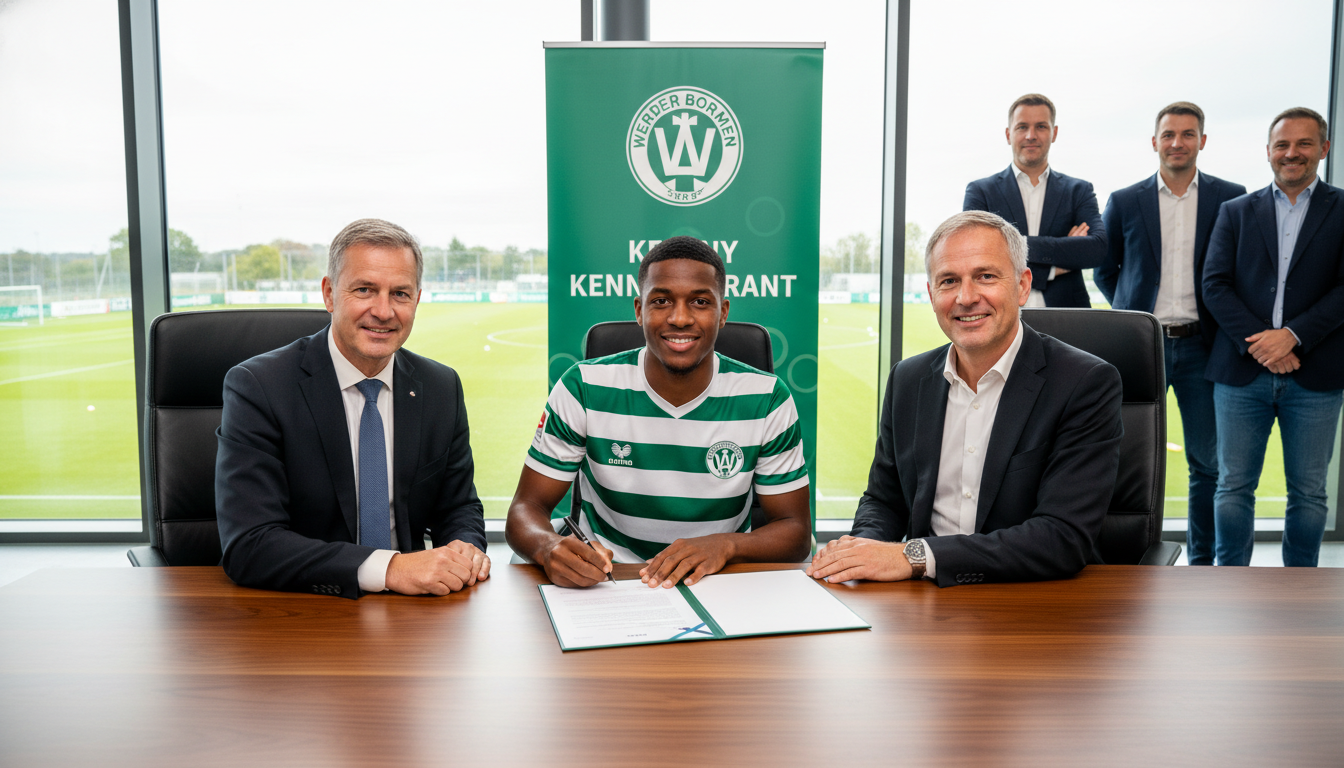
Werder Bremen Agree to Sign Kenny Quetant from Le Havre on Free Transfer
Werder Bremen set to complete signing of Kenny Quetant, with the 19-year-old forward available on a free transfer and medical scheduled this week.


Werder Bremen have reached an agreement to sign Kenny Quetant, the 19-year-old French forward, in what the club expects to be its first signing of the summer transfer window. The move sees Quetant leave Le Havre without a professional contract and join Bremen on a free transfer, with reports indicating a medical is planned before formal paperwork is completed. The player is set to sign a four-year deal, marking a long-term investment by Bremen into a young prospect with top-flight experience.
Agreement details and transfer status
Werder Bremen negotiated the terms of the deal after tracking Quetant through the season, and sources indicate the club moved quickly once the forward became available. The transfer is understood to be a free move because Quetant had not signed a professional contract with Le Havre, allowing Bremen to secure the player without a transfer fee. Club officials see the low-cost arrival as an opportunity to add depth and potential to the attacking ranks while minimizing immediate financial outlay.
The club has prepared a contract that, according to reports, extends for four years with an option to prolong by an additional season, a structure designed to protect Bremen’s investment if Quetant fulfills his potential. The agreement reportedly hinges on a medical examination and standard registration steps, after which the club will announce the signing formally. For Bremen, the move fits a recurring model of recruiting young talent from France and giving them a pathway to establish themselves in the Bundesliga.
Contract terms and the planned medical
According to media updates, Kenny Quetant will undergo a medical examination before completing the formal signing, a routine step that will precede the publication of official club paperwork. The contract under discussion runs for four years and includes an option to extend by a further year, giving Bremen control over the player’s medium-term future. That length signals Bremen’s intention to integrate Quetant into their sporting project rather than view him as a short-term solution.
Once the medical is cleared, the club will register Quetant in accordance with Bundesliga and DFL regulations, which could include provisional inclusion in preseason plans and marketing introductions. The timeframe between a passed medical and competitive registration can vary, but Bremen supporters should expect communications from the club confirming the player’s status in due course. The structure of the deal gives both the club and player stability and room for development.
Quetant’s profile and first-team experience
Kenny Quetant enters the Bundesliga with limited senior minutes but useful top-flight exposure, having made nine appearances for Le Havre in Ligue 1 this season and scoring one goal. Those appearances, although sporadic, provided him with experience at a high level and the chance to test himself against established professionals in France’s top division. At 19, Quetant arrives as a developing forward who has shown glimpses of the technical and movement qualities clubs look for in young attackers.
Scouts describe him as a forward with close control and a willingness to take on defenders, capable of operating across the front line if required. His youth career and training environment at Le Havre—an academy known for producing talented professionals—give him a foundation in tactical awareness and technical proficiency. Bremen will likely manage his minutes carefully, balancing the need for immediate impact with a longer-term plan for gradual integration into the first team.
Competition for the signing and earlier suitors
Reports leading up to the agreement indicated that Bremen were not the only club tracking Quetant, with Freiburg emerging as a frontrunner in earlier coverage and Lille also showing interest. French outlets named Freiburg as favourites at one stage, reflecting the player’s appeal to Bundesliga clubs and the broader market for promising French attackers. The competition illustrates how European clubs prize young forwards with top-division exposure and how a free transfer can trigger multiple bids or overtures.
Bremen’s successful approach suggests the club articulated a convincing development plan or timetable that appealed to Quetant and his representatives, outflanking rivals for his signature. The decision to join Bremen may have been influenced by the promise of a clear route into first-team football and the chance to develop under a coaching staff respected for nurturing young talent. For the player, choosing a club that guarantees a combination of playing opportunities and a pathway to progress will be critical to his next phase.
Le Havre relations and squad exclusion
Le Havre’s role in the transfer is complicated by reports that Quetant had not been part of the first-team squad since the end of March, reportedly due to concerns about his commitment to the club. That separation appears to have accelerated discussions with potential suitors and allowed Bremen to move in when he became available. Le Havre, which has a long tradition of developing young players, sometimes faces difficult conversations when promising talents and clubs pursue alternative pathways.
The circumstances of a player’s exit from a formative club are often sensitive, blending sporting, contractual and personal factors. Le Havre will aim to maintain its reputation for producing talent while managing the departure professionally, and the club’s academy will continue to supply prospects. For Quetant, the transition to Bremen represents a fresh start and a chance to re-establish himself in a new environment focused on development and performance.
How Quetant could fit into Bremen’s plans
Sporting directors and coaches at Bremen are likely to view Quetant as a developmental signing with potential to contribute in multiple attacking roles, whether as an option off the bench or as a rotational forward. Bremen’s tactical framework, which often prioritizes mobility and pressing from the front, could suit a young forward who offers movement and technical skill. The club’s record of integrating young players suggests a structured pathway where Quetant can add value while learning the demands of the Bundesliga.
Beyond immediate tactical fit, Bremen will consider Quetant’s long-term adaptability to the league’s physical and tactical demands, as well as his mental readiness to handle the step up. Preseason training and early competitive minutes in cup matches or controlled substitutions will provide the coaching staff with a clearer picture of his readiness. If he adapts quickly, Quetant could become a meaningful contributor within a couple of seasons; if not, the club’s contract length affords time for incremental progress.
Transfer context and Bremen’s summer strategy
Securing Kenny Quetant on a free transfer aligns with Bremen’s broader summer strategy of blending prudent financial management with targeted recruitment of young talent. The club appears to be prioritizing value signings that offer upside instead of high-cost immediate fixes. This approach reflects the economics of Bundesliga clubs outside the very top tier, where long-term planning and scouting are central to sustained competitiveness.
Quetant’s signing, if completed as reported, represents an example of how clubs can capitalize on contractual nuances—such as a player not yet tied to a professional deal—to acquire talent without transfer fees. For Bremen, the acquisition reduces financial risk while increasing the squad’s depth and future potential. The move will be watched closely by supporters and analysts as an indicator of Bremen’s appetite for developing youth and balancing short- and long-term objectives.
The final phase of the deal will be the medical and official registration, after which Bremen will confirm Quetant’s role in preseason plans and provide more detailed information about the club’s expectations for the coming season. This signing adds another chapter to Bremen’s record of scouting and recruiting from France, and sets a tone for how the club may approach further business in the transfer window.
Kenny Quetant arrives at Werder Bremen with room to grow and the chance to translate early promise into sustained progress under a Bundesliga platform that values young, dynamic attackers.