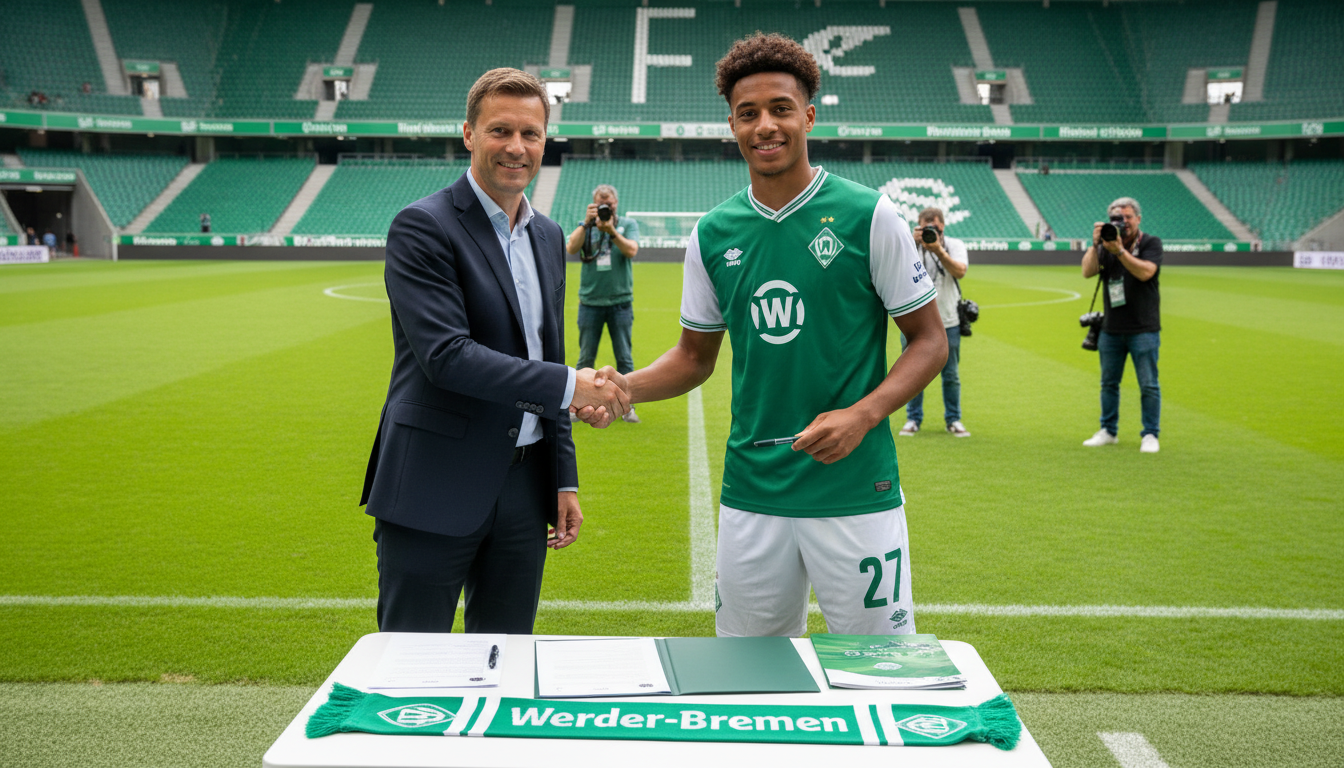
Werder Bremen sign Kenny Quetant from Le Havre on free transfer
Werder Bremen have signed 19-year-old Kenny Quetant from Le Havre on a free transfer, bolstering their attacking options ahead of the 2026–27 season with a tall, pacey forward.


Werder Bremen announced the acquisition of Kenny Quetant, a Paris-born striker developed at Le Havre’s academy, on a long-term deal that makes him the club’s first confirmed signing for the 2026–27 campaign. The club described Quetant as a player with significant potential and the physical attributes to adapt quickly to the Bundesliga. Bremen’s sporting leadership and head coach both highlighted the signing as part of a targeted plan to refresh the squad’s attacking profile.
Deal confirmed and initial reaction
Werder Bremen confirmed that Quetant will join on a free transfer after his contract with Le Havre concluded, with the move officially registered ahead of the summer window. Club officials framed the signing as an investment in a young player who can be integrated gradually into the first team. Sporting director Peter Niemeyer welcomed Quetant, noting the player’s technical skills and long-term upside for Bremen’s project.
Head coach Daniel Thioune also signalled clear intentions to work on Quetant’s development within his tactical setup. Thioune described the new arrival as a well-rounded striker who brings pace and movement to complement existing forwards. The club’s public statements emphasised both patience and ambition: Quetant will be given time to adapt while being prepared to contribute when opportunities arise.
Player profile and playing style
Kenny Quetant stands at 1.89 metres and is described as a technically comfortable forward with notable acceleration for his size. He emerged through Le Havre’s renowned youth system, which has produced multiple top-level professionals, and carries the profile of a modern centre-forward capable of holding play and making penetrating runs. Observers have highlighted his ability to link with team-mates and his willingness to work in transitional phases.
Quetant’s physical presence makes him a natural target in the box, but his speed also allows him to operate in spaces behind the defence. The young striker combines off-the-ball movement with a developing finishing repertoire, traits Bremen will aim to refine through targeted coaching. Werder’s staff see him as a long-term option who can be adapted to various attacking roles depending on match demands.
Development path at Le Havre
Quetant made his first-team debut for Le Havre in December after progressing through the academy ranks in Paris and Normandy. He broke into senior football gradually, making ten appearances for Le Havre’s senior side in competitive fixtures during the season. His breakthrough included a notable early-season home goal in Ligue 1 against Angers, which marked a milestone in his transition from academy prospect to senior contributor.
Despite showing promise, Quetant’s minutes were limited later in the season, with his last senior appearance coming in mid-March as Le Havre navigated a campaign that left their league status under scrutiny. The club experience provided him with exposure to a high tactical standard and the physical demands of top-flight French football, laying a foundation Bremen believe they can build upon.
Contract length and club expectations
Werder have committed Quetant to a long-term contract designed to provide stability as he adjusts to German football and the club’s training regime. While the club has not publicly disclosed the exact contract length or financial details, officials emphasised the strategic nature of the deal: a low-cost acquisition with potential for significant sporting return. Bremen’s front office framed the signing as part of a broader recruitment approach that prioritises young talents with upward trajectories.
Expectations within the club are measured but optimistic, with a focus on steady progression rather than immediate pressure to deliver. Quetant’s own statements on joining Bremen stressed his desire for playing time and adaptation to the Weserstadion environment. The club will manage his integration carefully, balancing competitive exposure with development training to accelerate his readiness for Bundesliga action.
Tactical fit under Daniel Thioune
Under Thioune’s leadership, Werder have sought versatile attacking options that can press high, link play effectively, and exploit transitional moments. Quetant’s combination of size and speed fits that blueprint, offering Thioune an alternative to more established forwards who favour different strengths. The coach intends to assess Quetant in training and pre-season matches to determine where he best complements the existing strike force.
Quetant’s potential role could include starting as an impact substitute to exploit tiring defences, or rotating in as a partner in systems that require a larger target man alongside quicker forwards. Thioune highlighted the player’s technical base and athleticism as assets that can be moulded into the squad’s tactical patterns. The club’s technical department will monitor his adaptation across positional drills, pressing schemes, and set-piece responsibilities.
Implications for Werder Bremen’s transfer strategy
The free signing of a high-upside teenager signals Bremen’s continued appetite for identifying and securing young talent with manageable financial risk. By targeting academy graduates from strong development pathways, the club aims to refresh its roster while preserving transfer flexibility. Quetant’s arrival may also influence recruitment priorities in other attacking areas, as the staff gauge whether further reinforcements are needed or whether internal options can cover next season’s demands.
The move underscores Bremen’s willingness to look beyond established markets and to bet on players with discrete but promising track records. If Quetant fulfills his potential, the club could benefit both on the pitch and in future transfer market value. The signing complements a roster-building philosophy that balances immediate competitiveness with a long-term developmental horizon.
Supporter and stadium expectations
Quetant expressed enthusiasm about joining Werder and the prospect of playing at the Weserstadion, citing both the club’s history and the fans’ reputation as motivating factors. Supporters who follow youth prospects will likely follow his early appearances closely, especially during pre-season friendlies and domestic cup fixtures. Bremen’s fanbase has a history of welcoming young talents who show commitment and promise, providing a supportive environment for Quetant’s early steps.
The club will also leverage the stadium’s atmosphere to ease his transition, offering opportunities for controlled exposure to large crowds before thrusting him into high-stakes fixtures. Community engagement, language support, and integration programs will form part of the off-field plan to help the Paris-born forward settle in Bremen. Those measures are intended to speed up his acclimatisation so he can contribute on matchdays with confidence.
Final paragraph
Kenny Quetant’s move to Werder Bremen represents a calculated addition to the squad ahead of the 2026–27 season, blending youthful potential with physical attributes suited to the Bundesliga, and the club will now focus on preparing him to make the step from promising academy product to effective first-team striker.