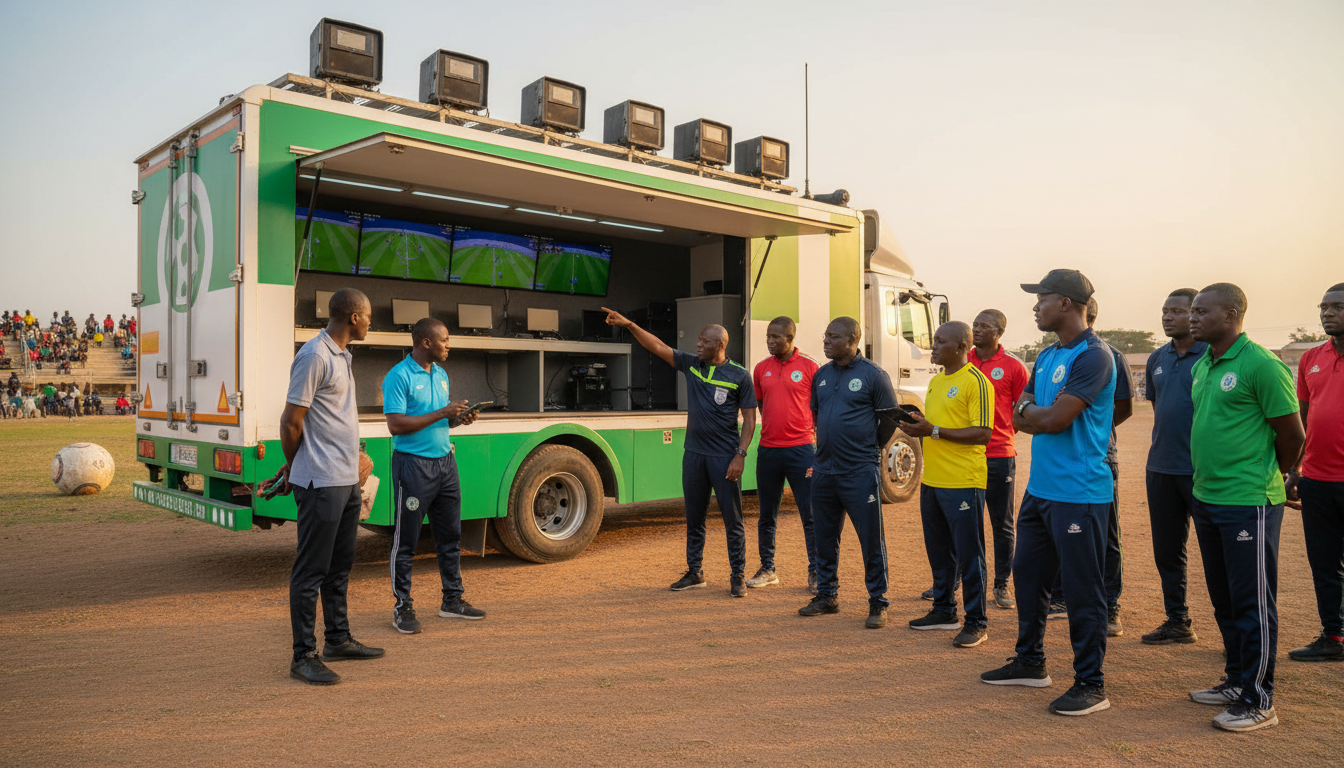
NFF pledges mobile VAR training truck to raise officiating standards across WAFU‑B
Nigeria Football Federation commits a mobile VAR training truck to deliver VAR training across WAFU‑B, aiming to upskill referees and strengthen women’s football pathways.


Alhaji Ibrahim Musa Gusau, president of the Nigeria Football Federation and leader of WAFU‑B, announced a plan to acquire a dedicated truck to transport Video Assistant Referee equipment for use across the West African subregion. The pledge came at the opening of a three‑day CAF Women’s Football Administrators workshop in Abuja and positions VAR training at the center of efforts to professionalize officiating across the zone. The NFF says the initiative will target both male and female referees and seeks to bring practical VAR training directly to member federations that currently lack access to equipment and structured instruction.
Gusau announces acquisition of mobile VAR transport
Alhaji Ibrahim Musa Gusau framed the truck purchase as a practical response to a persistent logistical barrier: the VAR kit is currently based at the zone headquarters in Abidjan and is not readily available for rotation among member nations. He said the dedicated vehicle will carry the technology needed for hands‑on instruction, allowing referees to train on the systems they will encounter in competitive matches. By moving equipment to national associations, the plan aims to reduce travel costs for trainees and accelerate the spread of VAR competency across WAFU‑B.
The NFF’s commitment reflects a broader push to close the gap between technology and human resources, where having the hardware in a region has not translated into widespread procedural familiarity. Officials described the truck as more than a transport vehicle; it will function as a mobile training unit equipped to host classroom sessions and on‑field simulations. The intent is to create predictable, scheduled visits to member federations so training can be integrated into domestic referee development calendars.
Operational questions remain part of the planning process, including the truck’s configuration, power and connectivity solutions for remote venues, and a rotation timetable to ensure equitable access. NFF and WAFU‑B representatives indicated these practicalities will be resolved in coordination with national associations and CAF instructors who can advise on equipment handling and curriculum. The success of the scheme will depend on logistics, maintenance funding and clear governance for scheduling the mobile unit among the seven countries of WAFU‑B.
VAR training for men’s and women’s referees
Gusau emphasized that the VAR training program will intentionally include both male and female match officials, addressing a recognized disparity in access to high‑level refereeing education. The mobile format is intended to deliver the same standard of technical and operational instruction to women referees who historically have had fewer opportunities to work with VAR systems. Officials noted that parity in training is essential if domestic women’s leagues and international fixtures are to adopt VAR effectively and fairly.
Participants at the Abuja workshop were told the curriculum will cover operational protocols, communication between on‑field referees and VAR operators, review procedures and the ethical framework that governs use of video assistance. CAF instructors at the workshop will help shape the program so that it reflects continental best practice while remaining adaptable to local conditions. The NFF plans to monitor outcomes from the initial training cycle and refine the syllabus based on feedback from trainees and match observers.
Building local capacity to operate and maintain VAR equipment was presented as a complementary objective to the instructional agenda, with the aim of creating a sustainable pool of certified VAR technicians in the zone. Training technicians locally reduces dependence on external providers and shortens response times when equipment requires servicing during competitions. Officials stressed that sustainability measures will include train‑the‑trainer modules so national federations can run their own refresher courses between visits by the mobile unit.
Abuja workshop stresses grassroots pathways for women’s football
At the same event, Gusau challenged heads of women’s football from the seven WAFU‑B countries to intensify work at grassroots level to build pipelines of talent that progress from youth to senior ranks. He argued that technical investment such as VAR training must be paired with structural development—talent identification, coaching education, league organization and school‑based programs—to produce a steady flow of women players and officials. Delegates were urged to adopt targeted policies to nurture young women players and create clearer pathways into professional football and national teams.
The CAF Women’s Football Administrators workshop, attended by commissioners and administrators from across the zone, served as a forum to exchange best practices on administration, competition management and development strategies. Facilitators included experienced practitioners from across the continent and beyond, offering a mix of tactical, logistical and governance advice. Organizers said the workshop’s objective was to ensure that administrative leadership is aligned with technical initiatives like VAR training so that improvements in officiating translate into improved competition standards for women’s football.
Delegates were encouraged to return home with actionable plans and to embed lessons from the workshop into their national development plans. NFF General Secretary Dr Mohammed Sanusi underscored the importance of attention to detail, asking participants to apply workshop materials and recommended processes within their federations. The emphasis on implementation placed responsibility on national administrators to convert ideas from Abuja into measurable activities and outcomes.
WAFU‑B executive praises initiative and foresees refereeing improvement
Mr Philippe Tchere, Executive Director of WAFU‑B, described the NFF pledge as a significant development for refereeing in the subregion and welcomed the prospect of more regular, practical VAR instruction. He told participants that transporting equipment to member countries would remove a substantial barrier to training and said the move would be a positive step toward consistent refereeing standards across WAFU‑B. Tchere framed the initiative as complementary to CAF’s broader referee education programs and a hopeful sign for a more uniform application of match‑deciding technology.
Local leaders who work directly in football development also voiced optimism. Nigeria’s Precious Dede, WAFU‑B’s Football Development Manager and a former international goalkeeper, will play a facilitation role at the workshop and highlighted the potential for improved officiating to uplift domestic competitions. She and other trainers will lead practical sessions aimed at familiarizing referees with VAR workflows, signal protocols and the decision‑making dynamics that arise during complex match situations. Trainers at the Abuja meeting combined continental experience with a focus on adapting instruction to the realities of West African football environments.
The endorsement by WAFU‑B executives signals a desire to coordinate resources and align priorities across federations, particularly for a technology that disproportionately affects match outcomes at the highest levels. Stakeholders suggested that harmonized training will reduce inconsistent interpretations and lead to greater referee confidence when VAR is deployed in regional tournaments and domestic leagues.
Facilitators and governance to shape training delivery
A team of instructors drawn from CAF and national federations will lead the initial training rollout, combining international refereeing perspective with local knowledge. The workshop facilitators named for the Abuja conference included Jules McGeever from England and Thuba Sibanda from Zimbabwe, both CAF instructors, working alongside Nigerian specialists and development staff. CAF’s Head of Women’s Football, Goshime Meskerem, and WAFU‑B Women’s Football Commission President Amina Amani attended the opening sessions, signaling continental oversight of the program’s design and delivery.
Governance arrangements for the mobile VAR unit will be critical to ensuring predictable access and transparent scheduling among member associations, officials said. The NFF and WAFU‑B will need to agree procedures for requests, risk management, customs and importation rules when equipment crosses borders, as well as insurance and security for the vehicle and kit. Organizers emphasized that early establishment of clear governance and cost‑sharing mechanisms would mitigate disputes and create a replicable model for similar regional initiatives.
Training quality will be evaluated through participant assessments, observation reports and follow‑up supervision during domestic matches where trained referees operate. The NFF indicated it would collect data on trainee performance and use that evidence to inform future visits and curriculum adjustments. This results‑oriented approach is intended to ensure that teaching translates into measurable improvements in refereeing performance on the field.
Logistical and financial considerations for mobile VAR operations
Officials acknowledged that acquiring a truck and equipping it as a mobile VAR classroom represents only the first step; ongoing operational funding and technical support will determine long‑term viability. Costs associated with vehicle procurement, retrofitting, fuel, drivers, technicians, customs clearance and equipment maintenance all require predictable budget lines. The NFF suggested it would work with WAFU‑B member associations and CAF to explore collaborative funding models and possible sponsorship to defray recurring expenses.
Technical challenges such as internet bandwidth, power supply at training venues and compatibility with local tournament broadcasting setups were identified as practical issues to resolve. Trainers noted that simulation exercises can be designed to accommodate limited connectivity, but that long‑term effectiveness depends on strengthening infrastructure for live VAR operations. Member associations with constrained resources were told that the mobile unit would provide interim access while federations plan for permanent systems in major stadiums.
A phased deployment was suggested by workshop leaders, beginning with demonstration visits to priority nations and then expanding coverage as trainers, technicians and funding are secured. This staged approach would allow organizers to test procedures, gather feedback and refine operational protocols before committing to a full rotation schedule. Participants were urged to prioritize sites where upcoming competitions and strong referee cohorts could benefit most from immediate intervention.
Nigeria’s General Secretary urged participants at the workshop to use the sessions to gather practical ideas and return home with concrete plans to strengthen the women’s game and referee development. He highlighted the need for disciplined follow‑through and the translation of workshop recommendations into national policies and programming. The emphasis on accountability reflects an intent to ensure the mobile VAR initiative forms part of an integrated development strategy rather than an isolated project.
This pledge from the NFF aims to close a notable gap between the availability of VAR technology and the human capacity to use it effectively in West Africa. By combining mobile VAR training with administrative reforms and grassroots measures for women’s football, the initiative seeks to create a more consistent, fair and professional refereeing environment across WAFU‑B. The coming months will show whether the logistical, financial and governance solutions discussed in Abuja can be translated into regular, high‑quality training that elevates officiating standards throughout the subregion.