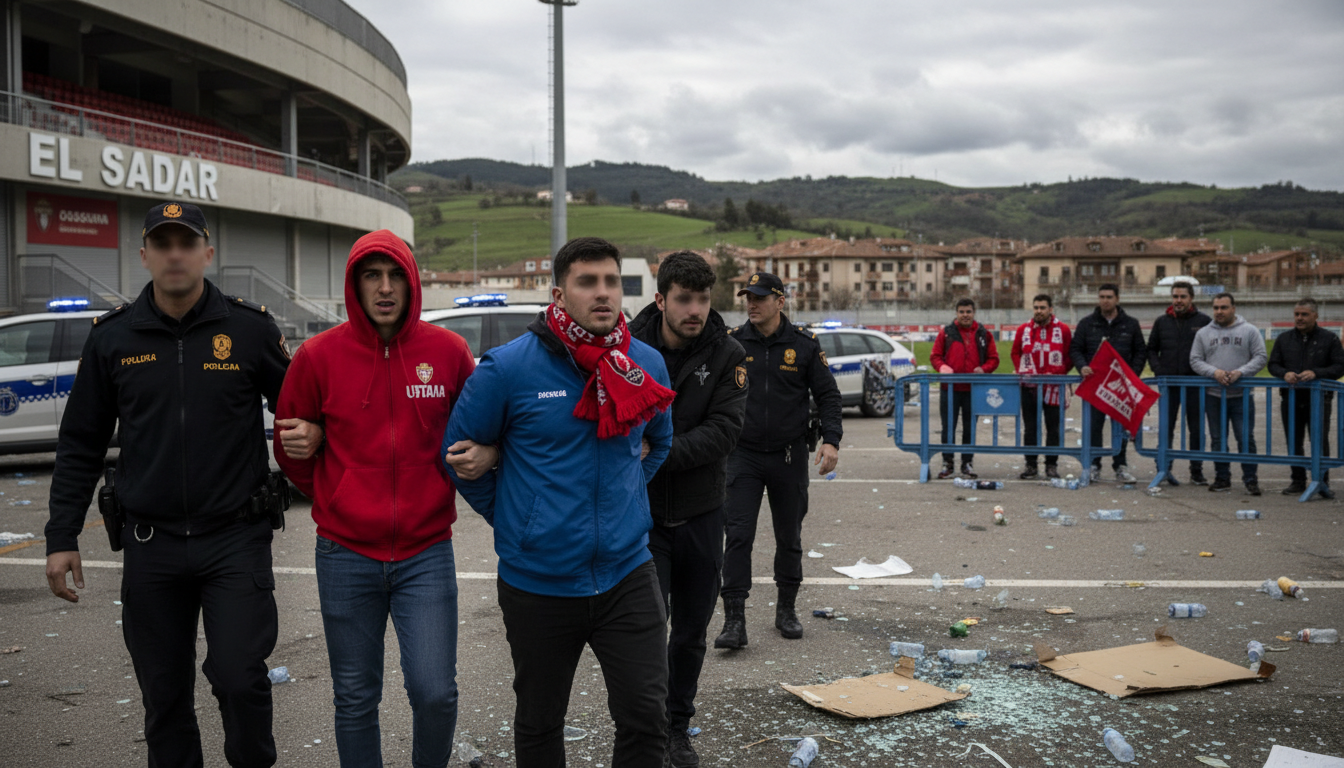
Eight Osasuna ultras detained after El Sadar clashes with police
Eight Osasuna ultras detained in Navarra after clashes with police following the Osasuna–Real Madrid match at El Sadar on February 21; investigation remains active.


The National Police in Navarra have detained eight men linked to the Indar Gorri ultras after public disorder and attacks on officers following the Osasuna–Real Madrid match at El Sadar on February 21. The arrests form part of an active operation led by the Provincial Information Brigade of the Navarra Police, which investigators say has already produced previous detentions in March and on the day of the match. The arrests are focused on alleged assaults against members of the Unidad de Intervención Policial (UIP) and other public order offences connected to disturbances outside the stadium.
Details of the recent arrests
The eight men now in custody are residents of different towns in Navarra and are identified by police as members of the Indar Gorri ultras group associated with CA Osasuna. Authorities have charged them with public disorder and offenses against law enforcement after identifying them as participants in violent episodes near the stadium perimeter. Police say the suspects actively engaged in coordinated attacks against officers and encouraged others in the stands to join confrontations around gate 23.
Investigators describe a sequence in which the group, after leaving the seating area, rallied other supporters to form a group of about 30 people that confronted police outside the stadium. According to official statements, that assembled group threw heavy objects and rubbish bins at three members of the UIP, forcing reinforcements to intervene to secure the exit and protect officers. The operation by the Provincial Information Brigade remains ongoing as authorities continue to question those detained and gather evidence.
How police say the confrontation unfolded
Police accounts indicate the disturbances began when private security staff at Osasuna requested assistance because a large group attempted to prevent identification of a spectator who had allegedly thrown a bottle onto the pitch. The request for support prompted the UIP to enter the stadium, where officers say they were met with resistance from fans who refused to allow the identification to proceed. When officers pushed to restore order, police say they were attacked and forced to use available means to repel the assaults.
Authorities report that three UIP officers suffered attacks from projectiles and physical aggression near gate 23, and needed aid from additional units to clear the area. Law enforcement sources say the actions of the detained men included both direct physical assault and instigation of crowd violence that endangered both officers and bystanders. The police statement cited the throwing of objects and obstruction of exit routes as aggravating factors that shaped the charges brought against the suspects.
Earlier detentions and the scope of the investigation
Police noted that the current operation follows a series of earlier arrests tied to the same incidents: two people were detained on the day of the match and four more were arrested in March. The latest eight detentions bring the number of suspects connected with the incident to at least fourteen, according to the official account. Investigators say their work includes witness interviews, review of stadium camera footage, and coordination with Osasuna’s security staff to identify those responsible.
The Provincial Information Brigade is coordinating forensic and testimonial evidence to build cases that prosecutors can pursue in the coming weeks. Officials have emphasized that the investigation targets those who crossed the line into violence and obstructed police duties, rather than general supporters, while also noting that inquiries will determine individual roles and degrees of culpability. Police added that operations of this nature typically continue until investigators are satisfied that all those responsible have been identified or until judicial authorities request further steps.
Osasuna club response and planned legal involvement
Club Atlético Osasuna has indicated it will appear in the judicial proceedings to protect the rights of its members and to ensure due process for anyone connected to the case. The club’s announcement follows public criticism from some sectors of the osasunismo about how police actions were conducted inside the stadium. Osasuna’s move to formally join the legal process signals the club’s intent to monitor the investigation closely and to represent the interests of season-ticket holders and other affected supporters.
Club spokespeople have emphasized a commitment to safety and the rule of law while also expressing concern for supporters’ rights during police interventions. Osasuna is expected to cooperate with law enforcement and provide access to security footage and steward testimony, while reserving the right to contest elements of the police account where club security reports differ. The decision to intervene legally underlines the sensitive balance between crowd control, spectator safety, and civil liberties in high-profile matches.
Legal implications and possible charges facing the detainees
The suspects face accusations of public disorder and offenses against authority, which in Spain carry penalties that vary according to the level of violence, damage caused, and whether weapons or dangerous objects were used. Assaults on law enforcement are treated seriously and can lead to custodial sentences if proven in court, while public disorder charges may combine fines and restrictions. Prosecutors will assess evidence such as video, steward statements, and forensic reports to define formal charges.
Defendants in such cases retain the right to legal representation and to contest the facts in judicial proceedings that may include preventative measures such as bail or restraining orders. The judge assigned to the case will decide on provisional measures and whether to open a full trial based on the material presented by police and the public prosecutor. Legal sources note that outcomes can range from negotiated penalties to criminal proceedings, depending on the strength of the evidence and the individuals’ prior records.
Security, policing and supporter relations after El Sadar disturbances
The El Sadar incidents have reignited debate over crowd management at football matches and the role of both private security and national police units in stadium operations. Supporters’ groups and club officials have raised questions about proportionality and communication when law enforcement enters spectator areas, while police argue that swift action is sometimes necessary to prevent escalation. The dispute highlights ongoing tensions between fan culture and public order obligations at high-stakes fixtures.
Experts in stadium safety emphasize the need for clear protocols that define when private stewards should escalate issues to police, and how officers should act to minimize risk to bystanders. They also stress the importance of evidence-led investigations after violent episodes to establish accountability without criminalizing entire supporter groups. Clubs, supporter organizations, and police forces across Spain will likely review procedures to reduce the chance of similar confrontations in future high-profile matches.
Investigations such as this one also carry reputational consequences for clubs and fans, with possible sanctions from governing bodies if crowd disturbances are confirmed. Authorities say they will weigh both criminal and administrative options as the probe advances, and both local prosecutors and sports authorities may monitor developments. The outcome will be watched closely by clubs and security services nationwide as part of broader efforts to improve spectator safety and policing cooperation.
The National Police operation in Navarra remains active as officers continue to gather evidence and question those detained in connection with the February 21 disturbances at El Sadar.