Sevilla relegation threat grows as club faces civil war, failed transfers and a weakened youth pipeline
Sevilla relegation looms as the Andalusian club battles boardroom turmoil, failed transfers and a stalled youth system with five matches remaining and fading faith.


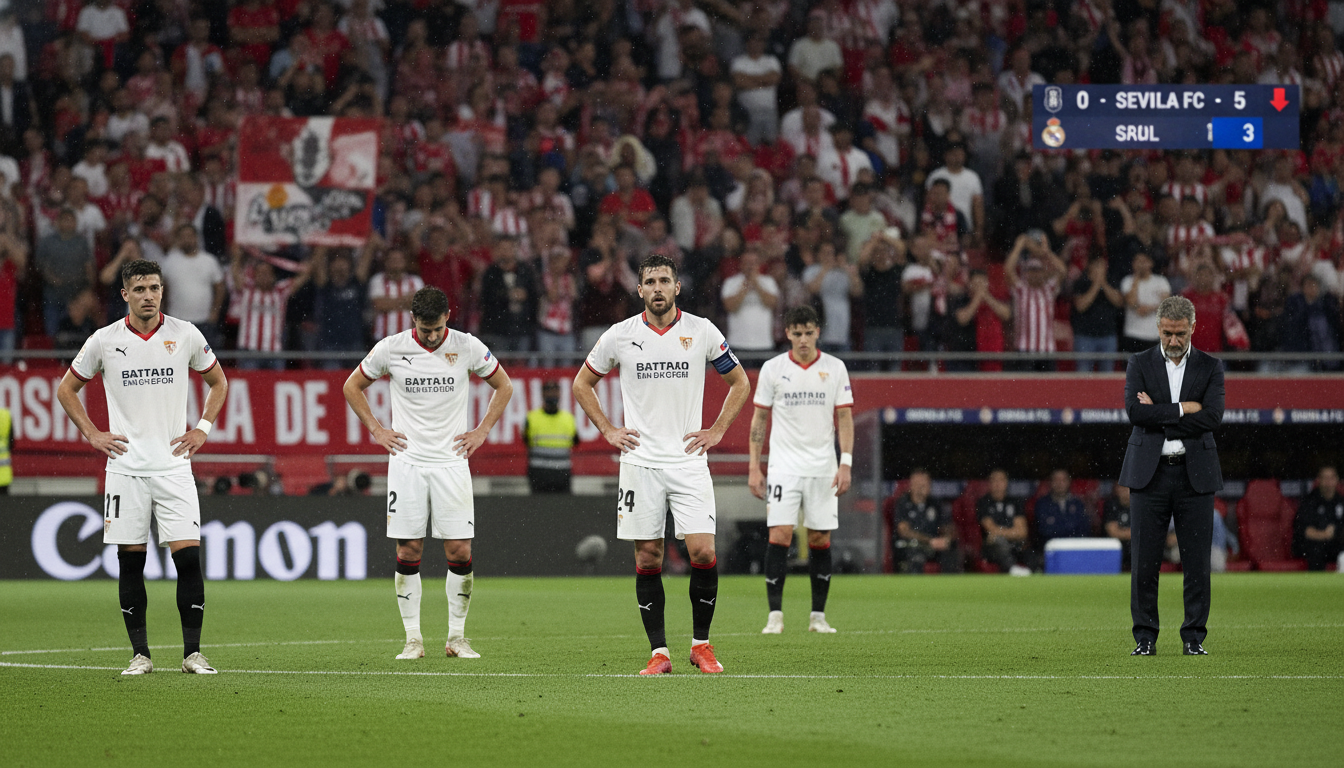
Sevilla sit perilously close to relegation after a season that has seen the club slide from European contender to domestic struggler. The threat of Sevilla relegation hangs over Nervión as internal disputes, poor recruitment and a decayed academy model have combined to produce one of the most dramatic downturns in recent Spanish football. With only a handful of league fixtures left, the club faces a defining fortnight that will determine whether it survives in La Liga or begins a painful reconstruction in the Segunda.
Sevilla on the brink with five matches left
Sevilla enter the final stretch of the season needing results to avoid the automatic drop to the second division. The team’s league position reflects months of inconsistent performances and a squad that has failed to perform to the level expected of a club with continental pedigree. Fans and analysts alike now treat relegation as a plausible outcome rather than an improbable catastrophe.
The timing is brutal: every remaining match becomes a high-stakes test for players, coaching staff and the board. Failure over the next five games would leave the club with little margin for error in any potential playoff or late-season turnaround. The pressure will not only be on the pitch but also in the boardroom, where decisions taken months ago are being scrutinized under a harsh spotlight.
From European glory to domestic decline
Sevilla’s history in continental competition is one of the most successful outside Spain’s traditional giants, a legacy built on smart scouting and managerial appointments. That success made the club synonymous with Europa League glory and elevated it to a standard that masked underlying structural weaknesses. Recent seasons have exposed those weaknesses, and the gap between past achievements and current capacity has never been more apparent.
Where once Sevilla turned modest signings into valuable assets, recent transfer windows have produced few clear successes. The lack of profitable sales and the burden of long-term contracts have constrained the club’s ability to rebuild quickly. As a result, the squad resembles that of a mid-table survival side rather than the European contender supporters remember.
Boardroom conflict and its fallout
Leadership disputes and public disagreements at the highest level have sapped the club’s stability and focus during a critical period. Internal feuds have distracted from long-term planning and undermined confidence in sporting project decisions. When governance is fractious, recruitment, youth development and managerial appointments often suffer the consequences.
The fallout has been measurable on the pitch through a lack of coherent strategy and visible erosion of institutional trust. Executives and sporting directors have faced increased scrutiny, and every poor result has intensified calls for accountability. In this environment, quick fixes are tempting but rarely deliver sustainable improvement.
Misfiring recruitment and financial strain
The pattern of scouting and signings that once defined Sevilla’s success has faltered, leaving the squad with limited resale value and few standout performers. Several incoming players have struggled to adapt or failed to match the club’s historical transfer returns. Coupled with a stricter salary cap environment, these missteps have tightened the margin for correcting course midseason.
Financially, the club is constrained by contracts that now carry more burden than benefit, limiting options in the January and summer windows. The inability to convert players into profit has also impeded reinvestment into the squad or the academy. The cumulative effect is a roster that lacks depth and the financial flexibility to recruit the kind of immediate impact signings needed to stave off relegation.
Erosion of the youth pathway and identity
Sevilla’s academy once produced homegrown talents who became club icons and valuable assets for the first team and the transfer market. Over time, however, investment in the cantera has waned and production has slowed, leaving fewer academy graduates to shoulder the club’s revival. The absence of a reliable pipeline has forced greater reliance on external recruitment, which has not delivered.
The loss of local role models and fewer opportunities for academy players to step into senior roles have weakened the club’s cultural continuity. Without a steady stream of homegrown talent, Sevilla’s identity—rooted in a blend of local development and savvy scouting—has become blurred. Rebuilding that pathway will be essential but will require sustained investment and patience.
City split as Betis enjoys the sun
The city of Seville finds itself in an unusual footballing divergence, with local rival Real Betis enjoying relative stability while Sevilla wrestles with crisis. That contrast sharpens the sense of grievance among Sevilla supporters and amplifies the stakes of the current run-in. Local pride and civic identity add a further emotional layer to the sporting consequences.
Derby dynamics will now carry extra weight in the city’s narrative, with every encounter serving as a barometer of each club’s direction. For Sevilla, reclaiming dignity in head-to-head matches would be a temporary balm, but it cannot substitute for the structural reforms required to secure long-term competitiveness.
The forthcoming fixtures present both a survival test and a mirror for the club’s deeper issues. Tactical adjustments and motivational lifts can yield short-term results, but lasting recovery demands clarity at the top, smarter recruitment and a renewed commitment to youth development.
Supporters’ patience has worn thin after a season of false dawns and missed opportunities. The task before Sevilla is to translate urgency into coherent action rather than reactionary decisions that merely paper over systemic problems.
If relegation becomes reality, the club will confront complex questions about leadership, financial strategy and sporting philosophy. A drop to the Segunda would be painful and costly, yet it could also offer a reset that forces difficult but necessary restructuring.
Should Sevilla survive this season, the next months will still require a thorough audit of recruitment, coaching and academy policies. Avoiding immediate catastrophe will not erase the need for a long-term plan that restores the club’s identity and competitive foundations.
The coming weeks will define whether Sevilla’s crisis is a temporary stumble or the start of a deeper decline. Fans, players and directors face a narrow window to alter course, and the choices made now will shape the club’s trajectory for years to come.