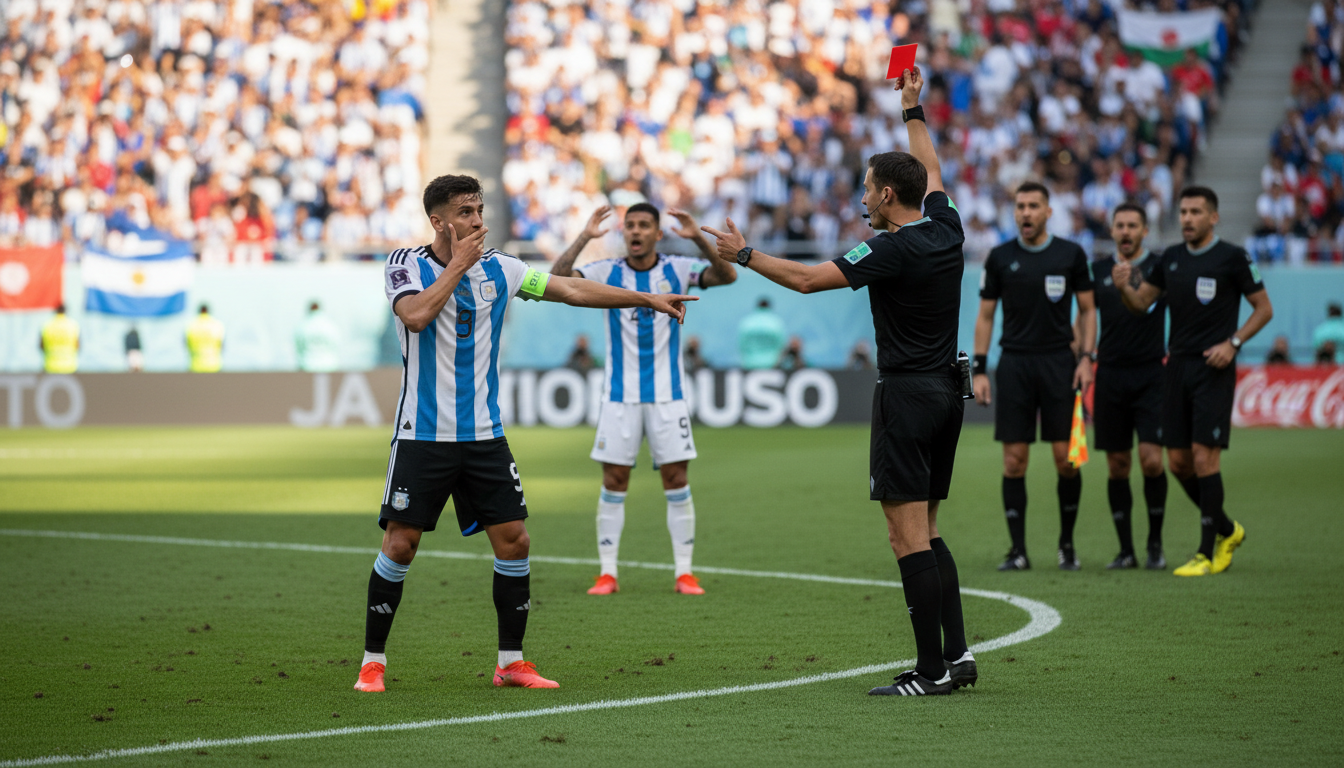
Ifab red card rules approved for mouth-covering confrontations and pitch departures ahead of 2026 World Cup
Ifab approves red-card rules allowing dismissal for players who cover mouths and for teams leaving the pitch; FIFA will apply changes at the 2026 World Cup.

Ifab confirms red-card sanction for mouth-covering and for leaving the field
The International Football Association Board announced new rules on Wednesday that allow referees to issue red cards to players who cover their mouths during confrontations and to anyone who leaves the field without the referee’s permission. The Ifab, which oversees the laws of the game, said the changes were agreed at its meeting in Vancouver and will be circulated to competition organisers and national associations. The move is intended to give match officials clearer authority to sanction conduct that obstructs transparency or undermines on-field control.
Ifab’s statement made clear that application will rest partly with competition organisers, but that the legal framework now permits dismissals in those specific situations. The board’s membership includes the four British associations and FIFA, which means the decision carries authority across most levels of the sport. Officials framed the amendments as targeted interventions rather than broad alterations to established disciplinary practice.
FIFA to implement Ifab reforms for the 2026 World Cup
FIFA confirmed it will adopt the Ifab reforms for the upcoming World Cup set to begin on June 11, 2026, in Mexico City. The tournament, which will be staged across the United States, Canada and Mexico and will feature an expanded 48-team format, will be the first major competition to apply the new measures at scale. FIFA said adjustments to match operations and disciplinary guidance are already under way to ensure consistent interpretation at venues across three countries.
The adoption by FIFA signals rapid operational changes for referees, team staff and competition organisers ahead of the tournament. Organisers will receive the amendments directly and are expected to provide briefings and additional instructions to match officials, while teams will be informed about the behaviours that can now lead to immediate dismissal.
Incidents that prompted the rule changes
Recent high-profile episodes influenced the timing and content of the Ifab reforms, notably a Champions League confrontation in February involving Real Madrid’s Vinícius Júnior and Benfica’s Gianluca Prestianni. That exchange, in which a player covered his mouth during a heated on-field dispute and was later disciplined by competition authorities, was cited as a motivating example for the new mouth-covering provision. European organisers issued a six-game ban in that case after determining the conduct constituted a form of verbal abuse.
Another trigger was the late controversy in the Africa Cup of Nations final, when Senegal’s coach ordered his team off the pitch in protest after a penalty was awarded to Morocco. The walk-off delayed the match and led to disciplinary and legal disputes that culminated in an appeal at continental level and a pending challenge to decisions at the Court of Arbitration for Sport. Ifab members said the new rule on leaving the field addresses the competitive and safety risks created when teams or officials attempt to force an interruption.
Disciplinary and competition rule adjustments beyond red cards
Alongside the red-card provisions, FIFA announced tournament-specific changes to yellow card management for World Cup 2026, reflecting the expanded format. Single yellow cards accrued during the three-game group stage will be cleared before the knockout phase, and a second amnesty will cancel single yellows again after the quarterfinals. The aim is to reduce the risk that players miss later, decisive matches because of earlier cautions in a tournament with an additional knockout round.
Competition organisers emphasized that these changes are designed to balance disciplinary deterrence with the practical realities of a longer tournament. By clearing single cautions at two distinct points, tournament administrators intend to limit suspensions derived only from accumulation while preserving sanctions for more serious or repeated misconduct.
Refereeing guidance and enforcement challenges
Referees will receive new guidance to help apply the mouth-covering and pitch-departure rules consistently, but practical enforcement presents clear challenges. Determining intent when a player covers a mouth in the heat of a confrontation requires context, and officials will be asked to use discretion in assessing whether the act was intended to conceal abuse. Ifab’s text allows competition organisers to set stricter interpretations, meaning enforcement could vary across leagues and tournaments.
Officials will also confront pressure-circuit scenarios where team staff encourage players to leave the field or where mass withdrawals test the limits of control and safety. The new rule explicitly extends to team officials who urge players to leave the field, placing responsibility on managers and backroom staff to avoid creating a situation that could lead to dismissal and further disciplinary action.
Implications for teams, players and coaching staff
Clubs and national teams will need to update internal protocols and pre-match briefings to reflect the risk of immediate dismissal for specific conduct. Coaches and technical staff are being warned that actively encouraging a team to vacate the pitch can carry the same on-field consequence as a player walking off. Legal and sporting departments across federations will likely revise codes of conduct, matchday instructions and crisis response plans in the weeks ahead.
Players must also be made aware that gestures previously treated as minor or ambiguous may now incur the most severe in-game penalty. The potential for varied enforcement across competitions increases the importance of education; teams competing in the World Cup will be briefed directly by FIFA to try to create uniform understanding before the tournament starts.
Reactions from federations, players and supporters
Responses to the Ifab decisions have been mixed among stakeholders. Some national associations and anti-discrimination advocates praised the mouth-covering provision as a tool to deter and penalise covert offensive language and abusive behaviour. Others cautioned that enforcement could be uneven and urged clear, practical guidelines to prevent inconsistent red-card decisions that might affect key matches.
Player unions and coaching associations focused on the rule covering walk-offs, stressing the need for measured responses to contentious refereeing decisions rather than spontaneous protests. Supporters’ groups expressed concern about how these changes might affect fan reactions and sideline tensions, calling on organisers to pair disciplinary change with education campaigns aimed at coaching staff, players and spectators.
Operational preparations for a 48-team World Cup
Operationally, the 2026 World Cup’s expanded format complicates match management while increasing the stakes of consistent officiating. With 12 groups and a new last-32 knockout round, tournament authorities are balancing the added competitive opportunities with a need to protect the integrity of matches. FIFA’s amendments to yellow card clearances are part of a broader package of measures intended to reflect the longer schedule and greater number of fixtures.
Tournament organisers will also adjust referee appointment protocols, matchday security and team liaison practices to address incidents quickly when they arise. Venue officials and confederation representatives are being briefed to ensure that any red-card decision linked to mouth-covering or pitch departures is supported by immediate procedures for appeals and post-match reviews.
The World Cup’s global visibility means contested decisions will be scrutinised internationally, and both Ifab and FIFA have indicated they will monitor the application of the new measures closely. Performance data, referee reports and disciplinary outcomes from the tournament are likely to inform whether the amendments become standard across other competitions or require refinement.
The steps taken by Ifab and FIFA represent a notable tightening of in-match disciplinary powers aimed at curbing behaviour that complicates refereeing and undermines match control. Teams, referees and officials now face the task of translating those powers into consistent practice in the months leading up to the World Cup.
Fans and administrators should expect targeted education, updated match protocols and a period of adjustment as the sport implements the new rules on a major stage. These reforms are positioned as narrow but impactful changes designed to protect player welfare, ensure accountability and maintain the smooth operation of the game at the highest level.