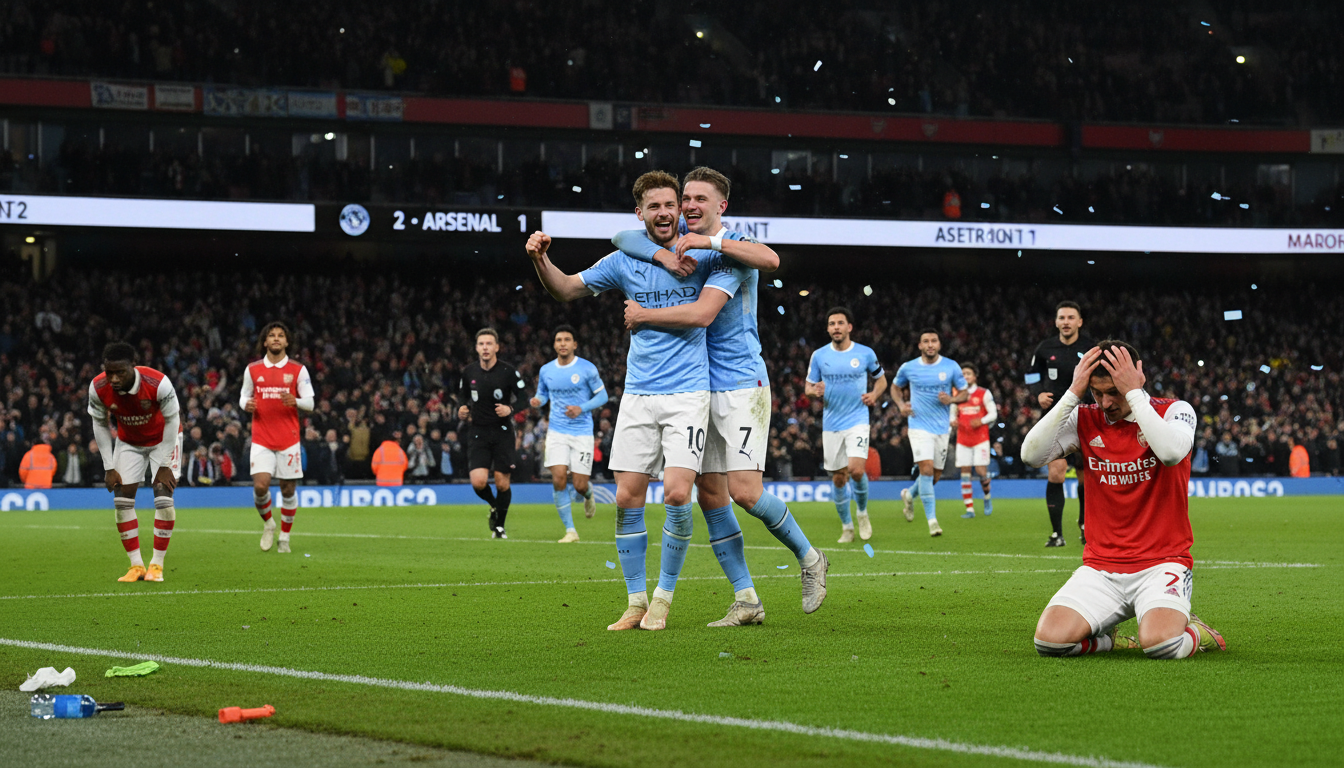
Arsenal title race on knife-edge after 2-1 defeat to Manchester City at Etihad
Arsenal title race tightens after Manchester City beat Arsenal 2-1 at the Etihad on April 19, 2026, leaving the Gunners’ lead vulnerable with five games to play.


Arsenal’s pursuit of a Premier League crown was tested at the Etihad Stadium on April 19, 2026, as Manchester City edged a 2-1 victory that leaves the Arsenal title race hanging by a thread. The Gunners produced a competitive performance and even threatened to rescue a point late on, but Erling Haaland’s decisive goal swung the tie in City’s favour. Arsenal remain in contention, yet the result handed momentum — and the chance to overtake the leaders — to Pep Guardiola’s side ahead of midweek fixtures.
Haaland strike and City’s late winner
Arsenal arrived at the Etihad seeking to arrest a run of mixed results and applied an aggressive press early on, but Manchester City found the decisive moment in the second half. Erling Haaland delivered the match-winner, capitalising on a narrow opening to put City ahead and silence Arsenal’s hopes of a share of the spoils. The goal arrived after sustained pressure from both teams, illustrating how fine margins have become in the title picture.
City’s late goal not only secured three points but also the opportunity to climb to the top of the table when they play again on Wednesday night. The timing of the strike magnified its significance: it turned a game that felt balanced into an immediate swing in the standings. For Arsenal, the decisive moment served as a reminder that good performances do not always produce desired results in a title race this close.
Odegaard’s return and Arsenal’s high press
Martin Odegaard’s return to the starting XI reshaped Arsenal’s approach and gave the midfield greater cohesion than in recent matches. The captain orchestrated an effective high press that frequently won possession in dangerous areas, and Arsenal recovered the ball in the final third multiple times in the opening 25 minutes. That intensity produced tangible attacking opportunities and briefly unsettled City’s rhythm.
Odegaard’s composure on the ball and his decision-making in transition were noteworthy after a period on the sidelines. His presence allowed Arsenal to pair creative movement with forward ambition, enabling Kai Havertz and Eberechi Eze to probe City’s defence. Despite his late-game fatigue, Odegaard described his return as encouraging and signalled he could be available for the run-in.
Chances, misses and the fine margins
Arsenal fashioned several clear-cut chances that might have altered the final outcome, including glaring one-on-one opportunities for Kai Havertz and Gabriel Martinelli and a strike from Eberechi Eze that clipped the post. A high-volume expected-goals figure reflected Arsenal’s threat: they generated one of City’s more dangerous single-match xG totals in recent fixtures. Yet the failure to convert those chances became decisive.
One key moment came from a brief goalkeeping lapse that Havertz reacted to, levelling the game for a period and underlining the match’s swinging momentum. Had Havertz converted another late opportunity in stoppage time, the result would have looked very different. Instead, Haaland’s finish delivered the decisive edge and illustrated how clinical finishing separates contenders at this stage of the season.
Managerial reactions and talk of momentum
Mikel Arteta emphasised belief in his squad after the loss, stressing that the title remains within Arsenal’s control and urging his players to reset for the remaining five fixtures. The manager insisted the team had demonstrated the identity he expects and that confidence in the dressing room remained high despite the defeat. Declan Rice was heard privately repeating “it’s not done,” a sign of internal conviction even as public pressure grows.
Pep Guardiola underlined that momentum in a title race can shift quickly and that isolated results do not capture an entire season’s trend. He cautioned against over-reading a single match while acknowledging the psychological benefit of a victory at this point in the calendar. Both managers framed the result as part of a longer sequence of matches where endurance, consistency and composure will decide the outcome.
Standings implications and scenario for the run-in
Before kick-off Arsenal had occupied first place for 201 consecutive days, but City’s victory means the top of the table could change again imminently. If Manchester City win their next fixture, they will leapfrog Arsenal and seize temporary control of the title race, while Arsenal must respond with maximum points in their remaining matches to keep pressure on. With five league games left for each side, the title could still hinge on small statistical margins such as goal difference and goals scored.
A straightforward scenario is simple points accumulation: if both sides win all remaining matches the championship would ultimately be decided by goals scored and goal difference. City currently boast prolific scorers near the top of the Golden Boot, which gives them an advantage if the hunt comes down to goals. Arsenal, however, retain control of their destiny and must convert performances into results to prevent a late-season reversal that has occurred in recent campaigns.
Fixture lists, opportunity and pressure
The schedule ahead provides contrasting tests for the contenders and could shape the final outcome. Manchester City face trips to clubs with differing forms while Arsenal’s remaining opponents include sides under stress, offering Arsenal potential paths to gather points. Close analysis of both teams’ fixtures suggests neither run-in is straightforward, and slip-ups remain possible for either side.
Arsenal supporters can point to the club’s capacity to produce high-quality performances when fully fit, particularly if Bukayo Saka returns to bolster the attack. A front three featuring Saka, Odegaard and Havertz again would offer more attacking variation and increase Arsenal’s scoring potential. Conversely, City’s depth and their high-scoring forwards pose a continuous threat, meaning every defensive lapse by Arsenal could be costly.
Key statistics and turning points from the Etihad
Several match metrics underpinned the narrative of a closely contested fixture: Arsenal’s high-press recoveries in the attacking third, the xG figure that reflected sustained threat, and the critical finishing that ultimately tilted the match toward City. Individual moments — a goalkeeper error that led to a leveller, a shot that hit the post, and Haaland’s clinical finish — combined to decide a match that otherwise showcased competitive balance.
Those data points also highlight where marginal gains can be found for Arsenal. Improving composure in the final third and converting high-quality chances will be central to their title ambitions. For City, the ability to deliver a decisive moment and rely on proven finishers underlined why they remain perennial challengers in tight league finales.
Looking ahead, Arsenal must channel the positive aspects of their Etihad performance into consistent results over the remaining fixtures to keep the title race open. The defeat is painful but contained to a single match in a broader season-long contest.
The coming weeks will test depth, fitness and nerve as Arsenal and Manchester City navigate a packed schedule and cope with mounting expectations. The title race remains finely poised and likely to be decided by the team that converts pressure into consistent points while minimising costly lapses.