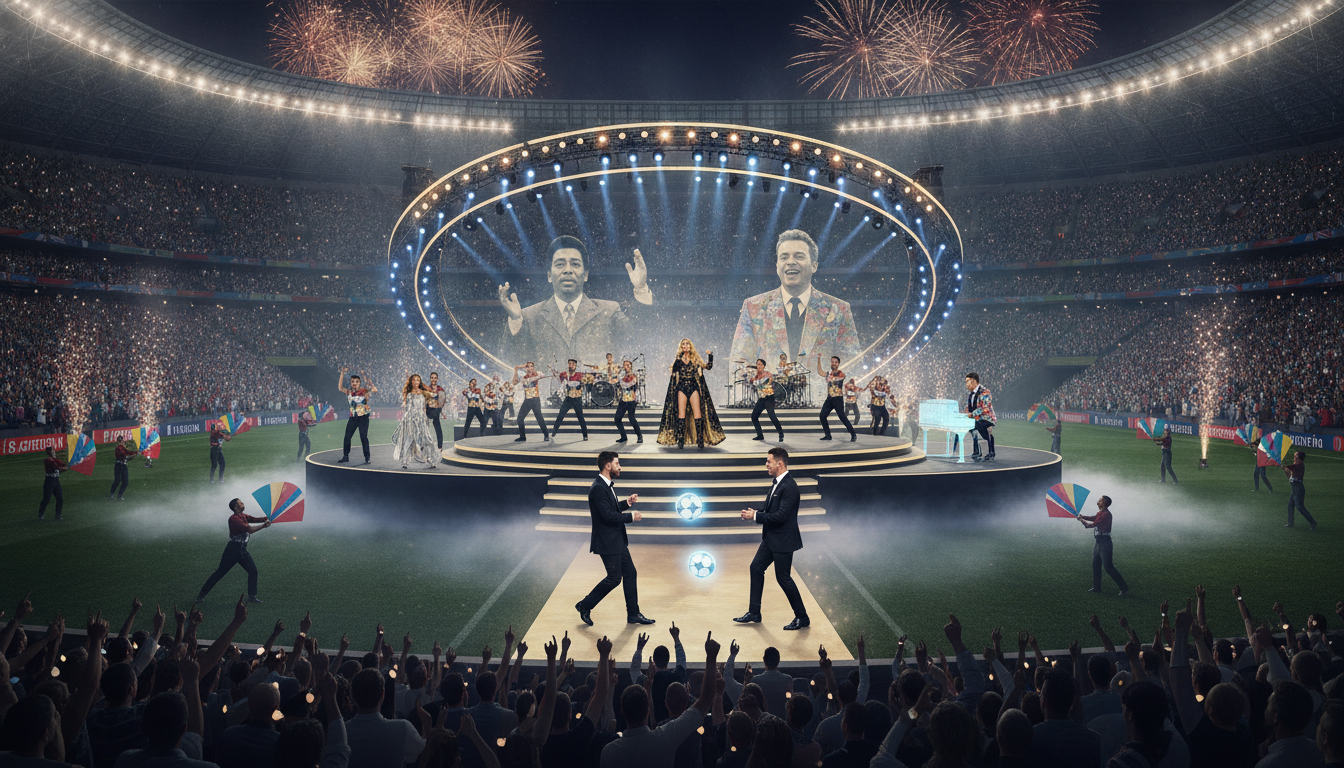
FIFA World Cup half-time show unites Madonna, Shakira, Coldplay and football legends
Star-studded FIFA World Cup half-time show united global artists and football legends at the Spain–Argentina final to raise funds with tributes globally.


The inaugural FIFA World Cup half-time show on Sunday turned the championship final into a cross‑cultural spectacle, bringing top pop stars, football icons and theatrical performers together for a charity-focused performance. The 12-minute production, staged during the Spain–Argentina final, extended the interval and was billed as a historic broadcast event aimed at raising funds for the FIFA Global Citizen Education Fund. Organizers described the sequence as the largest gathering of artists for a cause since Live Aid, while FIFA president Gianni Infantino suggested the show could draw "a couple of billion" viewers worldwide.
Star-Studded Lineup for First Final Half-Time Show
Madonna, Shakira, Justin Bieber, BTS and Coldplay were the headline acts in a program designed to mirror the high-profile entertainment of other global sporting spectacles. Each artist contributed distinct segments that ranged from solo appearances to collaborative reprises, creating a rapid‑fire sequence of performances that blended pop, rock and orchestral elements. The producers positioned the event as the first half-time show of its kind at a World Cup final, aiming to reach both traditional football fans and broader mainstream audiences with a familiar festival-style format.
Brazilian football legends also appeared on stage alongside actors from the television series Ted Lasso, linking the performance to the sport’s cultural and cinematic representations. The inclusion of football icons reinforced the connection between the game and its global entertainers, while the presence of actors signaled an intent to broaden appeal beyond music fans. Organizers emphasized that these appearances were part of a concerted effort to make the show feel uniquely tied to football’s history and storytelling.
Pelé Tribute and International Musical Collaboration
A centerpiece of the program was a tribute to football icon Pelé, acknowledged during the sequence with short commemorative segments that reflected his stature in the sport. The tribute framed the evening’s performances as not only celebratory but reverent, honoring a figure whose legacy transcends national boundaries. That theme of internationalism carried through in a rendition of "Seven Nation Army," conducted by Gustavo Dudamel and featuring musicians from the United States, Venezuela and Iran.
The collaboration between Dudamel and a multinational ensemble underlined producers’ intent to use music as a bridge between cultures at a globally televised sporting moment. The arrangement blended orchestral gravitas with the song’s stadium-ready riff, aiming to create a unifying sound for viewers across continents. Musical transitions were rapid and theatrical, reflecting the compressed nature of a half-time window while attempting to deliver high-impact moments within minutes.
Children’s Programming and Choir Participation
The closing moments of the show featured characters from Sesame Street and The Muppets joining Coldplay and a New York school choir, a move organizers said was intended to spotlight educational outreach. That finale tied directly to the show’s charitable aim and was framed as a family-friendly capstone intended to resonate across generations. The choir’s presence emphasized the participatory element of the event, linking community arts education with the fundraising message.
Producers and participating talent repeatedly highlighted the connection between performance and philanthropy, presenting the choir and children’s characters as emblematic of the beneficiaries targeted by the FIFA Global Citizen Education Fund. The fund’s stated mission to expand access to sport and education for underprivileged children provided the ostensible rationale for the program’s outreach-oriented moments. The staging of these segments sought to balance spectacle with social purpose during a brief broadcast window.
Charitable Goals and the FIFA Global Citizen Education Fund
Organizers said proceeds and visibility from the half-time show would support the FIFA Global Citizen Education Fund, which aims to promote access to sport and educational opportunities for disadvantaged youth. The fund’s involvement framed the entertainment as part of a broader philanthropic strategy tied to FIFA’s global development agenda. Officials presented the show as a fundraising and awareness vehicle, with performances explicitly linked to the campaign’s messaging and promotional materials.
Critics and observers, however, noted that the optics of a high-budget entertainment production must be measured against the fund’s long-term objectives and accountability mechanisms. Questions about how money raised will be allocated and monitored accompanied coverage in several markets, reflecting a recurring scrutiny of major sports organizations’ charitable initiatives. Organizers responded by emphasizing transparency and the immediate promotional value of the event in elevating the fund’s profile to millions of potential supporters.
Broadcast Reach, Claims and Viewership Projections
FIFA billed the half-time sequence as "the most-watched 11 minutes of broadcast music performance in history" and compared the gathering of artists to past global benefit concerts. Gianni Infantino’s projection that "a couple of billion" people might tune in underscored the federation’s expectations for historic reach. Broadcasters in multiple time zones and streaming platforms managed live feeds, while highlights and clips were expected to circulate rapidly across social media channels.
Whether the production achieves the viewer numbers claimed will depend on official audience measurement following the match, and on the extent to which highlights sustain engagement beyond the live event. Media analysts suggested the show’s success should be assessed both by peak live viewership and by subsequent digital engagement, which often drives long‑term awareness for fundraising campaigns. Early social metrics and audience samples will shape narratives about the show’s effectiveness in converting global interest into measurable support.
Match Logistics and Impact on Game Day Operations
The 12-minute performance extended the half-time period so that the total break in the Spain–Argentina final ran to 27 minutes, a scheduling decision with practical implications for match operations. Organizers coordinated stage build, artist movement and on-field resets to minimize disruption to the playing surface and to comply with competition timing requirements. Officials from both teams and stadium authorities confirmed that the extended interval was agreed in advance and that sporting preparations continued under modified timelines.
Match officials and broadcasters worked to ensure that the longer break did not impinge on competitive fairness or player recovery routines, with teams given time to adapt to the adjusted schedule. Stadium logistics, including crowd flow, security and broadcast camera placements, required precise sequencing to accommodate the entertainment production. Event planners emphasized that the integration of a major performance within a competitive fixture demanded detailed coordination across sporting and production teams.
Public reaction to the show was mixed in early commentary, with some applauding the spectacle and its charitable aims while others questioned the intrusion of entertainment into a sporting final. Supporters pointed to the unique blend of artists and the social messaging, while detractors raised concerns about attention diversion from the match itself. Media reviews and fan responses in the days following the final are likely to shape the legacy of this inaugural World Cup half-time show.
The performance marked a notable shift in how football’s flagship event can incorporate mass entertainment at scale, pairing high-profile musicians with football legends to create a global moment framed around charity as much as showmanship.