Iran football delegation rejects US claim of IRGC-linked attempt to board team flight
Iran football delegation denies US allegation that an IRGC-linked individual tried to board the team’s flight to Los Angeles ahead of their World Cup match, calling the claim fabricated.


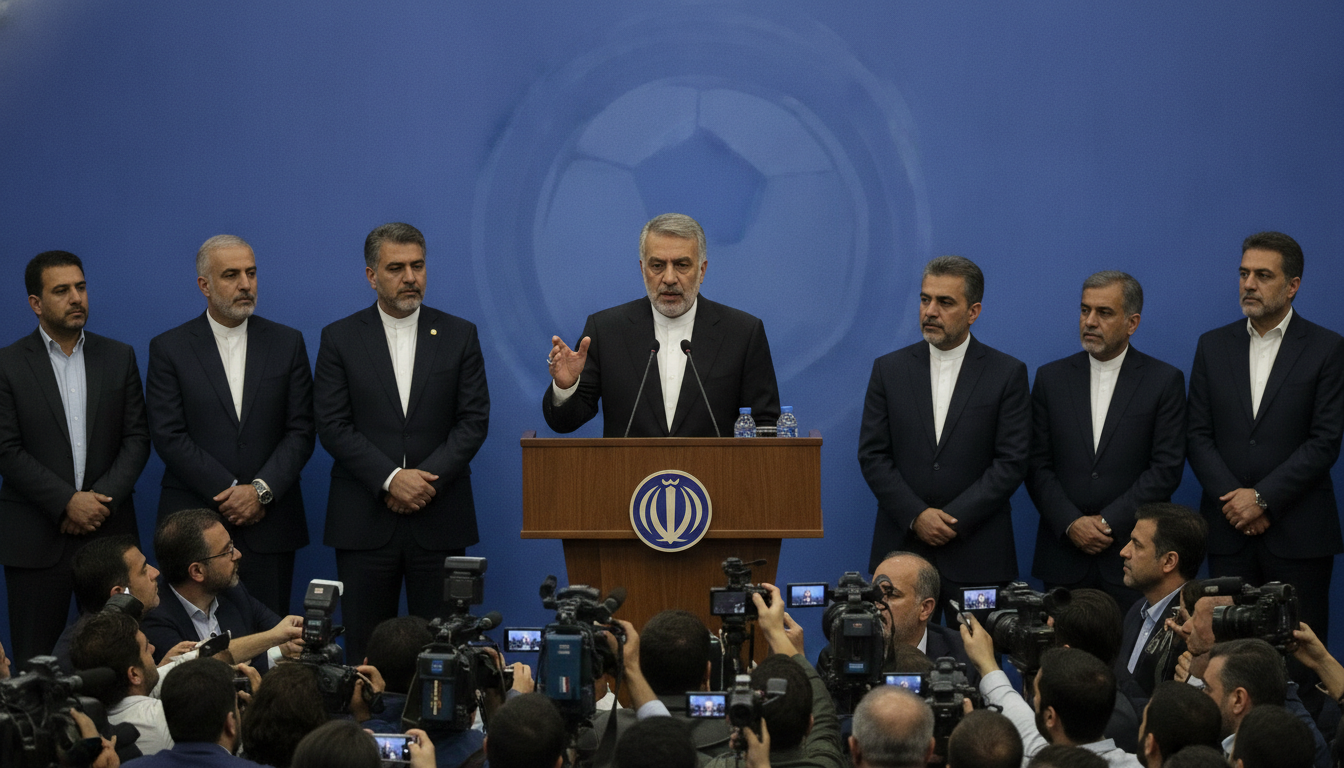
The Iran football delegation has strongly rejected a US official’s assertion that an individual with ties to the Islamic Revolutionary Guard Corps sought to board the national team’s flight to the United States. The claim, made by Homeland Security Secretary Markwayne Mullin, was described by the Football Federation Islamic Republic of Iran (FFIRI) as false and politically motivated. The dispute has raised questions about security checks, travel restrictions and the treatment of sports delegations amid strained US–Iran relations.
US official says IRGC-linked person attempted to board team flight
Markwayne Mullin told a US broadcaster that someone posing as an FFIRI official tried to board the Iran football delegation’s plane bound for Los Angeles. He said the person was stopped and characterized the individual as having direct links to the IRGC, a designation that carries serious security implications in US policy.
Mullin did not publicly name the individual during his on-air remarks, but suggested the reported incident occurred as the delegation traveled via Mexico en route to the World Cup match against Belgium. His comments were broadcast on television on the day before Iran’s scheduled fixture in Los Angeles.
FFIRI issues categorical denial and questions credibility
The FFIRI issued an official statement rejecting the US account, calling the allegation a “series of false, fabricated, and entirely baseless” claims. The federation singled out the assertion that an official tried to board the flight as an outright lie and said those who made the claim knew the incident had not happened.
FFIRI also warned that when a specific, verifiable allegation is proved false, it undermines the credibility of other accusations against members of the national delegation. The federation emphasized that Mehdi Taj is the recognized president of the FFIRI and that the delegation has traveled under established protocols.
Flight timeline and security procedures in question
According to the US account, the attempted boarding took place during a stopover in Mexico as the team traveled to Los Angeles, and airport security or immigration officials prevented the person from entering the aircraft. The timing and exact location of the intervention remain central to reconciling the competing narratives.
Travel by national teams to major tournaments typically involves multiple passport checks, accreditation verification by organizers, and coordination with host-country authorities for security clearance. Discrepancies between official statements from different governments or agencies can complicate routine procedures and increase scrutiny of delegations and support staff.
Political context sharpens scrutiny of sports delegations
The incident comes against a backdrop of long-standing US–Iran tensions and the US designation of the IRGC as a foreign terrorist organization. That broader political context elevates any allegation connecting individuals to the IRGC and can prompt heightened security measures when Iranian officials travel abroad.
Sports delegations frequently become entangled in diplomatic disagreements when national teams visit countries with fraught relations. Political sensitivities can lead to visa denials, travel curbs, or intensified checks that organizers and federations must manage while attempting to preserve competitive integrity.
Impact on the team’s World Cup visit and logistics
The competing claims risk adding distraction and logistical hurdles to Iran’s World Cup schedule in Los Angeles. Any restriction affecting delegation members or their access could complicate training, accommodation, and accreditation arrangements coordinated by tournament organizers.
Teams rely on smooth administrative procedures to focus on match preparation, and heightened security or political frictions can divert staff time and morale. Tournament hosts and football authorities are typically tasked with ensuring delegations can participate without undue interference, while also complying with host-country security protocols.
Responses from football bodies and diplomatic channels
At the time of the federation’s statement, international football authorities and tournament organizers had not released detailed public accounts clarifying the sequence of events. Governing bodies often seek information from both host authorities and national federations before making public judgments in such cases.
Diplomatic representations between the countries involved can be engaged when travel incidents affect high-profile delegations, and the matter may prompt further inquiries through consular or security channels. Independent verification by multiple parties is important to resolve factual disputes and avoid inflaming tensions around a sporting event.
Verification challenges and information gaps
Reconciling the US official’s public remarks with the FFIRI’s denial requires specific, verifiable details such as the individual’s identity, passport information, flight logs, and statements from airport authorities. Absent those details, competing accounts remain assertions rather than established facts.
Journalistic and official standards typically call for corroboration from third-party sources, including carrier records and border control statements, before drawing firm conclusions. The dispute underlines how quickly narrative and counter-narrative can circulate in high-profile international settings when verification is incomplete.
The episode will likely prompt tournament authorities and national federations to review travel accreditation and cross-border transfer procedures to avoid similar disputes during major events. Both security considerations and the principle of fair competition are at stake, and further clarity from relevant authorities could help defuse tensions and restore focus to play on the field.