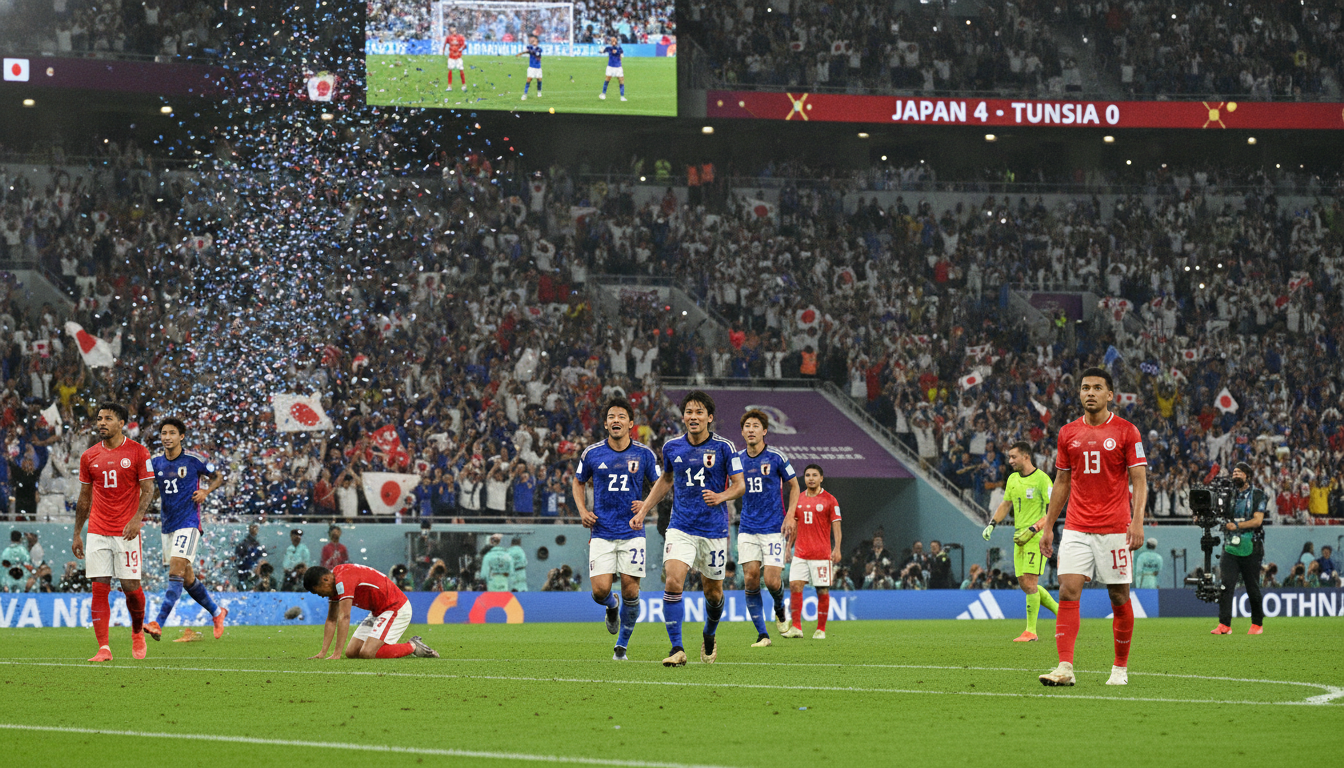
Japan 4-0 Tunisia: Ueda brace seals victory in World Cup’s 1,000th match
Japan 4-0 Tunisia in the World Cup’s 1,000th match, Ayase Ueda scoring twice as the Blue Samurai moved closer to the last 32 with a commanding win in Guadalupe.


Japan 4-0 Tunisia confirmed the Asian side’s authority in Group F as Ayase Ueda netted a brace and Daichi Kamada and Junya Ito added goals at Estadio BBVA in Guadalupe. The victory — staged as the 1,000th match in World Cup history — left Japan on four points alongside the Netherlands and ended Tunisia’s hopes of progressing after a second defeat. Tunisia entered the game under new manager Hervé Renard following Sabri Lamouchi’s dismissal and never recovered against a team that controlled possession and tempo throughout.
Ueda stars with two clinical finishes
Ayase Ueda emerged as Japan’s focal point in attack, converting two chances with poise that reflected his growing confidence at the tournament. His first goal opened the scoring after a slick sequence of passes that unsettled Tunisia’s backline, and his second came from a well-executed counter that punished a space left behind by the visitors. Both strikes underlined Japan’s ability to blend quick transitions with patient buildup play, giving Ueda the platform to finish decisively. His performance provided Japan with a cutting edge that Tunisia found difficult to contain for long spells.
Kamada and Ito add gloss as Japan dominate possession
Daichi Kamada and Junya Ito both found the net to round out Japan’s victory, their goals coming from sustained pressure and intelligent movement in the final third. Kamada’s contribution stemmed from a midfield surge that unsettled the Tunisian defence, while Ito’s finish showcased the wide players’ threat when given room to run into the box. Japan’s passing sequences were crisp and purposeful from back to front, allowing them to control the ball and dictate the rhythm for long periods. That dominance in possession translated to repeated opportunities and exposed Tunisia’s defensive vulnerabilities.
Tunisia’s campaign ends under new management
Hervé Renard’s first match in charge yielded a defeat that mathematically eliminated Tunisia from knockout contention after their earlier 5-1 loss to Sweden. The managerial change, implemented after Sabri Lamouchi was removed following the heavy opening defeat, failed to produce the immediate turnaround the North African side needed. Tunisia’s players showed glimpses of fight but were repeatedly outplayed by a technically superior opponent who exploited gaps in midfield and defence. With their World Cup campaign concluded, Tunisia must now shift focus to rebuilding and assessing the squad’s long-term prospects.
Group F implications and Japan’s route to the last 32
The result leaves Japan level on four points with the Netherlands at the top of Group F, setting up a decisive final round of fixtures to determine the group winner and qualification positions. Japan’s comfortable win gives them a superior goal difference and momentum heading into the last group match, where a positive result would secure progress to the last 32. For the Netherlands, their earlier draw with Japan means there is still work to do, but both teams have the upper hand over their remaining opponents. Tunisia’s elimination clarifies the qualification picture and raises the stakes for the final set of matches in Group F.
Tactical control highlighted Japan’s technical edge
Japan’s approach combined measured possession with rapid forward movements, enabling them to wear down Tunisia and create high-quality scoring chances. The Blue Samurai’s midfield trio maintained compactness and shifted the ball quickly to exploit spaces on the flanks, while the full-backs supported attacks without sacrificing defensive balance. Tunisia struggled to maintain cohesive pressing and often ceded control in central areas, which allowed Japan’s playmakers to orchestrate advances into threatening positions. Defensive discipline from Japan limited Tunisia’s opportunities to mount sustained pressure, turning the contest into a one-sided affair after the first goal.
Atmosphere and significance of the 1,000th World Cup match
Staging the tournament’s 1,000th match brought an added layer of historical context to an already important fixture for both teams, and Japan’s emphatic win ensured the milestone was celebrated with decisive football. The Estadio BBVA in Guadalupe provided a lively backdrop as supporters of both sides filled pockets of the stands, although the balance on the pitch quickly tilted in Japan’s favour. For players and staff, participating in such a landmark game will carry personal and national significance, particularly for a team chasing progression from a competitive group. The result will be archived as a memorable entry in World Cup history for Japan’s clinical display.
Japan’s defending was also a foundation of the performance, with disciplined backline play neutralizing Tunisia’s fewer attacking threats. The goalkeeper made routine saves but was largely untroubled due to Japan’s control of the midfield and effective screening in front of the defence. Set-piece organization and situational awareness helped Japan close out phases where Tunisia attempted to press higher up the pitch, preventing a late resurgence. Together, those elements allowed Japan to protect their lead and finish the match with a clear margin.
Tunisia must now address both tactical and personnel questions after a campaign that ended sooner than their fans would have hoped. The team showed moments of resilience but lacked the technical cohesion to compete consistently against higher-ranked opponents in this tournament. Renard faces the immediate task of evaluating performances and devising a plan to restore confidence ahead of future qualifiers and competitions. For Japan, the victory is a statement of intent that combines effective coaching, tactical clarity, and players ready to seize scoring opportunities.
Looking ahead, the composition and mentality Japan brings to their decisive group game will be scrutinized as they seek to convert this momentum into guaranteed progression to the knockout stages. Tactical tweaks and squad rotation are likely considerations as the coaching staff balance form, fitness and the need for results. The Netherlands will similarly prepare for their remaining fixture with an eye on both points and goal difference, knowing the margin for error is small in a tightly contested group. The close of Group F promises a dramatic finish as two in-form sides contend for top spot.
Japan 4-0 Tunisia will be remembered not only for the scoreboard but for the manner in which Japan executed a controlled, creative and effective brand of football. The result underscores Japan’s capacity to perform on a big stage and advances their campaign with confidence. Tunisia’s elimination signals a need for reflection and renewal under Renard as African football waits to see how the team rebounds. Both national teams return home with distinct lessons from a match that doubled as a historical milestone in World Cup history.