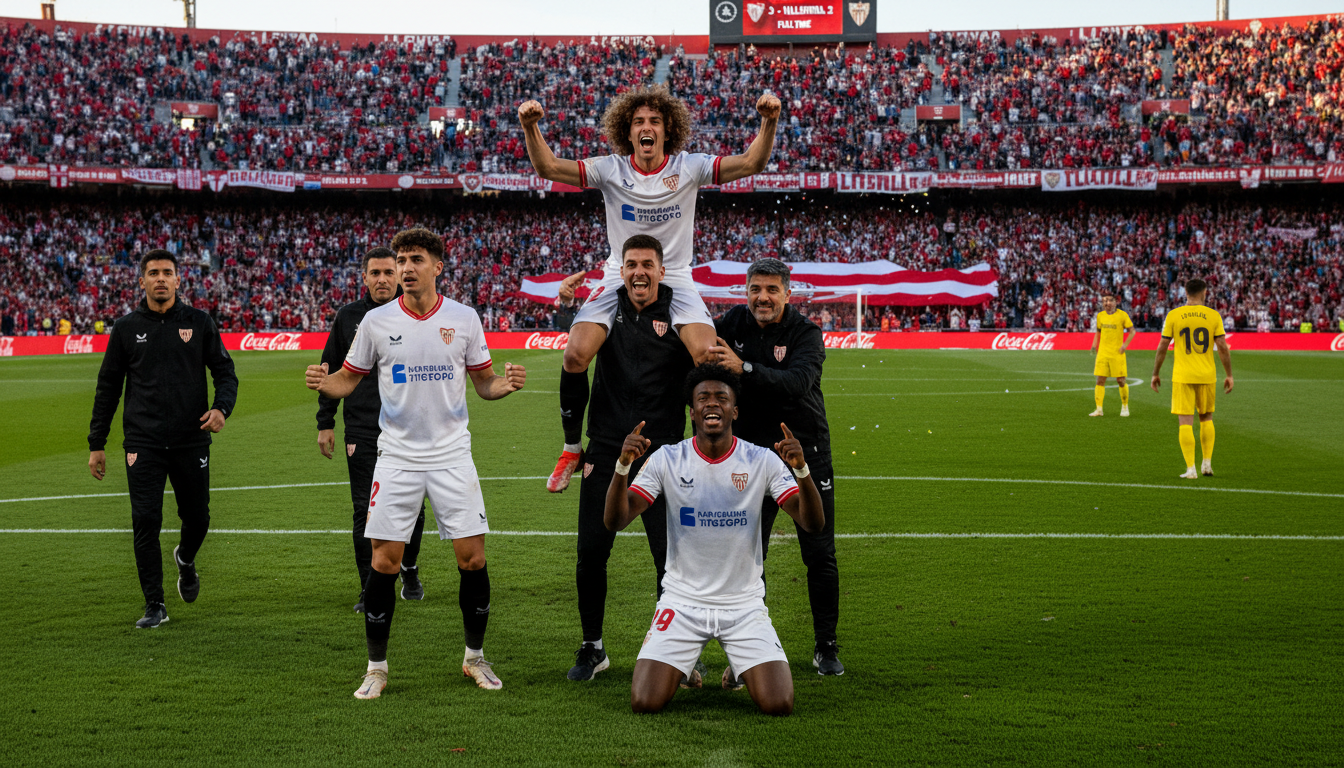
Sevilla youngsters drive dramatic 3-2 comeback at Villarreal as academy becomes survival engine
Sevilla youngsters spark a dramatic 3-2 comeback at Villarreal; academy players have 12 goals, 11 assists and are earning 11 vital points toward LaLiga survival.


Sevilla youngsters deliver in a do-or-die trip to La Cerámica
Sevilla produced a stirring 3-2 victory at Villarreal, with the club’s young players central to overturning a 2-0 deficit. The result at one of LaLiga’s toughest venues underlined how Sevilla youngsters have moved from occasional options to decisive contributors. That comeback not only rescued three points on the day but also reinforced a wider pattern of reliance on the club’s academy in the run-in to safety.
The two equalising goals from Oso and Kike Salas shifted the momentum and set the stage for the late winner that completed the turnaround. The performance was a clear example of how academy graduates are now trusted to manage pressure moments in top-flight matches. As the team approaches the final fixtures, the youth contingent’s role in securing results has become impossible to ignore.
Minutes and personnel: academy figures forming the spine
Sevilla’s integration of homegrown players is visible in playing time totals across the squad. José Ángel Carmona, Kike Salas and Juanlu Sánchez rank among the six most-used players this season, logging 2,563, 2,203 and 2,174 minutes respectively. Those three, along with Isaac Romero (1,588) and younger contributors such as Oso (1,493), Andrés Castrín (1,300) and Manu Bueno (429), combine to form a core that has accumulated more than 11,750 minutes across LaLiga and Copa del Rey.
That accumulation of minutes is not incidental; it reflects sustained selection and continuity under the current coaching regime. Players who rose through Sevilla’s ranks are not being shielded to preserve value, but instead trusted in critical matches. The depth of experience these minutes represent gives the squad balance and helps bridge gaps when senior players are unavailable.
Tangible attacking returns from academy graduates
The contribution from the academy is measurable in goals and assists as well as minutes on the clock. Collectively, Sevilla’s homegrown players have produced 12 goals and 11 assists this season, numbers that have directly influenced the club’s position in the table. Isaac Romero leads the scoring line among graduates with five goals, while Kike Salas has three and Oso two; Carmona and Castrín have chipped in with a goal each.
On the creative side, Carmona, Juanlu and Oso have provided three assists apiece, with Manu Bueno adding two assists in Copa del Rey competition. Those outputs have turned academy prospects into match-winners and problem-solvers, supplying decisive actions both in build-up play and in the final third. The statistical footprint confirms that Sevilla’s youth system is supplying not just squad depth but concrete attacking value.
Luis García Plaza’s arrival accelerated youth deployment
The uptick in minutes for academy players has coincided with the appointment of Luis García Plaza as head coach. Since his arrival, the reliance on young, homegrown faces has increased, with three academy graduates among the six players with the most minutes in the squad. That shift suggests a clear tactical and selection philosophy from the coaching staff, one that prioritises form, cohesion and internal development over expensive short-term fixes.
García Plaza’s choices have given promising players consistent opportunities to develop within first-team dynamics. Regular selection has allowed those players to build understanding and to handle high-pressure scenarios such as the recent comeback at Villarreal. The coach’s willingness to back the club’s academy has also created a visible pathway for reserve-team members to stake a claim in LaLiga action.
Direct points and season-defining moments from academy goals
Beyond statistics, the academy’s contributions can be translated directly into league points. Goals scored by Sevilla graduates have been worth an estimated 11 points in critical fixtures this season. The most recent examples came in successive matches against Espanyol and Villarreal, where strikes from Castrín, Oso and Kike Salas helped initiate two vital comebacks that yielded six points in the space of two rounds.
Those points have materially shifted Sevilla’s survival calculations as the season nears its end. The fact that young players produced the goals that changed results in such pivotal matches underscores their growing importance to the team’s objective. In tight relegation battles, marginal contributions such as those provided by academy talents can determine the final standings.
Squad balance, future planning and club strategy
Sevilla’s current blend of youth and experience raises strategic questions about squad construction moving forward. Relying on academy graduates has proven both cost-effective and competitive during the crisis of the closing months. The minutes, goals and assists delivered by homegrown players offer a model for sustainable roster management that aligns sporting and financial priorities.
At the same time, the club faces choices about contract planning, potential reinforcements and how to maintain development pathways for younger prospects. Continued faith in academy talent could encourage more pathways from the reserve teams into regular first-team roles. For the players themselves, the recent run provides a platform to secure longer-term roles and possibly attract broader interest, while the club will need to weigh retention against market dynamics.
Sevilla’s immediate task is straightforward: secure the points needed from the remaining fixtures to confirm LaLiga status. The emergence of academy players as decisive figures gives the club an operational template for the run-in, but it also sets expectations for next season. Sustaining the momentum will require careful rotation, injury management and a continued commitment to the players who have stood up when it mattered.
In the short term, the blend of form and youth at Sevilla offers reason for cautious optimism. The comeback at La Cerámica was not an isolated event but the latest evidence of a club turning to its own products for solutions in pressure moments. As the final matches approach, Sevilla will depend on the same blend of collective resilience and individual breakthrough performances that have kept them afloat.
The young players’ recent performances have reshaped the narrative around Sevilla’s season, transforming academy prospects into central protagonists in the fight for survival. Their minutes, goal contributions and game-changing interventions have already delivered crucial points and created a framework for the club to finish the season on a stable footing.