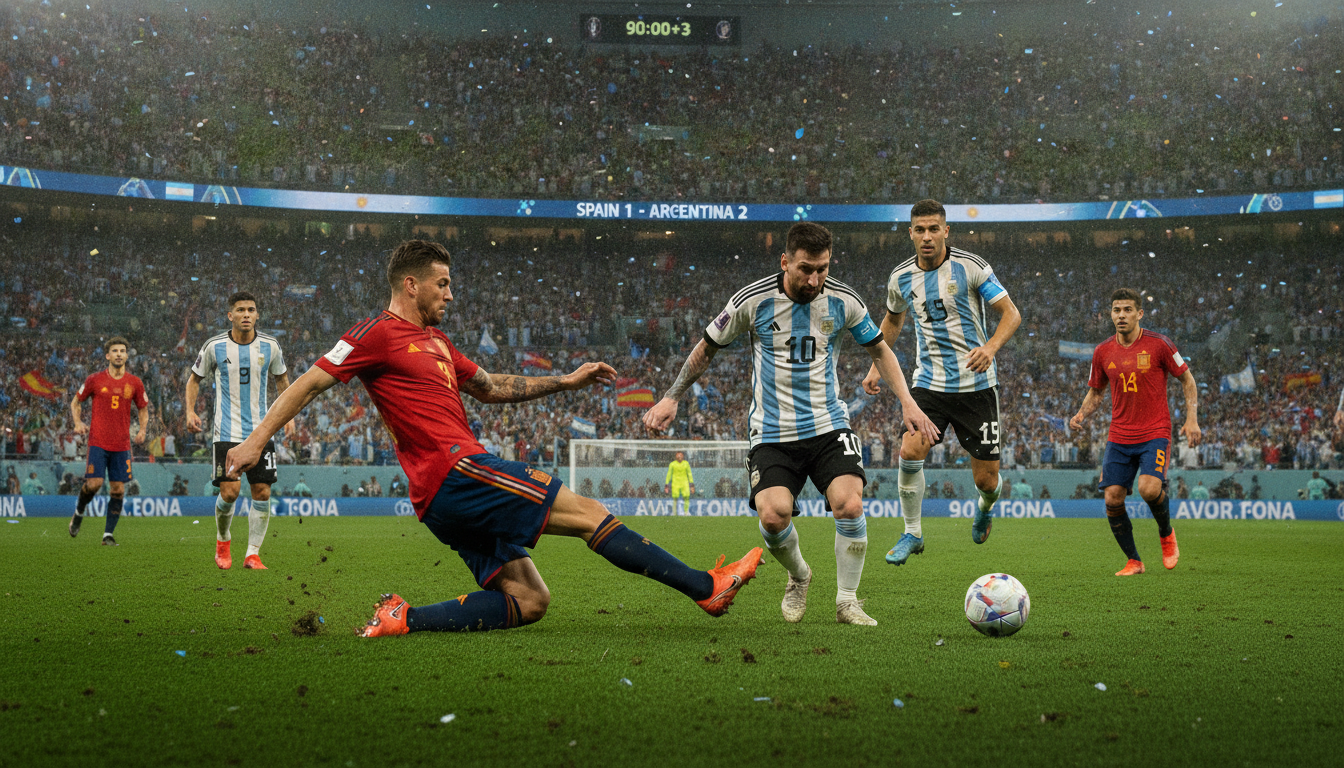
Spain vs Argentina set for MetLife finale as world title and legacy hang in balance
Spain vs Argentina World Cup final preview: tactical duel at MetLife Stadium with history, Messi, Yamal and contrasting styles on the line.


Spain and Argentina face off at MetLife Stadium in a World Cup final that promises to be as much about legacy as it is about silverware. The Spain vs Argentina match will decide whether a disciplined Spanish side establishes a new era or whether Lionel Messi and Argentina complete a title defence and cement one of the greatest international legacies in history. Both teams arrive having navigated a long tournament with distinct identities: Spain built suppression and control, while Argentina have relied on relentless attack and adaptability.
Final at MetLife Stadium
The championship decider is scheduled for a neutral venue that has hosted some of the sport’s biggest nights in the United States. Organizers expect a global television audience to tune in as two stylistically opposed finalists meet after a long 48-team tournament. The stadium setting underlines the occasion: a match that will be remembered as a defining moment for whichever nation prevails.
Fans from Europe and South America have made a mass pilgrimage to the New York-New Jersey area, turning the stadium into a cauldron of flag-waving and passion. Match build-up has been dominated by tactical speculation and individual narratives, and both coaches have signalled that the final will be approached with maximum seriousness and detailed preparation. Atmosphere and occasion are expected to amplify every tactical nuance and individual duel on the pitch.
Spain’s defensive record and organisation
Spain reach the final on the back of an extraordinary defensive performance across the tournament. Their backline, shielded by a disciplined press and controlled build-up, allowed just a single goal en route to the title match. That defensive consistency has been the foundation of a campaign built on structure and minimising risk.
The goalkeeper has been central to that run, producing a run of clean sheets and unbeaten minutes that rewrote expectations for shot-stopping at this level. The defenders in front of him have combined positional intelligence with measured interventions, preferring anticipation to rash challenges. If Spain lift the trophy while conceding only once, they would set a new statistical benchmark for defensive champions at the World Cup.
Midfield control has fed the defence by limiting transitions and denying opponents time to build pressure. Spain’s approach pairs a deep defensive block with patient forward progression, and full-backs balance width with defensive discipline. That blend of possession and protection has made Spain perilously hard to break down.
Argentina’s attacking potency and momentum
Argentina arrive in the final as the tournament’s most prolific attacking side, producing a sustained sequence of high-scoring performances. Their goal return has been among the highest for a finalist in decades, and the team has repeatedly demonstrated the capacity to score from varied situations. Momentum has become a defining characteristic of Argentina’s campaign.
Individual attackers have provided game-changing moments, delivering late goals and dramatic comebacks that shifted the tournament narrative in Argentina’s favour. This forward thrust is underpinned by a versatile midfield that can overload and unbalance opponents. Argentina’s capacity to alter tempo, probe wide spaces, and finish clinically gives them an offensive edge in any high-stakes match.
That attacking threat is matched by collective resilience; even when faced with early setbacks the side has shown composure and belief. The forward trio and midfield creators move with coordinated intent, creating overloads and exploiting gaps between defensive lines. For opponents, containing that rhythm without surrendering space is the chief tactical dilemma.
Key individual duels to watch
Several one-on-one match-ups could shape the final’s outcome and determine which team controls critical moments. On paper, the contest between the Argentine captain and Spain’s leading centre-back is the headline duel. The veteran attacker remains the focal point of his team’s game in critical zones and continues to register decisive contributions at the highest level.
Another battle will take place in midfield where Spain’s anchorman, who has orchestrated passing sequences and territorial control, meets Argentina’s creative engine, a player whose ball-winning and late runs have produced pivotal interventions. That confrontation will likely decide who controls transition moments and accumulates possession in dangerous areas.
On the flanks there is also a compelling narrative: a teenage dribbler bursting with confidence against an experienced full-back who has navigated the pressures of big finals. These wing duels could tilt the match, as any isolated defensive slip or quick beating of a marker can create clear scoring opportunities. Coaches will have to decide whether to plug these channels or to risk leaving them open in search of attacking advantage.
Tactical chess between the managers
The coaching contest is as consequential as any individual battle on the pitch. Spain’s coach has refined a modern possession model that mixes patient circulation with sharper vertical passes and a proactive press. His iteration of controlled football emphasizes structure, rotation, and quick recovery, producing a team that dominates possession while restraining opposition counters.
Argentina’s manager has forged a flexible template, capable of switching between dominance of the ball and compact countering depending on circumstance. His willingness to adapt formations mid-game and to redeploy key attackers into deeper or wider roles has produced tactical surprises and late winners throughout the tournament. That adaptability gives Argentina a toolbox of options for different match developments.
In a final, adjustments will be continuous: substitutions, positional tweaks, and reactive changes to momentum. Each bench decision will carry amplified weight, and the coach who reads the flow of the match better is likely to influence the outcome. The contrast is clear — one coach prioritizes structured control, the other emphasizes adaptability and tactical variation.
Statistical milestones and historical context
Both sides chase milestones that would deepen their place in football history. Argentina have the chance to complete a perfect winning run through the tournament, a feat achieved by only a handful of World Cup winners. Such a record would place them alongside an elite group whose campaigns combined consistency with peak performance in decisive matches.
Spain are pursuing a different kind of legacy: pairing a possible second World Cup with what would be a historically low number of goals conceded by a champion. That defensive narrative reframes Spain’s evolution from a possession-heavy past to a more balanced, pragmatic identity. Individual statistical achievements within both squads — from passing tallies to save percentages and successful dribbles — have punctuated the tournament and will be referenced if the final goes their way.
Beyond numbers, the final offers players the chance to alter their standing in the sport’s pantheon. For some, the match represents the crowning moment of a sustained rise; for others, it could consolidate a late-career affirmation of greatness. Whatever the result, the game will enter record books and reshape headline narratives for years to come.
What the outcome will mean for both nations
A win for Argentina would secure back-to-back titles and cement the coach’s reputation for building a team that can adapt and deliver under pressure. It would also punctuate the captain’s international story with a final act that would rank among the greatest in the sport’s history. The psychological boost of consecutive triumphs would reverberate through the nation and the global football community.
For Spain, victory would signal arrival of a new golden generation capable of combining technical excellence with defensive resolve. It would mark a statement that the nation’s footballing philosophy has matured into a winning blueprint in major tournaments. Such a triumph could redefine comparisons with past champions and prompt a recalibration of continental power narratives.
Regardless of the result, the match will influence transfer discussions, managerial reputations, and youth development models across leagues and federations. Clubs and national associations alike will study the game’s tactical patterns and individual performances for lessons on building successful teams.
The final will not only award a trophy but also resolve which style — disciplined defensive structure or dynamic attacking flexibility — is crowned on the sport’s biggest stage. This Spain vs Argentina meeting is therefore both a competition for a title and a referendum on contemporary footballing philosophies.
As kickoff approaches, expectation is high and narratives abound; two contrasting squads meet with a single prize separating them from immortality. The world will watch as players, coaches and nations bid to write the final lines of a remarkable tournament.