Super Falcons Olympic qualifying draw in Cairo sets Nigeria on knockout path to Los Angeles 2028
CAF conducts official draw in Cairo on April 29, 2026, launching a five-round knockout Olympic qualifying tournament across Africa for Los Angeles 2028.


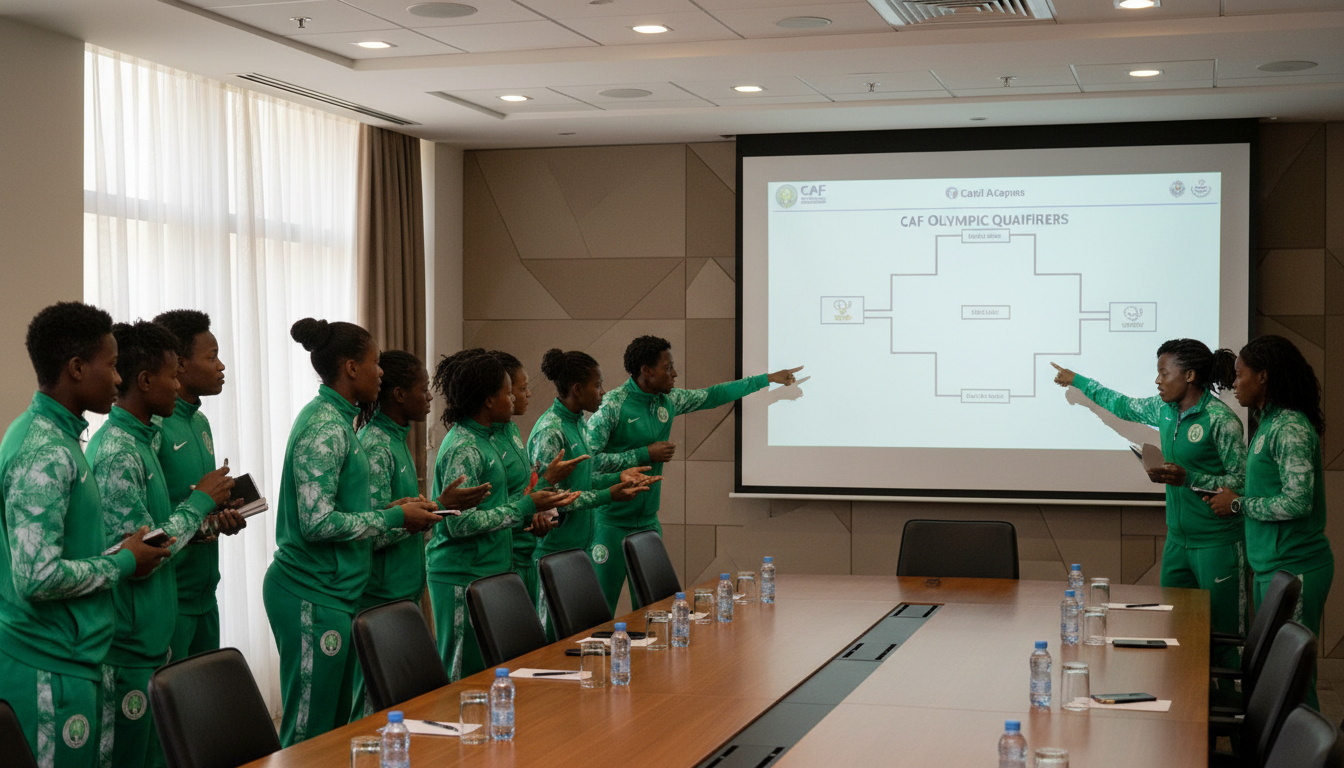
The Super Falcons Olympic qualifying draw in Cairo on Wednesday, April 29, 2026, formally opened Africa’s campaign for the women’s football tournament at the 2028 Los Angeles Olympics. The Confederation of African Football staged the ceremony at its headquarters in Cairo, with the proceedings streamed live on CAF’s YouTube channel. Nigeria’s senior women’s team, the Super Falcons, now know the shape of their early path in a competition defined by short margins and high stakes.
CAF holds official draw in Cairo to launch women’s Olympic qualifying
The draw at CAF’s Cairo headquarters marked the administrative and competitive starting point for Africa’s road to Los Angeles. Confederation officials presided over pairings that will determine each nation’s sequence of knockout ties across five rounds. Fans and federations were able to watch the draw live, gaining immediate clarity on potential opponents and travel schedules.
CAF’s decision to broadcast the draw reflects increased public interest in women’s national team competitions across the continent. The live stream offered federations and supporters a first glimpse of the bracket-style route to the Olympics. For national teams, the draw will shape preparation windows, scouting priorities, and logistical plans for fixtures that leave little room for error.
Officials emphasized that the draw’s results are the starting point rather than a verdict on outcomes, noting the fluidity inherent to knockout football. Early-round matchups can determine momentum for the entire campaign, and underdogs who prepare methodically can overturn expectations. The ceremony therefore sets both a schedule and a psychological framework for teams preparing to negotiate multiple two-legged tests.
Five-round knockout format raises the stakes for every fixture
CAF has structured the qualification as a five-round knockout tournament, a format that prioritizes consistency and resilience. Unlike group-stage systems that allow teams to recover from a poor result, each round in this schedule functions as a high-pressure elimination hurdle. Teams advancing must manage short preparation periods and tightly scheduled home-and-away ties that reward squad depth and tactical discipline.
The knockout pathway compresses opportunities to experiment and demands immediate execution from coaching staffs and players. Match planners must account for travel, rapid opponent analysis, and the possibility of extra-time or penalty deciders shaping outcomes. For federations with limited resources, the format intensifies the operational burden, making early logistical planning as important as on-field preparation.
This structure effectively halves the margin for error at every stage, with each tie capable of ending a nation’s Olympic aspirations. The final outcome will yield just two African qualifiers for the Los Angeles field of 16, amplifying the significance of each round. As a result, national teams are incentivized to treat every qualifying window as decisive rather than preparatory.
Thirty-five entries underline expansion and competitiveness across Africa
A total of 35 national teams entered the tournament, underscoring the expanding footprint of women’s football across the continent. The entry list brings together established powers such as Nigeria, South Africa, Morocco, Cameroon, Ghana, Zambia and Algeria alongside emerging sides seeking their first major global appearances. That breadth of participation illustrates both development gains in many federations and heightened ambition at regional and continental levels.
The geographic spread of entrants means the draw can generate long-distance ties with significant travel demands, along with encounters between clubs and systems of differing professionalization. For the tournament’s favorites, avoiding complacency against unfamiliar opponents will be crucial. For newcomers, the draw offers a chance to test progress and gain international experience that can accelerate domestic investment in the women’s game.
From a competitive standpoint, a 35-team field increases the possibility of upsets and surprise progressions that could reshape the wider continental pecking order. With only two Olympic slots available, every federation faces the same arithmetic: sustained performance across multiple knockout rounds to secure one of the continent’s limited berths. That reality will likely intensify scouting, player conditioning and strategic planning in the coming months.
Super Falcons focus on early rounds and squad depth
For the Super Falcons, the draw is not merely a formality: it defines the initial terrain of a campaign where early results matter most. Nigeria enters as Africa’s most decorated women’s national team, with a history of continental dominance and regular appearances on the global stage. Yet the knockout format tests more than pedigree; it probes squad depth, physical conditioning, and the capacity to adapt tactically across successive high-stakes ties.
Coaching staff will prioritize immediate preparation for the opponents drawn in the first and second rounds, where momentum can be built or lost. The Super Falcons’ technical team must balance domestic selection issues, player travel, and match-readiness in a compact schedule. Effective management of injuries, rotation, and set-piece scenarios could be decisive in progressing through the initial knockout phases.
Nigeria’s federation and supporters will also watch how the draw aligns with domestic league calendars and international windows, since synchronized scheduling can ease preparation burdens. The two-legged nature of most ties gives weight to away-goal strategies, defensive organization, and the capacity to secure results on foreign soil. For a nation with Olympic ambitions, those operational details are as influential as tactical formations.
Paris 2024 lessons inform Africa’s Los Angeles ambitions
Recent cycles offer a framework for expectations and areas for improvement as Africa looks toward 2028. In the Paris 2024 qualifying campaign, Nigeria and Zambia emerged as the continent’s representatives, navigating the same unforgiving structure to reach the Olympic tournament. Their progress demonstrated that disciplined execution across successive knockout ties is a prerequisite for global participation.
However, African teams have historically found advancing beyond the early group or knockout stages at the Olympic Games more difficult, highlighting a persistent gap against highly professionalized opponents. Federations now appear more focused on bridging that gap through enhanced coaching, youth development and competitive exposure in the years leading to Los Angeles. The 2028 cycle will be judged not only on qualification but on whether African sides can translate entry into deeper Olympic campaigns.
Federations are also likely to use the qualifying period to evaluate talent pipelines and accelerate integration of younger players into senior squads. Doing so could improve long-term competitiveness while providing immediate tactical options for knockout ties. Lessons from 2024 underscore the importance of combining short-term match planning with medium-term development strategies.
Key matchups, timelines and what to watch after the draw
With the bracket now set, attention will shift to the mechanics of fixtures and the earliest head-to-head contests that could define the tournament’s narrative. Fans should watch which heavyweights meet in initial rounds, as early clashes between leading teams can eliminate favorites before the later stages. Conversely, pathways that avoid top-seeded opponents until the final rounds can offer clear routes for ambitious mid-level teams.
The Olympic tournament itself will run from July 11 to July 29, 2028, in Los Angeles, with the United States participating as host nation. That fixed window shapes national team calendars and prepares federations to align domestic competitions and international friendlies to peak at the right time. The next several months will include confirmation of match dates, travel arrangements and official fixture lists as CAF and national associations finalize logistics.
Stakeholders will also track squad announcements, injury updates and coaching decisions that could alter the balance of specific ties. International friendlies arranged in the lead-up to qualifying rounds will provide further indicators of form and tactical intentions. Ultimately, the draw is the structural start; the coming weeks and months will determine which teams convert that opportunity into qualification.
Nigeria’s mission is straightforward: navigate the pathway laid out in the draw, assert continental pedigree, and secure one of Africa’s two tickets to Los Angeles. The Super Falcons will be judged not only on the immediate results after the draw but on their capacity to sustain performance through successive knockout tests. With a dense field and limited slots, the 2026 qualifying campaign promises drama, high stakes and meaningful benchmarks for the future of African women’s football.