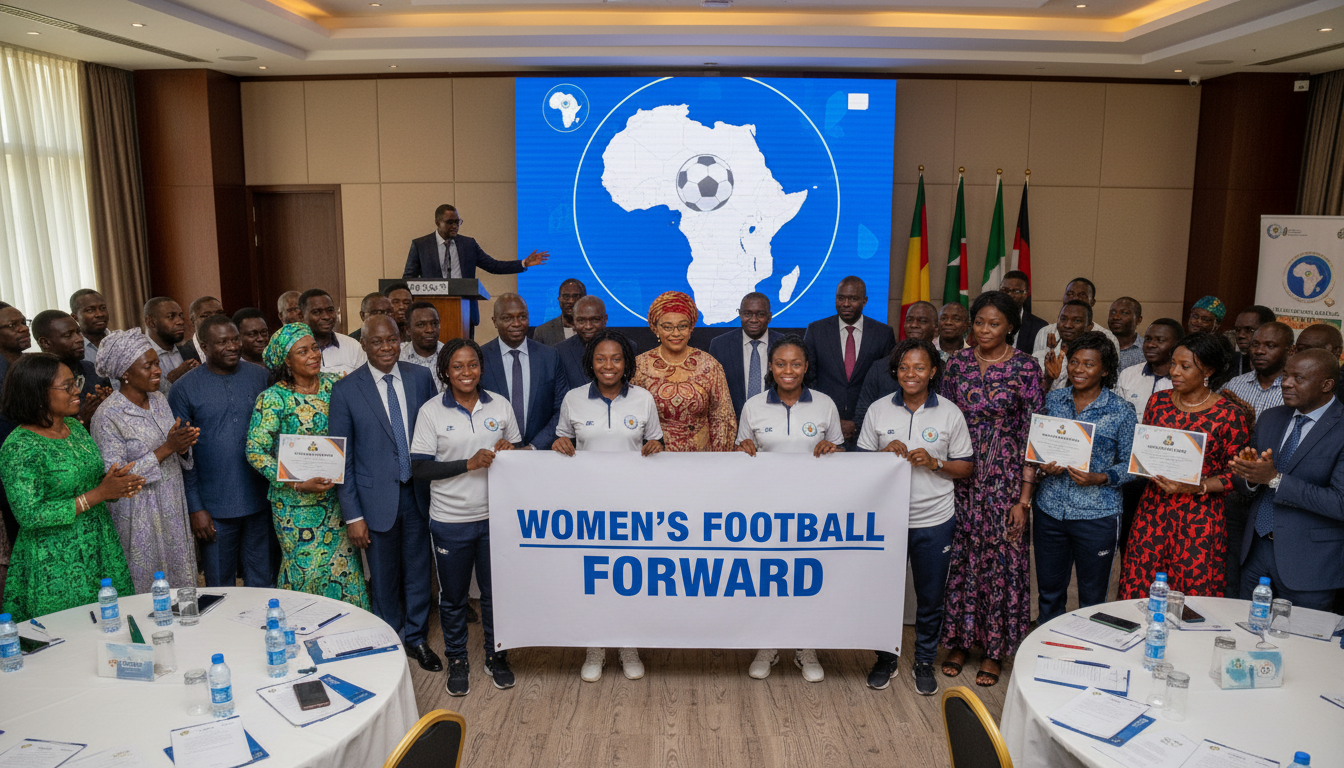
WAFU-B Women Football Administrators Workshop Ends in Abuja, Promising New Momentum for Regional Women’s Game
Nigeria-hosted three-day CAF-WAFU B Women Football Administrators Workshop concluded in Abuja, equipping regional officials with fresh strategies to advance the women’s game across West Africa.


The three-day CAF-WAFU B Women Football Administrators Workshop closed in Abuja with participants praising the event’s depth and practical focus. Attendees said the programme supplied concrete tools and strategies to strengthen administration and growth of women’s football across the WAFU-B region. Organizers described the workshop as a step toward more coordinated, professional stewardship of the women’s game.
Strong Endorsements from Nigerian Football Leaders
Aisha Falode, a member of the Nigeria Football Federation Executive Committee, addressed participants and commended the workshop as both insightful and impactful. She highlighted the session content and delivery as offering useful new approaches that administrators can adapt to local contexts. Falode also pointed to WAFU-B’s increasing influence across the continent and urged delegates to convert lessons learned into measurable action.
Representing the host federation, NFF Deputy General Secretary Emmanuel Ikpeme said the NFF expected participants to return home ready to drive meaningful progress in women’s football. Ikpeme stood in for NFF President Ibrahim Gusau and General Secretary Mohammed Sanusi, noting the pair were attending the FIFA Congress in Canada. He thanked WAFU-B and CAF for the collaboration that made the workshop possible.
Organizers Highlight Regional Collaboration and Capacity Building
WAFU-B Executive Director Philippe Tchere publicly acknowledged the NFF for hosting the programme and praised the contributions of CAF, facilitators, and local stakeholders. He framed the workshop as part of a broader push to professionalize administrative structures and encourage cross-border cooperation. Tchere said stronger administrative capacity would underpin improvements in competitions, development pathways, and governance across the zone.
CAF representatives reinforced that message, positioning the workshop as one element of continental efforts to raise standards for women’s football. Organizers emphasized practical outcomes, including improved competition management and better alignment between national federations and regional bodies. They also signalled an intent to track implementation and provide follow-up support where needed.
Experienced Facilitators Led Technical and Practical Sessions
Facilitation for the workshop combined former players, regional administrators and CAF instructors to bridge theory and practice. Precious Dede, a former Nigeria international now serving as WAFU-B Football Development Manager, was among the lead facilitators drawing on playing and administrative experience. Dede’s involvement underscored an emphasis on translating on-field perspectives into policies and administrative practice.
CAF instructors Jules McGeever from England and Thuba Sibanda from Zimbabwe delivered sessions designed to sharpen operational skills for competition planning, stakeholder engagement and development programming. Delegates reported that the mix of international and regional viewpoints broadened discussion and highlighted adaptable solutions for varying federation capacities.
Attendance Demonstrated Wide Stakeholder Support
The workshop drew senior officials from federations and regional bodies alongside CAF technical staff, reflecting buy-in at multiple levels. CAF Head of Women’s Football Goshime Meskerem and President of the WAFU-B Women’s Football Commission Amina Amani were both in attendance. Their presence reinforced the importance attached to administrative strengthening as a precondition for competitive and commercial growth.
Representatives from the NFF also took active roles in the sessions, including Director of Communications Ademola Olajire and Director of Competitions Ruth David. CAF Football Development Officer Yousra Oukhouya and members of the WAFU-B secretariat provided additional technical support and helped tailor discussions to the zone’s specific needs.
Practical Focus Aimed at Immediate and Long-Term Impact
Participants said the workshop prioritized implementable strategies over abstract theory, with sessions focused on governance, competition organization and stakeholder management. Delegates discussed ways to improve domestic league structures, enhance youth and grassroots pathways, and strengthen matchday operations. The practical orientation was intended to shorten the time between training and visible improvement on the ground.
Organizers encouraged federations to establish action plans and peer-learning networks to sustain momentum. Speakers outlined monitoring mechanisms and suggested periodic reviews to assess progress on governance reforms, competition quality and player welfare initiatives. The aim, officials said, was to convert workshop outcomes into measurable gains for athletes, coaches and referees.
Next Steps and Regional Commitments
At closing, WAFU-B signalled plans for follow-up activities, including technical support and further workshops tailored to federation needs. Attendees were urged to nominate focal contacts and submit action plans that WAFU-B and CAF can help implement. The collaborative approach seeks to avoid one-off training and instead build an incremental pathway to durable administrative capacity.
Several federations indicated readiness to pilot specific recommendations, ranging from competition calendars to enhanced communications strategies. WAFU-B officials also noted the importance of securing resources and aligning sponsors and partners to fund women’s football initiatives. The region’s coordinated effort will be evaluated against concrete indicators such as league improvements and increased female participation.
The workshop in Abuja marked a concentrated investment in administrative know-how that regional leaders hope will pay dividends on the pitch and in governance structures. Delegates left with concrete steps to pursue at home, and WAFU-B and CAF have committed to continued technical follow-up to ensure those plans are realized.