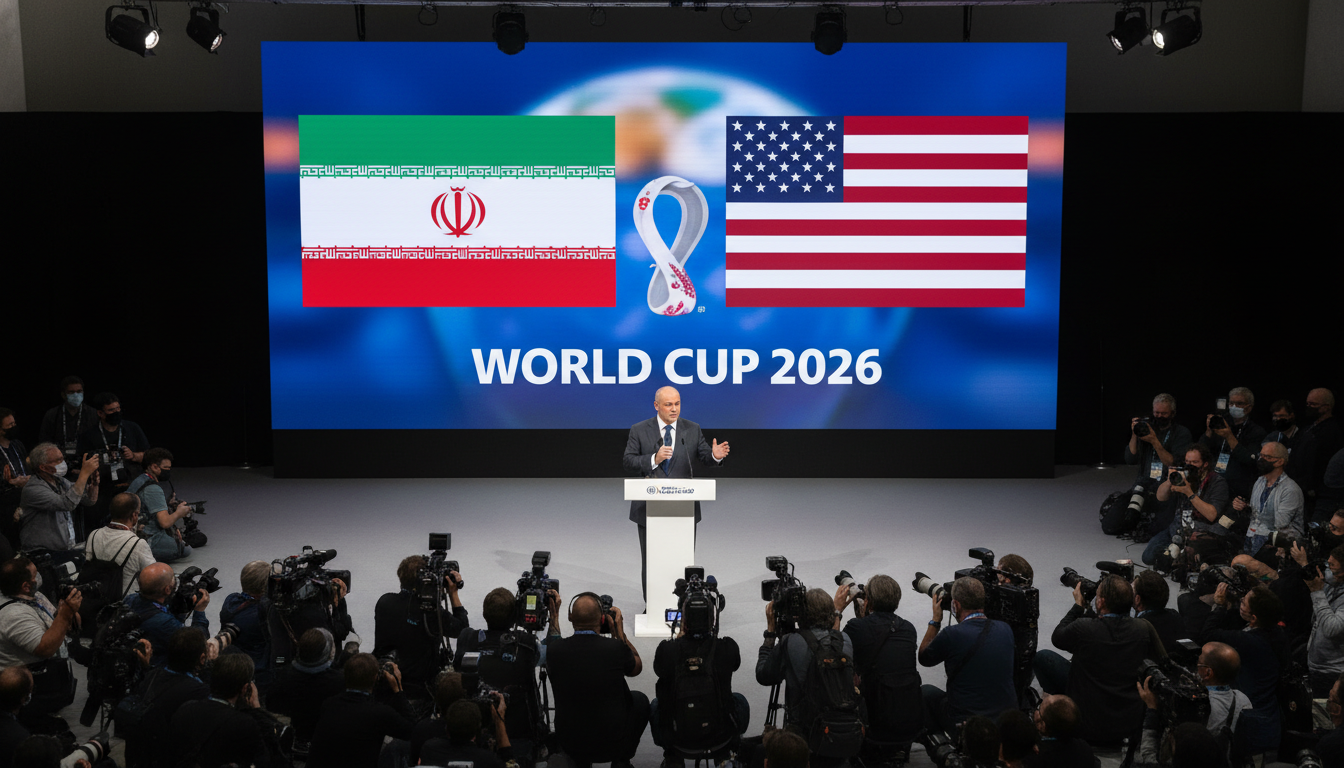
FIFA Reaffirms Iran at World Cup 2026 Will Play Its Matches in the United States
FIFA confirms Iran at World Cup 2026 will play matches in the United States, as Infantino reassures delegates and the White House signals support amid regional tensions.


FIFA president Gianni Infantino used the opening of the organization’s 76th Congress in Vancouver to declare that Iran will participate in the 2026 World Cup and will compete in fixtures scheduled on U.S. soil. The confirmation came amid lingering uncertainty over the participation of countries affected by recent regional hostilities, and it directly addresses concerns that had emerged since the conflict escalation in February. The statement sets a clear position from football’s governing body ahead of a tournament split between Canada, Mexico and the United States.
Infantino Confirms Iran Will Take Part and Play U.S. Fixtures
Gianni Infantino told delegates that Iran’s place at the World Cup is secure and that the team will play its matches in the United States as planned. His remarks were delivered at the start of FIFA’s congress in Vancouver and framed as a straightforward clarification of the tournament’s lineup. The president emphasized FIFA’s authority over competition participation and appeared intent on removing ambiguity about the Iranian team’s status.
FIFA’s message was concise and meant to provide certainty to organizers, broadcasters and competing federations who have been monitoring the situation closely. Infantino’s statement did not, however, outline the operational details that will govern Iran’s travel, accommodation or matchday procedures in the U.S. Those logistical elements are left to be negotiated between FIFA, the tournament hosts and relevant national authorities. The announcement shifts the debate from whether Iran will be present to how its attendance will be managed in a complex security environment.
Context of Regional Conflict and Qualification Uncertainty
Iran’s participation had been clouded by regional developments since February, following strikes attributed to the United States and Israel that heightened tensions across the Middle East. Those events prompted questions about the safety of travel for national teams, the status of players and the willingness of host governments to admit delegations from affected countries. For months, football stakeholders have been balancing sporting commitments with diplomatic sensitivities and public safety considerations.
The 2026 World Cup, shared among three North American hosts, presents an unprecedented logistical undertaking that has invited extra scrutiny when geopolitics intrude on sport. Federations and confederations have watched the situation for signs of escalation or de-escalation that might force alterations to match venues or scheduling. With Infantino’s confirmation, the calendar now assumes Iran will fulfill its fixtures, shifting urgency onto contingency planning rather than eligibility disputes.
Reaction from Washington and Presidential Response
The White House signalled immediate public acceptance of FIFA’s position, with the president indicating support for the governing body’s decision and expressing willingness to allow Iran’s team to compete on U.S. soil. The presidential response was framed as deference to FIFA’s judgment and as a pragmatic endorsement of sport proceeding despite geopolitical strain. That public alignment between FIFA and the U.S. administration aims to remove potential friction that might otherwise affect travel approvals and security coordination.
Officials in Washington now face the practical work of translating political assent into administrative action, including visa processing and interagency security planning. The U.S. Department of State and Department of Homeland Security, together with host cities and local authorities, will need to coordinate closely with FIFA and the Iranian football federation to ensure compliance with U.S. law while facilitating tournament operations. Those conversations are likely to be detailed and confidential, but the public signal of support reduces the risk of public diplomatic clashes over Iran’s presence.
Security, Visa and Logistical Challenges for Iran’s Matches
Ensuring safe passage and secure match environments for Iran will require intensive collaboration between FIFA, host governments and local organizers across multiple jurisdictions. Visa issuance, transportation corridors, training site access and matchday security protocols are among the operational issues that will need bespoke arrangements. Organizers must reconcile public safety priorities with the competition’s obligations to allow teams to prepare and compete on equal terms.
The presence of heightened regional tensions means contingency planning will be more elaborate than in a typical World Cup cycle, with multiple scenarios likely assessed for escalation or disruption. Host cities will have to integrate intelligence assessments and crowd-management plans into their tournament playbooks, while keeping commercial partners and broadcasters informed. FIFA’s role will be to arbitrate the sporting requirements while the hosts manage the on-the-ground implementation of safety and entry procedures.
Implications for FIFA, Hosts and Organizers
FIFA’s explicit confirmation that Iran will participate and play in the United States reinforces the organization’s authority over competition entry and venue allocation. It also places pressure on the three host federations to deliver seamless coordination across national borders and jurisdictions. Any failure to manage the practicalities could generate reputational risks for FIFA and the host nations in the run-up to the tournament.
The decision has financial and contractual implications as well, because broadcasters, sponsors and commercial partners rely on a fixed match schedule to plan production and marketing activities. Changes to fixtures or last-minute relocations can be costly and require renegotiation, so a stable declaration from FIFA helps to reduce commercial uncertainty. Organizers will still need to maintain contingency reserves and legal frameworks to respond to any unexpected developments as the tournament approaches.
Reactions from Teams, Fans and the Football Community
National teams and players will be watching closely for clarity on travel, security and scheduling so that they can finalize preparations. Fan groups, particularly those planning to travel to matches in the United States, will be looking for clear guidance on ticketing, entry requirements and safety advice. The broader football community, including confederations and leagues, has an interest in the precedent set by how FIFA and hosts manage politically sensitive participation.
Supporters’ groups and civil society organizations may voice differing opinions about teams from conflict-affected nations competing internationally, and football bodies are often called upon to balance sporting inclusivity with ethical considerations. FIFA’s mandate has long emphasized the separation of sport from politics, but practical realities mean that organizing committees and governments must remain attentive to public sentiment and security imperatives. Open communication and transparent protocols will be essential to maintaining trust among stakeholders.
Timeline to the Tournament and Next Steps for Coordination
With the World Cup scheduled to begin in mid-2026, organizers and governing bodies now face a compressed timetable to finalize operational details related to Iran’s matches. In the coming weeks and months, FIFA will likely convene working groups with host authorities to lock down visas, travel routes and training facilities specific to teams affected by regional tensions. These preparations must be completed well in advance to allow teams sufficient time for pre-tournament camps and acclimatization.
Tournament organizers will also be expected to brief broadcasters, sponsors and ticket holders on any special arrangements and to publish guidance for fans planning to attend matches involving Iran. Local governments in host cities will need to ensure that emergency services, policing and transportation systems are prepared for the influx of supporters and the unique demands of hosting fixtures involving a nation at the center of geopolitical attention. Progress reports from FIFA and the host committees will be important to preserve confidence in the event’s smooth delivery.
The confirmation of Iran’s participation and U.S. fixtures removes a major layer of speculation about the tournament’s roster and places the emphasis on practical delivery in a complex security and diplomatic landscape.