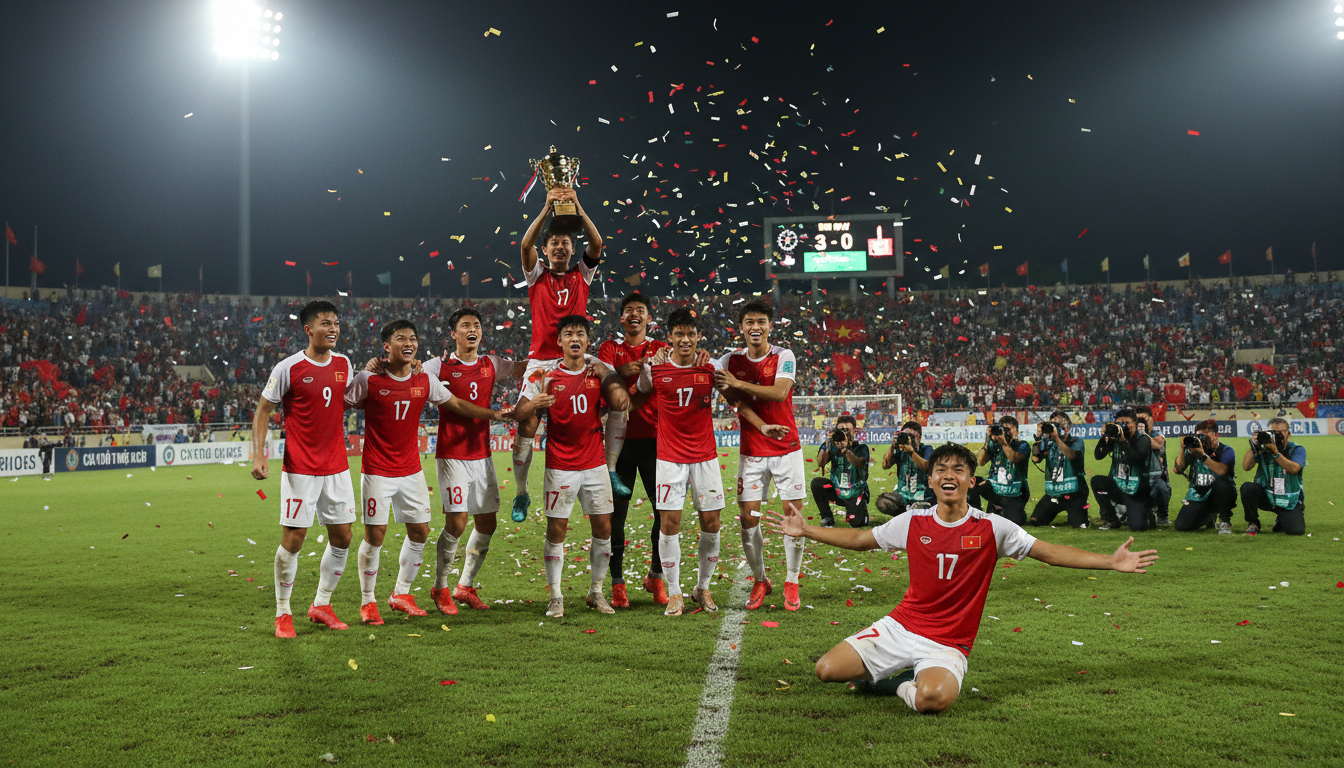
Vietnam Win ASEAN Under-17 Championship 2026 with 3-0 Final Victory over Malaysia
Vietnam defeated Malaysia 3-0 to lift the ASEAN Under-17 Championship 2026 in Sidoarjo, powered by Nguyen Van Duong’s brace; Australia finished third.


Vietnam sealed the ASEAN Under-17 Championship 2026 title with a commanding 3-0 victory over Malaysia at Gelora Delta Sidoarjo on Friday night. Dao Quy Vuong opened the scoring early before Nguyen Van Duong added a late first-half strike and a second-half goal to secure the trophy. The result capped a tournament in which Vietnam combined attacking threat with defensive discipline to outclass regional rivals.
Match Narrative and Final Scoreline
Dao Quy Vuong’s early breakthrough set the tone for Vietnam, who never allowed Malaysia to recover control of the midfield. Vietnam played with intensity from the first whistle and converted possession into decisive chances. Nguyen Van Duong’s brace — the first at the end of the first half and the second shortly after the restart — put the result beyond doubt.
Malaysia showed fight and had moments where they probed for openings, but the visitors were unable to convert their opportunities into goals. Vietnam’s defensive line remained compact and disciplined throughout the match, limiting Malaysia’s most dangerous attackers. By full time the scoreboard read 3-0, a clear reflection of Vietnam’s superiority on the night.
Key Moments That Defined the Final
The game’s decisive moments came at both ends of the first half and early in the second period. Dao Quy Vuong gave Vietnam the lead in the 11th minute with a well-taken finish that unsettled the Malaysian defensive structure. That early goal forced Malaysia to alter their approach and chase the game rather than control it on their terms.
Vietnam struck again just before halftime when Nguyen Van Duong capitalised on sustained pressure to score in stoppage time of the first half. The psychological blow of conceding at 45+4 left Malaysia with little margin for error. Van Duong’s second goal in the 54th minute effectively extinguished any remaining hopes of a Malaysian comeback.
Player Performances and Match Winners
Dao Quy Vuong’s early contribution proved pivotal and highlighted his composure in front of goal. Nguyen Van Duong’s two finishes showcased clinical timing and an ability to perform under pressure. Together they formed a decisive attacking partnership that delivered the championship-winning goals.
Vietnam’s goalkeeper and defensive unit were also noteworthy, producing timely interventions to snuff out Malaysian attacks. Several midfielders combined work-rate with technical control to dominate possession phases. The combination of individual moments and collective discipline underpinned Vietnam’s success in the final.
Australia Rout Laos to Claim Third Place
In the third-place match, Australia produced a dominant 8-0 win over Laos to take the final podium spot in the tournament. Georgio Hassarati produced a remarkable personal haul with five goals, while Aston James Reid contributed a brace and Josef Hunter Sikora added another. The margin underlined Australia’s attacking potency and finishing ability in the classification fixture.
Hassarati’s goals came across the first half and late in stoppage time, with finishes in the 29th, 32nd, 41st, 51st and 90+5 minutes, demonstrating both consistency and fitness. Reid’s strikes in the 44th and 59th minutes and Sikora’s earlier effort in the 21st minute completed a comprehensive victory. The result gave Australia a strong finish after falling short of the final.
Tactical Approaches and Coaching Decisions
Vietnam’s head coach deployed a balanced approach, prioritising midfield control and quick transitions into attack. The coaching staff prepared a game plan that exploited Malaysia’s tendency to commit numbers forward, creating space for quick counters. Tactical substitutions after the interval helped maintain tempo and sealed the match by widening the gap.
Malaysia attempted to respond with tactical tweaks aimed at regaining midfield presence and stretching Vietnam’s backline. Those adjustments produced occasional pressure but were not sustained long enough to change the outcome. In contrast, Vietnam’s measured management of the game — both in possession and when defending leads — demonstrated a clear strategic framework from the bench.
Tournament Context and Vietnam’s Road to the Title
Vietnam’s title run was built on consistent performances across the competition, combining attacking flair with defensive organization. The final victory in Sidoarjo was the culmination of preparation that emphasized pace, pressing and clinical finishing. Throughout the tournament Vietnam showed an ability to adapt their game plan to different opponents while maintaining a core identity.
For Malaysia, reaching the final reflected progress at youth level, even if the side fell short in the decisive match. Australia’s emphatic third-place win highlighted depth in their attacking options and potential in the talent pipeline. Laos’ participation and the experience gained will be valuable for their developmental pathway despite the heavy defeat in the classification match.
The tournament overall delivered several individual breakout performances and exposed a range of tactical schools emerging from across the region. Teams will now assess player development, fitness and tactical systems as they move into the next stages of their youth programs and international fixtures.
Vietnam will now turn attention toward transitioning these U17 successes into sustained progress at higher age groups. The coaching staff faces the task of managing player development while preserving the momentum from this championship. The players themselves will attract attention from clubs and national program managers seeking to integrate the tournament’s top performers into broader development pathways.
Photographs from the final were circulated by the Football Association of Malaysia and other regional bodies, capturing key moments of the match and podium celebration. The visual record underlined the occasion’s significance for players, staff and supporters who traveled to Gelora Delta Sidoarjo.
Vietnam’s victory in the ASEAN Under-17 Championship 2026 offers a clear signal of the country’s advancing youth structures. The clean sheet in the final and the poise shown in attack suggest a generation capable of stepping into under-19 and under-23 roles in the coming years. The regional football community will now watch closely to see how these players progress and how national programs capitalize on this success for long-term development.