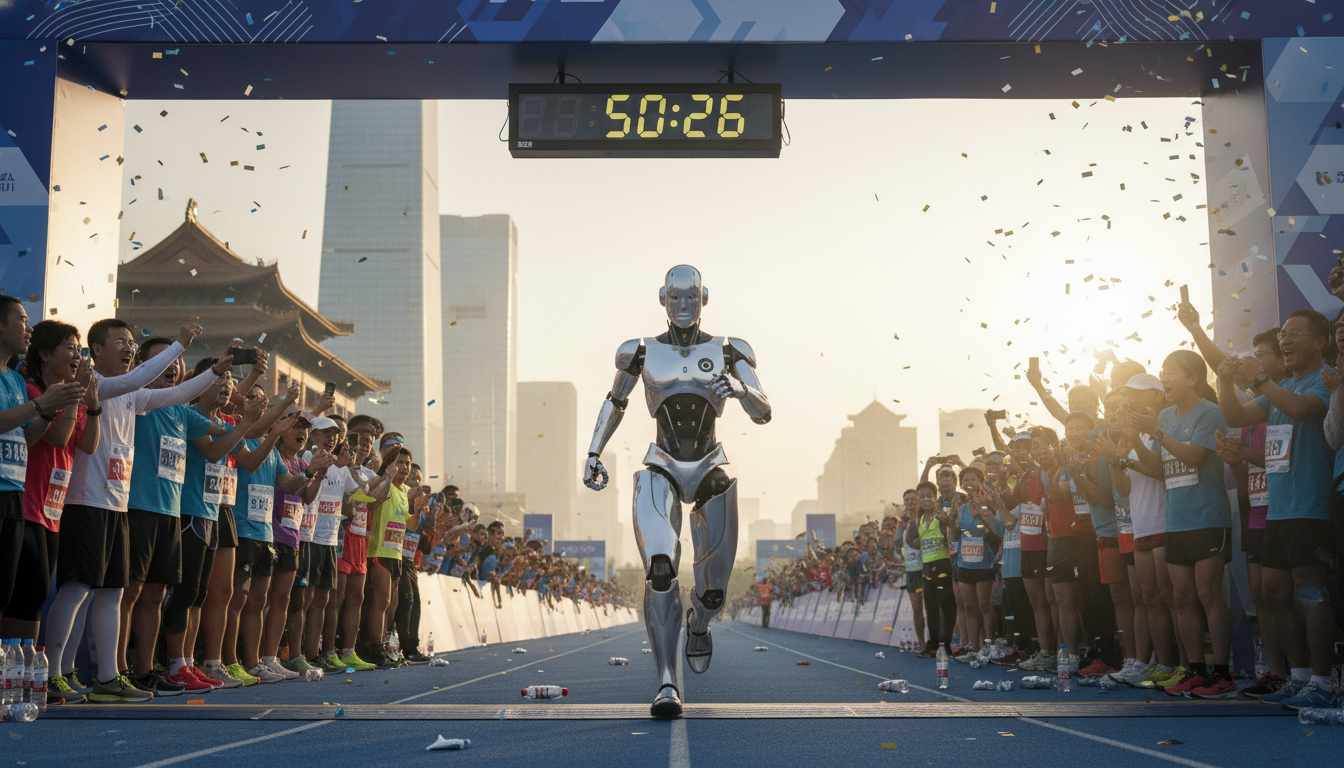
Humanoid Robot Wins Beijing Half-Marathon, Breaks Human World Record
Humanoid robot wins Beijing half-marathon in 50:26, breaking the human world record and highlighting China’s rapid progress in humanoid robotics technology.


A humanoid robot competing alongside amateur runners in a Beijing half-marathon on Sunday finished the 21.1-kilometre course in 50 minutes, 26 seconds, breaking the human world record and drawing global attention. The robot’s victory in the mixed-field event underscored rapid advances in Chinese robotics engineering and reignited debate about the boundary between human athletic achievement and machine performance.
Robot Sets New Benchmark at Beijing Half-Marathon
The machine’s finishing time of 50:26 surpassed every human mark recorded in the race and established a new benchmark for powered bipeds on a road course. Organizers arranged the event to include humanoid robots running with amateur competitors, a format intended to test gait control, endurance systems and real-time balance in outdoor conditions.
Officials described the result as a demonstration of coordinated advances in actuators, control software and energy management rather than a traditional athletic contest. The robot’s performance was timed and validated under the event’s protocols, producing an official finish time that has now been widely reported.
Event Structure and Competition Conditions
Race organizers staged the half-marathon through central Beijing on a course meeting standard half-marathon distance requirements. The mixed field paired humanoid platforms with non-elite runners, creating a rare side-by-side comparison between human pacing and robotic locomotion over a road distance.
The event followed a set of technical and safety rules designed to manage interactions between machines and people on public roads. Marshals monitored the course and enforced separation buffers where necessary, while technical teams followed each robot to address any mechanical or control issues that arose during the run.
Teams, Design and Technical Capabilities
The winning machine reflected a synthesis of lightweight structural materials, high-torque actuators, and real-time locomotion algorithms tuned for uneven urban surfaces. Engineering teams emphasized balance control, adaptive stride planning and efficient power use as the key enablers for maintaining speed over 21.1 kilometres.
Battery and thermal-management systems were central to sustained operation, alongside sensors that enabled foot placement and reactive adjustments to minor surface variations. Developers characterized the victory as the result of iterative testing across controlled environments and incremental improvements in software that allowed the robot to sustain near-constant pace for the duration of the race.
Reactions from Organizers, Competitors and Observers
Event organizers framed the result as a showcase of national technological progress and a platform for public engagement with robotics. Amateur runners on the course described a mix of surprise and curiosity as the humanoid machines maintained consistent cadence in urban traffic conditions and around pack dynamics.
Observers and commentators noted that the event raises questions about how athletic performance is defined and measured when machines can operate at speeds beyond human capability in endurance settings. Several athletes and sport administrators signaled the need for clearer rules if such mixed competitions are to be repeated in pursuit of records or medals.
Implications for Sporting Records and Governance
The robot’s record time prompted immediate discussion about the categorization of results and whether performance achieved by machines should be recorded alongside human marks. Sports governing bodies generally separate human achievements from robotic assistance, and that separation is likely to be reiterated as technology continues to advance.
Policy experts and sports officials will be tasked with clarifying whether races that include autonomous or semi-autonomous machines should be classified as exhibition events, technical demonstrations, or recognized competitions with distinct record-keeping. The Beijing event suggests that the pace of technological progress will outstrip established regulatory frameworks unless stakeholders act to define new standards.
Broader Significance for Robotics and Public Perception
Beyond sport, the event signaled practical strides in translating laboratory locomotion experiments into robust outdoor performance. Sustained bipedal movement over a standard race distance has been a longstanding technical challenge, and the Beijing outcome indicates meaningful progress in materials, power systems and control algorithms.
Public reaction blended fascination with pragmatic questions about safety, utility and the potential non-sporting applications of advanced humanoid robots. Engineers argue that improvements demonstrated in endurance running have direct relevance for disaster response, logistics and environments where human-like mobility is advantageous.
The Beijing half-marathon and the robot’s 50:26 finish offer a concrete illustration of the narrowing gap between experimental robotics and field-capable machines, while also highlighting the ethical and regulatory discussions that will shape future interaction between humans and autonomous competitors.