Real Madrid fury after Camavinga red card sparks touchline confrontations
Real Madrid reacted furiously to the Camavinga red card in Munich, sparking touchline confrontations, Arda Guler’s dismissal and questions over referee Slavko Vincic.


England midfielder Jude Bellingham expressed visible frustration on the pitch after Eduardo Camavinga was shown a second yellow and subsequently sent off, a decision that provoked a heated response from several Real Madrid players and staff. The dismissal, which occurred with the game finely balanced, triggered animated scenes on the touchline and produced disciplinary consequences that will affect the club into the next season. Real’s coaching staff and players argued the timing and justification of the card, saying it changed the course of a tightly contested match.
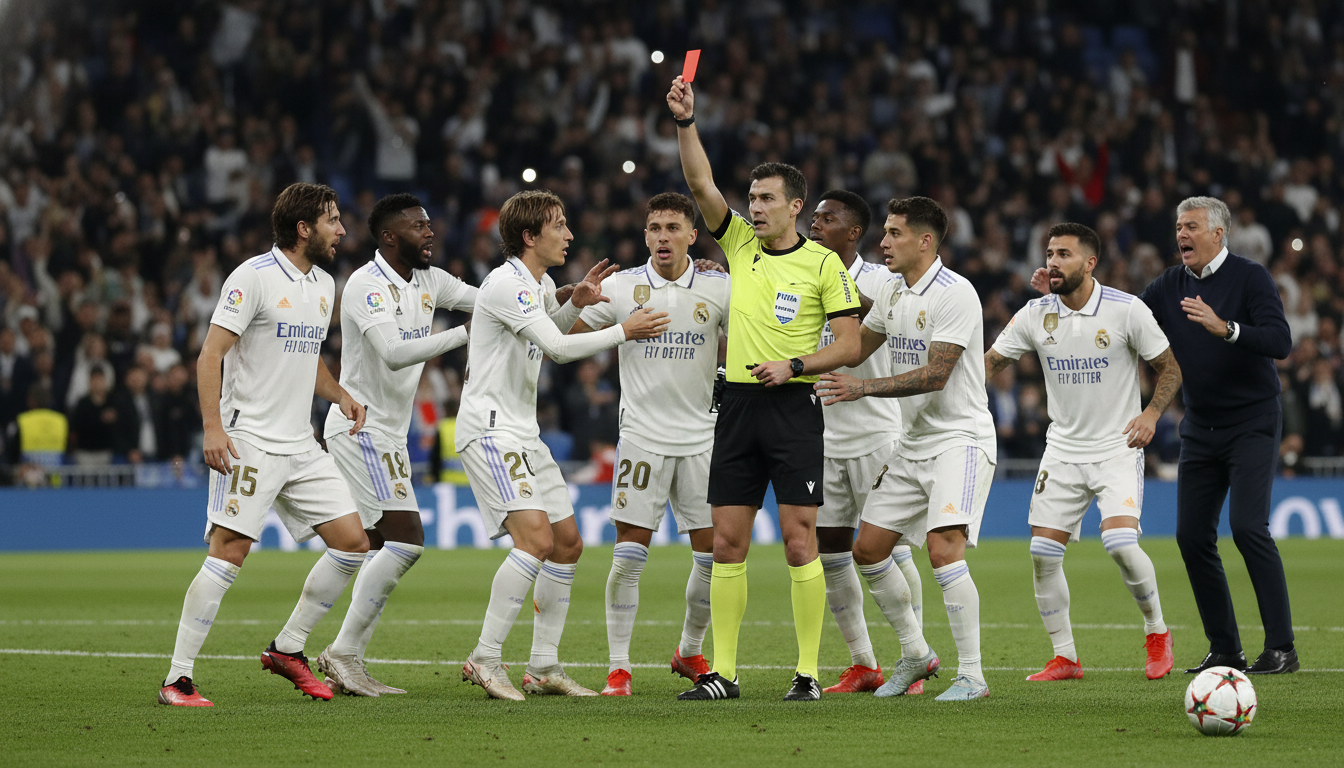
Players confront referee after Camavinga red card
Several members of the Real Madrid squad made their displeasure plain immediately after the incident, approaching the referee and gesturing from the touchline. Club captain Dani Carvajal, who had not featured in the match, was shown on television angrily confronting referee Slavko Vincic and pointing at him as he protested the decision. The scene on the sideline underscored the intensity of the reaction among players and staff, with teammates visibly stunned by the turn of events.
Defender Antonio Rüdiger avoided direct criticism of the official but indicated his dissatisfaction when asked after the final whistle, suggesting that the red card had been an unnecessary escalation. Other members of the squad, including on-field leaders, gathered around match officials in the immediate aftermath as emotions ran high. Those confrontations culminated in further disciplinary action after the match, illustrating how a single decision can ripple through a team’s response.
Arda Guler sent off after storming to the referee
Arda Guler, who had earlier scored two goals to put Real ahead, was shown a red card following his approach to the referee after Camavinga’s dismissal. Television footage captured Guler angrily confronting Vincic and being dismissed from the technical area, a reaction that drew further attention and will carry its own consequences. The club later conveyed remorse for how events unfolded on social media, with the player offering an apology to supporters and promising a response on the pitch.
The immediate sporting effect of Guler’s sending-off goes beyond the match itself, as the player has been handed a suspension that will see him miss the first game of next season’s league phase. That automatic ban follows the rules that govern dismissals for dissent and violent or abusive conduct, and it adds a layer of administrative fallout to what began as a contentious in-game refereeing decision. The sequence — a contested second yellow followed by a player protest that resulted in his expulsion — framed the remainder of the evening for Real Madrid.
Manager Álvaro Arbeloa says the card decided the match
Interim manager Álvaro Arbeloa described the sending-off as decisive, arguing that the dismissal altered the match at a critical moment when both teams were evenly matched. Arbeloa questioned the logic of the second yellow, suggesting that the referee’s decision was both unnecessary and damaging to the balance of the contest. He also implied there had been a breakdown in the referee’s awareness of prior events on the field, which compounded the error in his view.
Arbeloa pressed the point that the match was at its peak intensity when the incident occurred, and that losing a player in that context effectively ended Real’s chance to influence the result on equal terms. His remarks reflected the club’s immediate belief that the officiating, rather than the players’ performance, became the defining factor in the closing stages. The coach’s measured but pointed criticism will likely feed into any formal response pursued by the club in the days ahead.
Spanish media report disbelief and concern in Madrid
Spanish journalists and commentators described a mood of disbelief within the Real Madrid camp, with reports suggesting anger and anxiety about the consequences of the decision in Munich. Commentators argued that issuing a second yellow to Camavinga at that key moment weakened Real’s prospects and swung momentum towards the opposition. Coverage in Madrid emphasized the visual evidence of players converging on the referee and the sense that the decision had changed the competitive balance.
Media voices also suggested the incident could have broader repercussions, both in public perception and in the internal handling of officiating standards for high-stakes matches. Observers in Spain framed the episode as more than a single poor call, proposing it was symptomatic of refereeing choices that can decide major ties. The coverage has kept the story alive beyond the stadium, ensuring the debate over the correctness and timing of the card will continue to feature in analyses.
Refereeing controversy centred on awareness of previous booking
Central to Real Madrid’s complaint was the contention that the referee, Slavko Vincic, issued a second yellow without proper awareness that Camavinga had already been booked earlier in the match. Club officials and the coaching staff alleged a procedural lapse or confusion that led to what they described as a double error: giving a questionable second booking and appearing unaware of the player’s prior caution. That combination, they argued, transformed an otherwise manageable incident into a match-defining dismissal.
Officials from the club maintained that had the referee or his assistants been certain that Camavinga was already cautioned, the course of action might have differed, or at least the decision would have been treated with more caution given the game’s timing. The exchange on the pitch and the subsequent review of the footage are likely to be focal points if Real pursue any formal appeal or if governing bodies elect to assess the referee’s performance. The incident has underscored how split-second awareness and communication among match officials are critical in elite fixtures.
Possible disciplinary steps and what to expect next
Following the events, Real Madrid have several avenues available, including formal appeals against individual dismissals and requests to review the match officials’ performance. Any appeal will be considered by the competition’s disciplinary committee, which has the authority to uphold, reduce, or dismiss sanctions depending on its assessment of the evidence. The red card to Camavinga, being the result of a second yellow, will be scrutinized for its factual basis and for whether process errors occurred during the booking sequence.
Off the field, match footage and referee reports will be collated as part of routine post-match review, and UEFA’s match delegates and refereeing bodies may comment or take action depending on their findings. For Real Madrid, the immediate priority will be to manage the sporting consequences while deciding whether to lodge a formal complaint, mindful that appeals do not always overturn referee decisions. Meanwhile, the club must also prepare for the confirmed suspension of Guler at the start of the next league phase and consider squad rotation to compensate for temporary absences.
The aftermath in Munich leaves Real Madrid facing the practical fallout of on-field discipline and a longer-running conversation about officiating standards in top-level fixtures. The club has signalled its displeasure through the reactions of players and staff, and the incident will remain a talking point until any official review is completed.