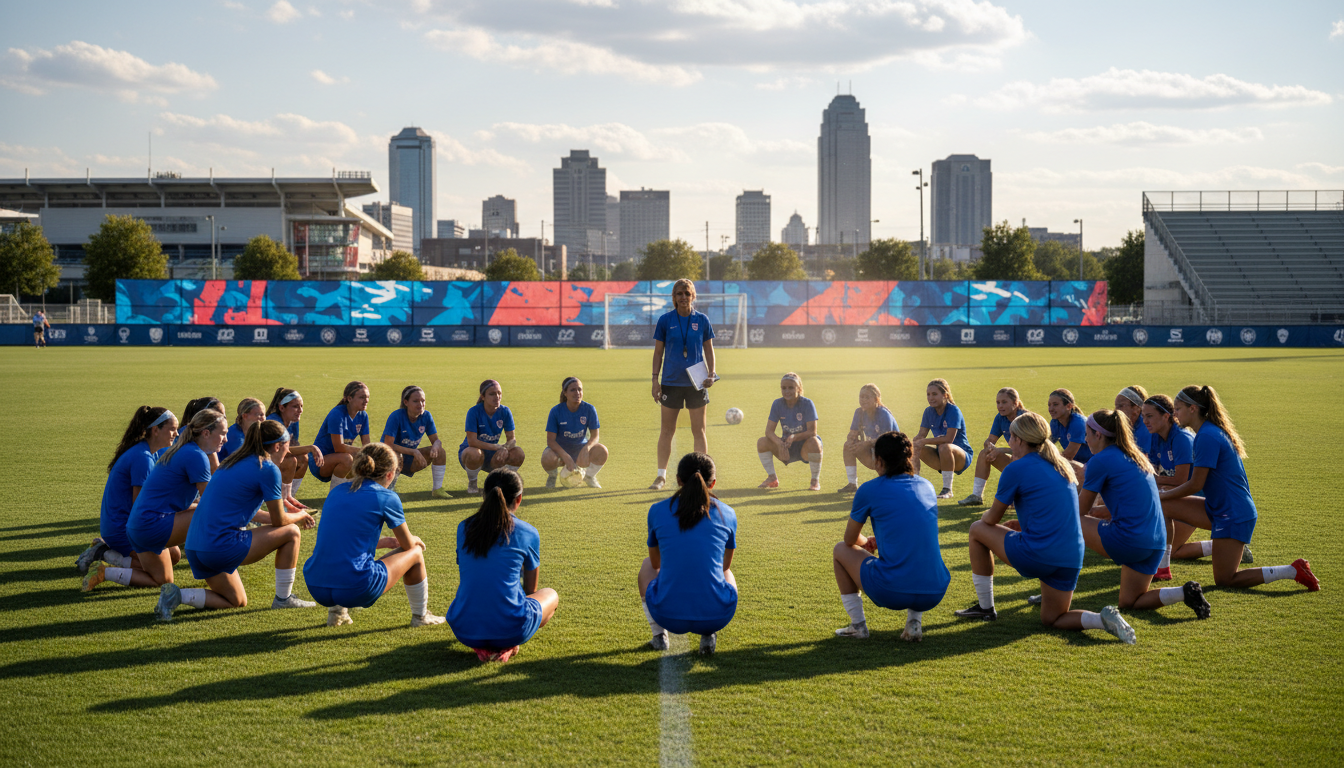
Jepson Calls 24-Player U.S. U-20 Women’s National Team for Kansas City Camp, Brazil Friendlies
Vicky Jepson has named a 24-player U.S. U-20 Women’s National Team roster for a domestic training camp in Kansas City, running April 7–16, that includes two high-profile friendlies against Brazil. The camp and matches are a key step in preparations for the 2026 FIFA U-20 Women’s World Cup in Poland and give the young Americans competitive minutes against one of their World Cup-qualified rivals. The squad mixes NWSL professionals, college standouts and decorated youth internationals as the staff evaluates depth and combinations ahead of the summer tournament.

Jepson names 24-player camp roster
Vicky Jepson’s selection comprises 24 players representing a blend of professional clubs and collegiate programs across the United States. The roster features three goalkeepers, eight defenders, seven midfielders and six forwards, with an average age of 18.8 years and eligibility tied to players born on or after Jan. 1, 2006.
The camp will convene April 7 and run through April 16 in Kansas City, bookended by two matches versus Brazil on April 11 and April 15. The April 11 match takes place at CPKC Stadium at 6:30 p.m. CT, with the April 15 fixture scheduled for 2 p.m. CT at Riverside Stadium on the Kansas City Current training campus.
Kansas City friendlies will test preparations ahead of Poland 2026
Both matchups against Brazil carry heightened significance because both nations have already secured spots for the 2026 FIFA U-20 Women’s World Cup in Poland, scheduled for Sept. 5–27. The friendlies are designed to provide a competitive laboratory for Jepson’s staff to observe tactical implementation and player readiness against a top international opponent.
Playing in back-to-back fixtures also allows the coaching team to replicate tournament conditions—rapid recovery, rotation and tactical adjustments—while measuring how different player groups respond under pressure. Brazil will offer a stylistic contrast to domestic opponents, presenting technical and attacking challenges that will inform roster decisions later this year.
Roster makeup: mix of NWSL pros, college talent and youth internationals
The 24-player group is built from a mix of pathways into the senior game, with a noteworthy contingent of NWSL players alongside college-based talents. Ten players on the roster currently have professional ties to NWSL clubs, while 14 remain tied to college programs, including multiple players from powerhouse programs.
Stanford contributes three collegiate players to the roster, while Florida State, Penn State and North Carolina each have two representatives. The mix reflects an emphasis on blending established youth internationals with players gaining first-team experience in the professional ranks.
Age distribution skews young but experienced: 14 players were born in 2006, eight in 2007, and two in 2008. That spread gives Jepson options both for immediate tournament readiness and for building a longer-term core as the team moves toward Poland.
Key players and storylines to watch in Kansas City
Several individual narratives will draw attention in the Kansas City camp. Onyeka Gamero, a winger who returned to action this season after an ACL injury, will be watched closely as she seeks to reestablish her pace and attacking influence after signing with Bay FC following a spell in Barcelona’s development setup. Her experience at youth World Cups and prior senior youth tournaments makes her a candidate for immediate impact if fit.
Alex Pfeiffer’s comeback from an ACL injury is another compelling subplot; now with Bay FC, Pfeiffer has shown scoring form at the professional level and represents an important attacking option as she fully returns to fitness. Kimmi Ascanio, although the youngest on the roster, brings substantial experience through multiple youth CONCACAF events and the U-17 World Cup, underscoring how age and exposure can diverge in international youth setups.
Goalkeeper competition and defensive depth will also be under scrutiny. Caroline Birkel, Kealey Titmuss and Kealey’s peers bring collegiate and youth international experience that the staff must weigh against the demands of tournament play. Defenders who logged minutes in age-group World Cups and multi-sport events add valuable composure to the backline options.
Injury comebacks and recent club form influencing selection
A number of roster spots reflect recent recoveries and form at the club level, which Jepson’s staff will need to balance against workload and long-term development goals. Players such as Alex Pfeiffer and Onyeka Gamero are in second-chance phases of their early careers, returning from ACL reconstructions with the objective of proving durability and match sharpness.
Several rookies and early-career professionals are included to continue their progression in competitive environments. Young NWSL players who logged minutes this year or gained experience in secondary leagues bring a different readiness profile than college-based peers, giving the coaching staff the opportunity to evaluate how professional minutes translate to international youth performance.
Staff will also monitor how recently graduated college players and multi-year youth internationals integrate tactically and recover physically across the camp’s training cycle and two-match schedule.
Tactical evaluation and coach Vicky Jepson’s objectives
Jepson’s immediate tasks are to finalize positional pecking order, examine combinations in transition and set pieces, and assess which players can sustain the physical and mental demands of a World Cup schedule. The coaching staff will test multiple defensive pairings and midfield structures to identify a balanced formation that can be adapted across opponents.
Set pieces, pressing triggers and out-of-possession organization are likely focal points during the camp given their outsized impact in tournament knockout games. Jepson has emphasized competition for places in recent camps, and these friendlies provide tangible match contexts in which selectors can compare direct performance under match pressure.
Beyond tactics, player management—minutes distribution, load control and recovery protocols—will be critical as the staff balances short-term results with long-term tournament planning and the players’ club commitments.
Teal Rising Week and the Kansas City setting
The two matches in Kansas City are staged as part of the Kansas City Current’s Teal Rising Week, an event spanning April 8–15 that celebrates women’s soccer with matches, youth events and community programming. The April 11 fixture at CPKC Stadium will take place in a venue built as a primary home for women’s professional soccer, while the April 15 match at Riverside Stadium will be played on the Current’s training campus.
Those settings provide both a showcase environment and a chance for the squad to experience different match atmospheres in a condensed timeframe. Playing in front of engaged local crowds and within the broader festival of events gives the young Americans an opportunity to perform on visible stages while the coaching team evaluates game-day preparations and media demands.
Final preparations in Kansas City will also include training sessions at the Current’s facilities, internal tactical walkthroughs and fitness monitoring to ensure players enter the friendlies in optimal condition.
The camp schedule and high-level opposition are intentionally calibrated to deliver learning experiences that mimic tournament conditions, including rapid turnarounds and varied opponent tactics.
The U.S. staff has signaled that evaluation in Kansas City will inform selection decisions heading into the summer’s final preparations, with particular attention on building a roster that can adapt to the condensed, high-stakes format of a 24-team FIFA U-20 World Cup.
Players will return to their clubs and colleges with clear performance benchmarks and feedback from the national team coaches, positioning the next selection window as a continuation of the assessment process.
The Kansas City camp and Brazil friendlies represent a substantive step in the U.S. program’s preparations for Poland 2026, blending competitive matches, tactical work and player development as the team builds toward a major summer tournament.