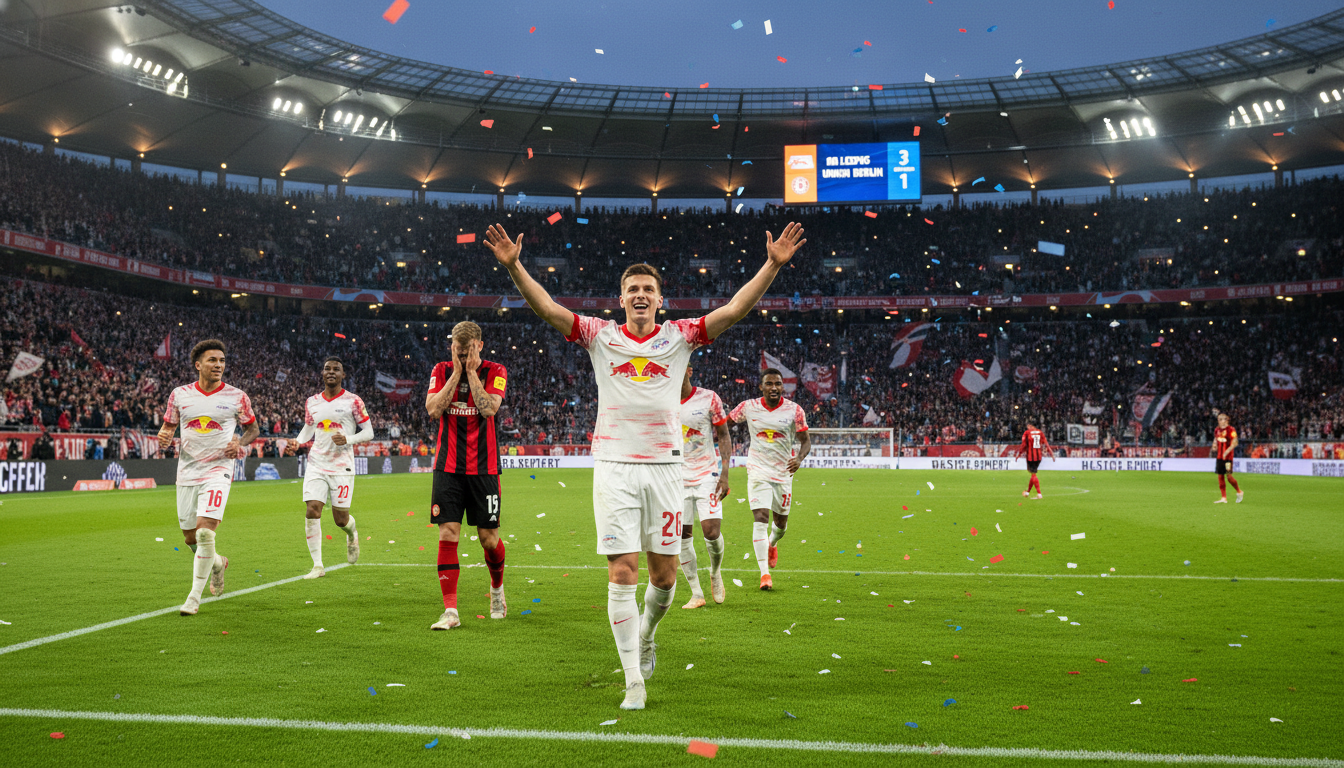
RB Leipzig vs Union Berlin: Leipzig cruise to 3-1 win to strengthen top-four bid
Leipzig secure a commanding 3-1 victory over Union Berlin at the Red Bull Arena on April 24, 2026, in a result that leaves RB Leipzig firmly in the top-four conversation. The RB Leipzig vs Union Berlin clash saw early strikes from Max Fingräfe and Rômulo set the tone, with Ridle Baku adding a decisive third after the break. The win was Leipzig’s fifth straight across all competitions and extended their unbeaten run at home as the season approaches its final three fixtures.


Leipzig seize control with early strikes
Leipzig took the initiative from the opening exchanges and converted pressure into goals inside the first half-hour. Yan Diomande’s work down the right carved space and led to a rebound that Max Fingräfe clinically dispatched from the edge of the area to make it 1-0. Minutes later, a defensive mix-up allowed Rômulo to pounce, round the goalkeeper and double the lead after a loose header from Leopold Querfeld.
The two early goals gave Ole Werner’s side full control and visibly unsettled Union Berlin’s shape. Leipzig continued to press for more before the break, striking the crossbar and preventing Union from establishing any sustained possession spells. By half-time the contest felt settled, with Leipzig dictating tempo and forcing Union into reactive defending.
Diomande’s influence and the quickfire attacking patterns
Yan Diomande was central to Leipzig’s creative thrusts, winning his man and finding runners with quick, probing passes. His cross that led to Fingräfe’s opener was parried by Frederik Rønnow but fell perfectly for the full-back to volley into the bottom corner. Diomande’s intelligence in possession and ability to draw multiple defenders opened pockets for teammates, particularly on the right flank.
That attacking symmetry paid dividends again in the second half when Diomande’s movement and vision created the chance for Ridle Baku. The wing-back slid a precise pass into Baku, who took a composed touch before squeezing his finish past substitute goalkeeper Carl Klaus to make it 3-0. Across the 90 minutes, Diomande’s combination play and willingness to carry the ball forward were the defining features of Leipzig’s attack.
Key moments and turning points that decided the match
The match contained a handful of decisive moments which effectively removed Union’s chance of a comeback. Rômulo’s second-minute touch after the goalkeeper’s misjudgement and Fingräfe’s first-time half-volley arrived inside a short window, creating a cushion that Union struggled to breach. Later, Leipzig’s strike against the crossbar and Maarten Vandevoordt’s timely stop on Oliver Burke maintained their momentum and kept the visitors pinned back.
Union managed a set-piece consolation when Danilho Doekhi met Josip Juranović’s delivery with a powerful header to beat Vandevoordt, but the goal arrived too late to alter the result. A disallowed Ilyas Ansah effort momentarily threatened Leipzig’s control, yet it underlined how Union could only fashion fragmented opportunities rather than sustained periods of pressure.
Defensive strengths for Leipzig and defensive lapses for Union
Leipzig’s defensive structure balanced aggression and compactness, preventing Union from finding space between the lines. Maarten Vandevoordt’s presence in goal provided assurance, and the backline absorbed the limited threats that did emerge before clearing danger efficiently. Ole Werner’s team also showcased discipline in maintaining shape when possession was turned over, limiting Union’s transitional counters.
By contrast, Union Berlin were punished for individual errors and moments of hesitation at the back. The poor header that allowed Rômulo to steal in early on exemplified the lapses that cost them. Across the 90 minutes Union’s backline struggled to build cohesion under Leipzig’s pressing rhythm, leaving their midfielders chasing possession rather than dictating play.
Tactical adjustments and Werner’s game management
Ole Werner’s set-up emphasized wide overloads and quick vertical passes to unsettle Union’s defensive lines. Leipzig deployed their full-backs with license to join attacks, giving Diomande and Fingräfe the freedom to create and finish chances. Werner’s substitutions were conservative but effective, ensuring the team retained control after the third goal while also managing legs ahead of a congested run-in.
Union’s coach made attempts to alter the match dynamics, introducing fresh legs between the lines to spark forward play, but the timing and execution of those changes failed to wrest momentum back. Carl Klaus’ late appearance in goal limited the damage to the scoreline, but it did little to change the underlying imbalance in territorial control. Tactical discipline from Leipzig and a lack of coherence from Union proved decisive in the closing stages.
Standings impact and the run-in with three games left
The victory strengthens Leipzig’s bid for a top-four finish as the Bundesliga season enters its final phase with just three matches remaining. Leipzig sit third after the result, extending a run of five consecutive wins and six matches unbeaten at the Red Bull Arena. That consistency has placed them in a favorable position to secure Champions League qualification, provided they maintain form over the remaining fixtures.
For Union Berlin, the defeat deepens a troubling sequence of results that has now seen them go five matches without a win and suffer three straight losses. Sitting 11th, Union face a period in which points must be salvaged to avoid slipping further, especially given the congested nature of the table below them. Both sides will take stock quickly, with Leipzig aiming to preserve momentum and Union searching for tactical answers before the next round of fixtures.
Leipzig’s performance on April 24, 2026, offered a comprehensive display of control, clinical finishing and tactical maturity, while Union Berlin will need to address defensive frailties and improve their attacking cohesion. The result keeps Leipzig on course as the title race and European qualification push reach a decisive stage, and it leaves Union with urgent work to halt a downturn in form ahead of their remaining matches.