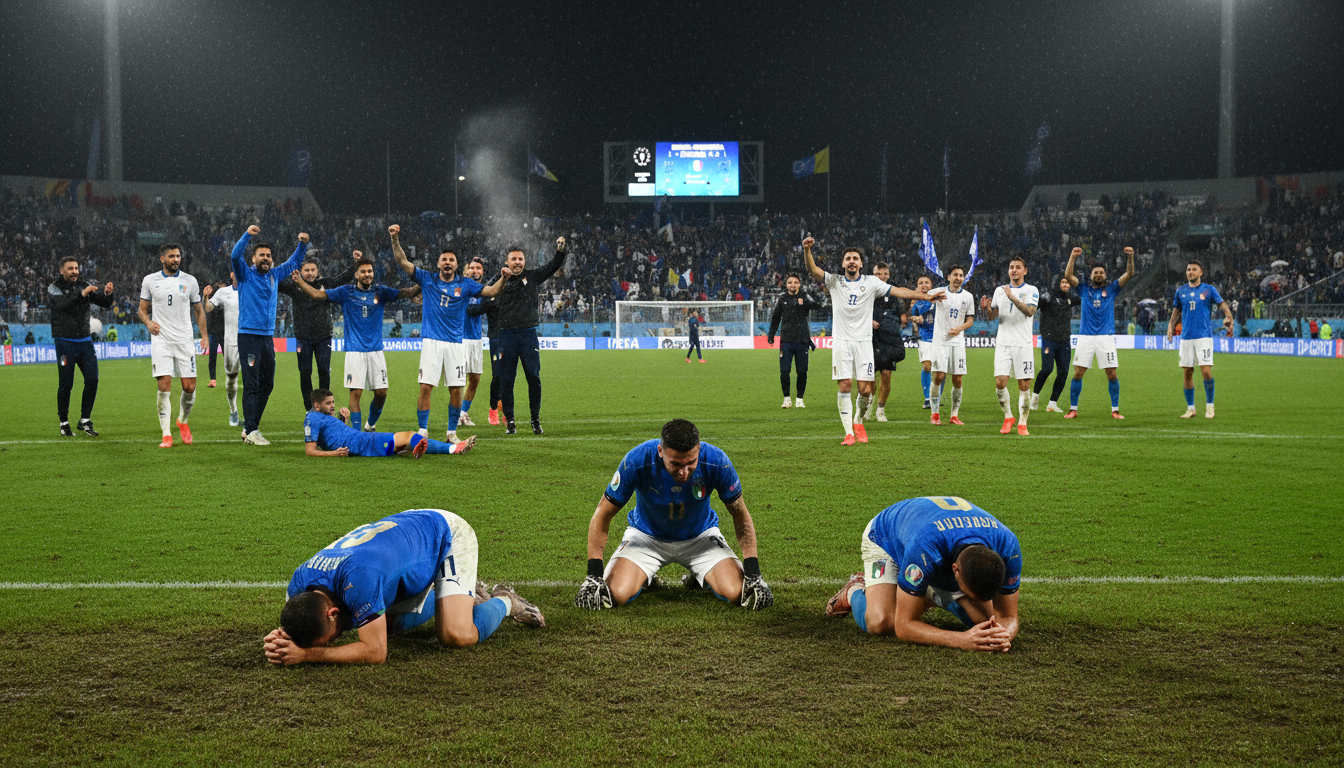
Italy Fail to Qualify for World Cup After Bosnia Win on Penalties
Italy fail to qualify for World Cup as Bosnia beat them on penalties in Zenica; Turkey, Czech Republic, Sweden, DR Congo and Iraq also clinch 2026 places.


Italy fail to qualify for World Cup after a dramatic play-off defeat to Bosnia and Herzegovina, who prevailed 4-1 in a penalty shootout in Zenica following a 1-1 draw after extra time. The result means the four-time champions will miss a third successive World Cup, while Turkey, the Czech Republic and Sweden secured European places and intercontinental ties produced debutants and surprise qualifiers. The outcome casts fresh uncertainty over Italy’s immediate future and marks a historic night for Bosnia and Herzegovina and the other teams that sealed their spots.
Bosnia stun Italy in Zenica with dramatic shootout victory
Bosnia and Herzegovina held firm to force a penalty shootout after Haris Tabakovic cancelled out Moise Kean’s early strike, leaving the tie level at 1-1 after extra time. The shootout unfolded in favour of the hosts, who converted four spot-kicks while Italy managed only one, with Sandro Tonali the lone successful penalty taker for the Azzurri. Bosnia’s composure under pressure in front of a partisan Zenica crowd proved decisive, delivering one of the most seismic qualification shocks in recent European qualifying history.
The match narrative swung on a handful of pivotal moments that shaped the outcome and set the tone for the shootout. Italy began brightly and took an early lead, but the game turned in the closing stages of the first half when Alessandro Bastoni was dismissed with a straight red card. Reduced to ten men, Italy were forced to adapt tactically and ultimately could not find a way to regain control against a determined Bosnian side.
As the game stretched into extra time, both teams carved chances but neither side could find a decisive goal, and the contest moved to penalties where Bosnia executed with clinical efficiency. The Italian players confronted high drama from the spot, with Francesco Pio Esposito missing an early attempt and Bryan Cristante striking the crossbar, moments that swung the shootout irreversibly. Bosnia’s victory was sealed when their fourth successful spot-kick left Italy unable to respond.
The result will be remembered in Bosnia as a landmark achievement, with players, staff and supporters celebrating a qualification that underscores the nation’s progress on the international stage. For Italy, the night will register as a bitter reversal after a campaign and a final that promised much but ended in elimination.
Key turning points: Kean’s opener and Bastoni’s red card
Moise Kean’s 15th-minute finish gave Italy an early ascendancy and suggested the Azzurri might control the remainder of the match. The goal was composed and clinical, a swift response to the pressure of a one-off play-off final that demanded an early statement from the visitors. Kean’s strike briefly eased the nerves of the travelling Italy supporters and provided a platform for the team to build on.
The momentum shifted late in the first half when Alessandro Bastoni received a straight red card, reducing Italy to ten men and forcing a tactical reshuffle from coach Gennaro Gattuso. Playing a man down in a hostile environment reshaped the remainder of the encounter, as Italy were obliged to retreat into a more conservative shape and rely on counter-attacks and set-piece opportunities. The numerical disadvantage placed an increased physical and mental strain on the Azzurri, which Bosnia exploited through sustained pressure in the second half.
Bosnia’s persistence paid off when Haris Tabakovic found the equaliser on 79 minutes, a strike that shifted belief to the home side and set the stage for a nervy finish. Italy, hindered by the dismissal and the mounting intensity, struggled to fashion clear chances in regulation and could not manufacture a winning goal in extra time. Those key moments — the early lead and the subsequent red card — will be scrutinised closely as Italy’s coaching staff and federation assess the factors behind the failure to qualify.
The disciplinary turning point highlighted broader tactical questions for Italy, including squad selection and in-game management under pressure. Facing a must-win fixture with limited margin for error exposed vulnerabilities that opponents exploited, and those issues will now demand attention at both the national team and federation levels.
Penalty shootout breakdown and decisive misses
The shootout became the focal point of a tense evening, with Bosnia converting four spot-kicks to Italy’s solitary success from the spot. Sandro Tonali converted his attempt, but Francesco Pio Esposito struck his early penalty over the bar and Bryan Cristante’s effort cannoned off the crossbar, compounding the pressure on the remaining takers. Bosnia’s trier of spot-kicks displayed composure, accuracy and mental resilience when it mattered most.
Penalty shootouts often turn on details — the weight of expectation, the goalkeeper’s posture, the taker’s technique — and this shootout was no exception. Italy’s misses came at inopportune moments and left little margin for recovery, particularly in a fixture that permitted no second leg or reprieve. For the Bosnian keepers and takers, the evening will be celebrated as a collective demonstration of nerve and preparation.
The psychological toll of the shootout on Italy’s players and staff will be considerable, as elimination in this format compounds the challenge of assessing individual responsibility and systemic issues. The Azzurri’s inability to convert from the spot now becomes a focal point in post-match analysis, with set-piece practice and mental preparation likely to receive renewed emphasis in the coming weeks.
For Bosnia, the shootout success represents the culmination of careful planning and execution, validating travel, scouting and penalty preparation that paid dividends under intense pressure. The victory provides momentum and belief as the nation prepares for a first-hand experience at the expanded World Cup stage.
Bosnia’s qualification and national significance
Bosnia and Herzegovina will travel to the 2026 World Cup with the confidence that comes from overcoming a heavyweight opponent in a winner-takes-all encounter. The qualification carries substantial emotional and sporting weight for the nation, representing a historic achievement for players who have carried the national jersey through qualifying and beyond. Celebration across Bosnia is likely to be widespread, reflecting the cultural importance of football and the magnitude of the victory.
Qualification offers practical benefits as well, including increased visibility for Bosnian players, potential commercial opportunities and a platform to test the squad against some of the world’s best teams in North America. The tournament will provide exposure that can accelerate player development and attract attention from clubs and leagues seeking to bolster their rosters. For the national federation, the success creates a rare momentum window to invest in infrastructure, youth development and long-term planning.
The path to the World Cup was shaped by tactical discipline, home advantage and a willingness to shoulder pressure, traits that will be examined and reinforced as Bosnia prepares for the tournament draw and logistics. How the squad transitions from qualification euphoria to measured preparation will be important in determining how they perform on the global stage.
Beyond immediate footballing consequences, the qualification serves as a unifying event for supporters and the country’s diaspora, offering a powerful narrative of achievement and international recognition. The emotional resonance of this night in Zenica will endure in the nation’s sporting memory.
European landscape: Turkey, Czech Republic and Sweden join the finals
Alongside Bosnia’s breakthrough, other established European nations secured their places at the expanded 48-team World Cup, with Turkey, the Czech Republic and Sweden all booking tickets to North America. Each qualification reflects different trajectories: Turkey’s emerging talent pool and tactical evolution, the Czech Republic’s reliance on technical structure and Sweden’s continued consistency on the international stage. These nations add further depth to the European contingent at the finals.
The presence of Turkey, Czech Republic and Sweden in the tournament underscores the competitive balance across UEFA qualifying and the ripple effects of key play-off ties. Their inclusion alters group projections and potential matchups, as tournament organisers and media begin to speculate on seeding and draws. For each federation, qualification secures not only sporting prestige but also the logistical and commercial planning that accompanies World Cup participation.
These qualifications also highlight the rigorous nature of European cycles, where fine margins from single elimination fixtures determine which nations advance. The expanded field in 2026 increases opportunities, but the play-off format retains high-stakes drama where a single result can redefine a national team’s four-year trajectory. Expect detailed preparation from the qualified sides as they map out training camps, friendlies and squad building for the summer finals.
For supporters across the continent, the final list of qualifiers crystallises months of drama and will inform summer viewing plans, travel arrangements and national expectations for the tournament itself. The contest to secure one of Europe’s spots remains among the most fiercely contested pathways in international football.
Intercontinental play-offs deliver DR Congo and Iraq for final berths
The intercontinental play-offs produced two notable outcomes, with the Democratic Republic of Congo qualifying for the World Cup for the first time since 1974 and Iraq claiming the final available berth. DR Congo’s return marks a rare and celebrated appearance on the sport’s biggest stage, reflecting the nation’s growth and competitive potential in recent years. Iraq’s qualification adds further diversity to the tournament field and rewards a campaign that culminated in a dramatic intercontinental decider.
Both teams now face the operational and sporting demands of World Cup preparation, including expanded travel, squad consolidation and strategic planning to ensure competitiveness in North America. These qualifications will provide a global showcase for players who may seize opportunities to secure moves to larger clubs or leagues. From a federation perspective, the financial and developmental implications of World Cup participation can catalyse investment in domestic football structures.
The intercontinental play-offs once again underscored football’s global reach, offering nations outside Europe a pathway to the finals and the chance to challenge established powers on football’s premier stage. The addition of DR Congo and Iraq enriches the tournament narrative and introduces fresh storylines fans and commentators will follow closely as the event approaches.
The successful teams will need to schedule preparatory matches and manage player availability carefully to translate qualification into a competitive World Cup presence. The logistical hurdles are considerable, but the reward — exposure and the experience of tournament football — outweighs the challenges for both federations.
Italy face a complex process of review, rebuilding and renewal after failing to secure a place in the 2026 World Cup. The loss in Zenica compounds the disappointment of previous cycles and will prompt an internal evaluation of coaching decisions, squad selection, disciplinary issues and the strategic direction of the national program. There will be calls for clarity from the federation on the next steps and for a roadmap that addresses immediate weaknesses while laying foundations for future competitiveness.
Public and media scrutiny is likely to intensify in the wake of elimination, with supporters demanding answers and a coherent plan that moves beyond short-term fixes. Italy’s rich footballing history and infrastructure provide resources for recovery, but translating those assets into a renewed on-field identity will require focused leadership and transparent decision-making. The coming months will be critical as the federation decides whether to pursue continuity or introduce fresh voices to shepherd the team forward.
For the wider international calendar, these qualification results reshape the field of contenders and create new groupings of interest for the tournament draw. As nations begin logistical preparations, tune-up matches and squad selection, the narrative of the 2026 World Cup will continue to evolve toward the summer in North America. The outcome in Zenica stands as a reminder of the thin margins that define international football, where a single night can reshape history for players, coaches and entire nations.
The aftermath of Zenica will reverberate across Italian football, while Bosnia, Turkey, the Czech Republic, Sweden, DR Congo and Iraq prepare to take their places on the World Cup stage in what promises to be an expanded and compelling tournament.