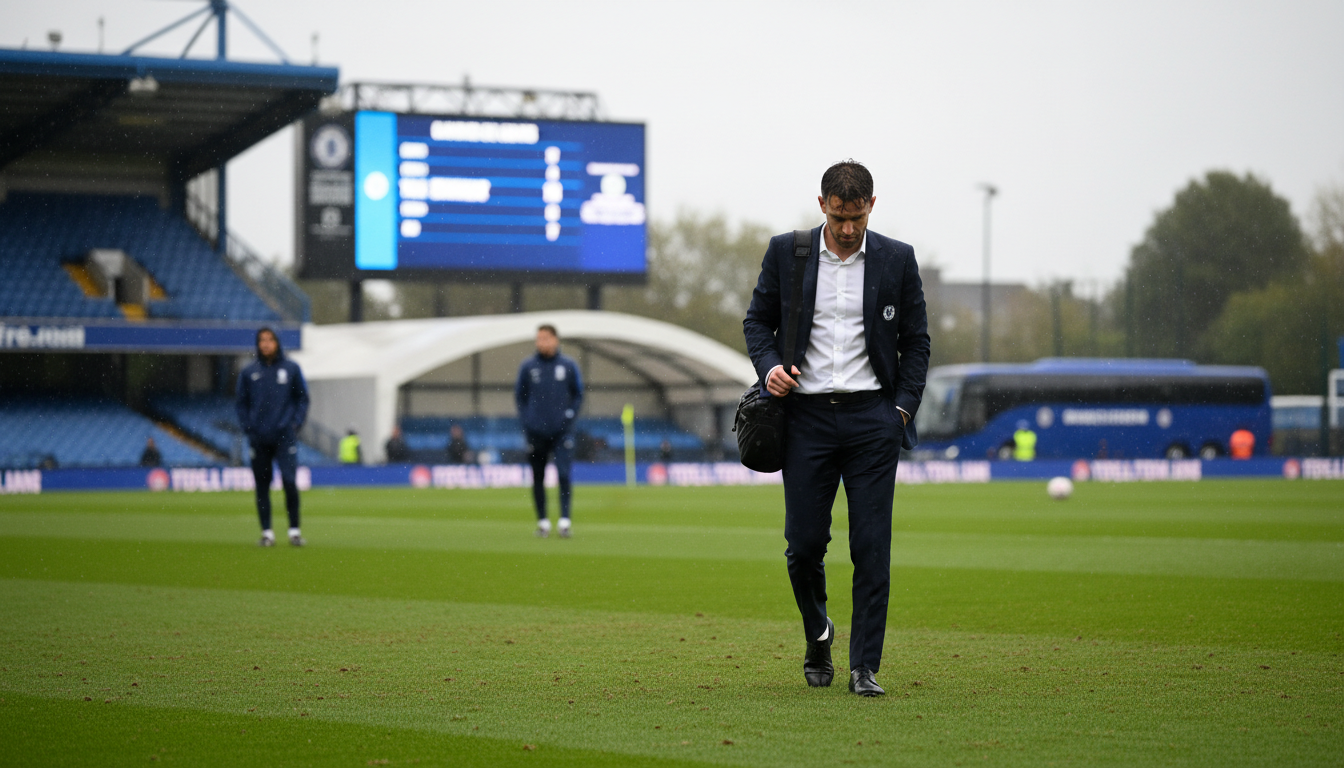
Chelsea sack Liam Rosenior after five straight Premier League defeats
Chelsea sack Liam Rosenior after five successive Premier League defeats; Blues goalless in five league games for first time since 1912, club cites poor form. (155 characters)


Liam Rosenior has been dismissed as Chelsea head coach after less than four months in charge, the club announced on Wednesday following a run of five successive Premier League defeats. The decision comes as Chelsea endured a barren spell in front of goal, failing to score in five straight league matches for the first time since 1912. Rosenior, 41, was appointed in January after Enzo Maresca’s departure and had arrived from Strasbourg, an affiliate of Chelsea’s ownership group.
Club ends Rosenior era after rapid slide
Chelsea confirmed the parting in a brief statement that framed recent results and performances as falling below the club’s required standards. The board signalled the move was not taken lightly but made clear that with so much still to play for this season a change was necessary. The result that crystallised the decision was a 3-0 loss at home to Brighton & Hove Albion, a defeat Rosenior described himself as “unacceptable.”
The club’s announcement stopped short of detailing an interim plan for the remaining fixtures, instead focusing on the need to restore performance levels quickly. Behind the terse messaging was a season-long context of underachievement and mounting pressure on the technical staff and playing group. Chelsea’s hierarchy faces immediate questions about timing and the pathway forward given the proximity of remaining domestic and European commitments.
Historic run and scoring drought underline crisis
Chelsea’s inability to find the net in five consecutive league games represents an unprecedented low in the modern era for the club. The sequence, combined with seven losses in eight matches across all competitions, placed severe scrutiny on Rosenior’s methods and the squad’s response. The last time the club endured a similar goalless losing streak in league play was 1912, highlighting the rarity and severity of the slump.
The offensive problems were compounded by defensive lapses and inconsistency in midfield control, leaving the team unable to exert sustained pressure in matches. Fixture congestion and squad turnover over the season have been cited internally as contributing factors, but on the pitch the drop in output was plain. Fans and pundits have noted a lack of cutting edge in the final third and insufficient cohesion in transitional moments.
From Strasbourg appointment to short tenure
Rosenior was recruited from Strasbourg in January, an appointment that reflected Chelsea’s ongoing links with the French club under the ownership group’s broader network. The former full-back arrived with a brief to stabilise results and reinvigorate a squad that had endured change earlier in the campaign. His tenure lasted under four months, a period that included sporadic promise but ultimately failed to arrest the slide.
His predecessor, Enzo Maresca, had left the Stamford Bridge hotseat earlier in the season, prompting a search that prioritised familiarity with the ownership model and an emphasis on progression. Rosenior’s coaching background and approach were seen as compatible with the club’s long-term framework, yet the rapid deterioration in form meant the window to effect tangible improvement closed quickly. That short timeline has revived debate about managerial turnover and expectations at elite clubs.
Tactical questions and squad dynamics
Across recent matches Chelsea displayed fluctuating formations and personnel choices, as the coaching staff sought answers to the team’s scoring drought. The tinkering, while intended to spark creativity, often resulted in a lack of continuity that hindered rhythm between defensive and attacking units. Several promising players failed to convert chances or adapt to shifting roles, which intensified scrutiny of training methods and match-day preparation.
Injuries and rotation added to the complexity, but the club’s recruitment and selection decisions were also scrutinised by supporters and analysts. The balance between youth opportunities and reliance on experienced heads became a recurring talking point as results declined. Opponents exploited gaps in transition and pressing structures, and Chelsea’s inability to register consistent shots on target became a recurring theme in post-match analysis.
Board response and club statement on standards
Chelsea’s public statement emphasised that recent performances had not met the standards expected by the organisation, underlining the club’s aim to protect its competitive objectives. The board framed the decision as necessary given the remaining fixtures and the opportunity to salvage the season. While the statement did not name an immediate successor, it made clear that the club would move swiftly to appoint a replacement capable of improving results.
Internal meetings between senior executives and technical staff were understood to have taken place in the wake of the Brighton defeat as the club evaluated short- and medium-term options. Supporters received the news with mixed reactions, reflecting frustration with results and concern about the instability at managerial level. The ownership and board now face pressure to choose a direction that balances short-term rescue with long-term planning.
Outlook for the remainder of the season and succession scenarios
With the season still active, Chelsea must quickly address tactical coherence and goal-scoring deficiencies to preserve its competitive standing domestically and in Europe. Possible internal options include appointing an interim caretaker from within the coaching ranks while conducting a global search for a permanent replacement. External candidates discussed by industry observers range from experienced managers able to produce immediate results to younger coaches aligned with the club’s developmental philosophy.
Any successor will inherit a squad in need of clearer identity and striking efficiency, and the transfer window context will shape medium-term decisions. The club’s recruitment strategy, already a focal point this season, will be essential in any managerial transition to ensure alignment between playing style and personnel. For now, Chelsea’s priority is to halt the negative run and restore confidence among players and supporters.
Liam Rosenior’s dismissal closes a brief chapter that began with promise and ended amid a stark downturn in form, leaving Chelsea to regroup and determine the next steps in a season that remains very much alive.