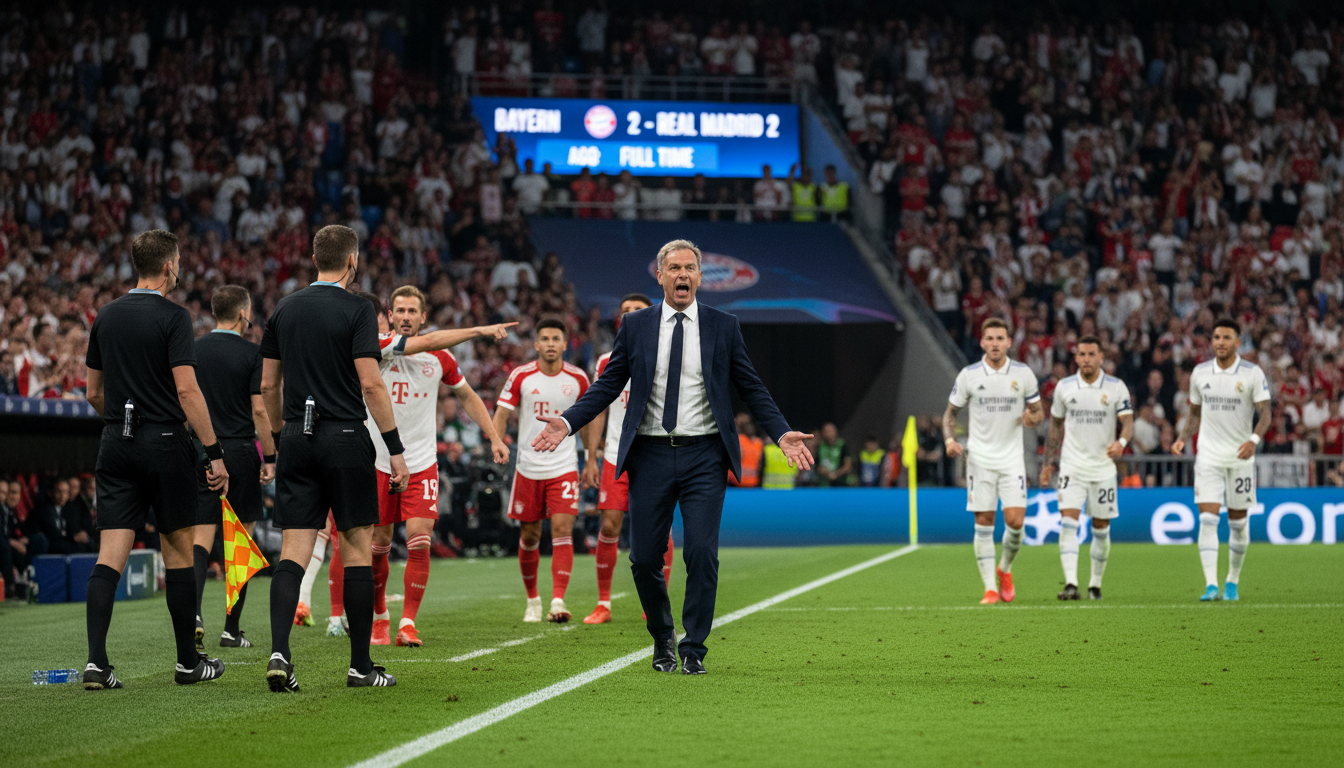
Bayern Munich refereeing controversy overshadows Champions League exit after 1-1 draw with PSG
Bayern Munich refereeing controversy after a 1-1 draw with PSG: Vincent Kompany criticises two handball decisions that shaped a 6-5 aggregate exit. Dramatically.


Bayern Munich were eliminated from the UEFA Champions League after a 1-1 draw with Paris Saint-Germain at the Allianz Arena that left the Bavarians trailing 6-5 on aggregate. The result was immediately followed by intense criticism from Bayern coach Vincent Kompany and widespread debate over two handball incidents that shaped the tie. The match and its officiating decisions have become the central focus of post-match coverage and debate across European media. (apnews.com)
Kompany’s post-match criticism of match officials
Vincent Kompany publicly challenged the referee’s handling of two incidents in the first half, telling reporters he had viewed replays and believed one decision in particular was “absolutely clear” and potentially decisive. Kompany argued that Konrad Laimer had not handled the ball in the sequence that was punished, and that Nuno Mendes should have received a second yellow card for a separate handball. His comments, delivered at the post-match news conference, set the tone for the widespread criticisms aimed at João Pinheiro’s refereeing that followed. (tntsports.co.uk)
Contested Laimer handball and the Mendes booking that was not given
The first flashpoint came when the referee awarded a free kick for an apparent handball by Bayern’s Konrad Laimer, a call that Bayern argued was mistaken and that the earlier action by PSG’s Nuno Mendes—apparently a handball—had gone unpunished as a second yellow. Bayern staff and players maintained that replays showed no clear hand contact by Laimer, and that the match official had penalised the wrong player in the sequence. Broadcasters and analysts replayed the moment repeatedly, and the incident quickly became the most cited example of the decisions Bayern said cost them the tie. (uk.sports.yahoo.com)
João Neves handball in the area and competing interpretations
Minutes later, Bayern appealed for a penalty after the ball struck PSG midfielder João Neves inside the penalty area following a clearance attempt by a teammate. The referee chose not to award a spot-kick, a decision explained by match officials and subsequent coverage as being influenced by the fact the ball was played by a PSG teammate immediately prior to Neves’ contact. That sequence intensified the debate because Bayern argued the ball had been kept alive in a dangerous area by Neves’ arm and therefore should have been penalised. Media outlets and former referees gave differing assessments in the hours after the match. (en.as.com)
Law 12 and the IFAB guidance cited by both sides
At the centre of the argument between Bayern and match officials is the interpretation of IFAB’s Law 12 on handball, which sets out when contact between ball and arm is an offence and lists specific situations where it is not. IFAB guidance has long distinguished deliberate handling from accidental contact and offers examples covering deflections and situations where the ball comes from a teammate. That text has been used by refereeing bodies and commentators to justify not awarding a penalty in cases where an initial clearance by a teammate directly precedes contact with another player’s arm. The rulebook’s wording and the application of its Q&A clarifications have become focal points for analysts breaking down the incidents. (theifab.com)
Referee João Pinheiro’s decisions and the match context
João Pinheiro’s rulings in Munich have been scrutinised not only for the two handball episodes but also for how the calls influenced the momentum of a tight semifinal. Pinheiro, who officiated the pairing, opted for a free kick against Laimer and declined to award a penalty when Neves was struck by the ball after a teammate’s clearance. Bayern coaches and players said those choices changed the structure of the match at a moment when an extra card or a penalty would have had immediate consequence for the aggregate scoreline. Coverage across several outlets highlighted how a brief spell of contentious decisions can alter the strategic balance in two-legged knockout football. (sports.fr)
Divergent expert views and wider media reaction
Reactions from pundits, former referees and national media were mixed, with some arguing that the referee’s calls were defensible under existing guidelines and others calling them clear errors. Certain analysts stressed that application of the handball law is nuanced and that the referee and his team may have judged intent and ball trajectory in real time, while critics insisted that the replays left little room for doubt in at least one of the incidents. National outlets in Germany and France ran strong editorials and television panels dissecting the decisions, reflecting the passionate stakes of a Champions League semi-final. (as.com)
Implications for Bayern and the competition’s governance debate
Beyond the immediate grievance, Bayern’s complaints feed into a broader conversation about refereeing consistency in UEFA competitions, the role of VAR and how IFAB guidance is communicated by match officials. Bayern administrators have traditionally reserved formal protest procedures for only the clearest breaches, but public pressure following high-profile calls in a semi-final increases scrutiny on the governing bodies. The episode is likely to prompt renewed calls for clearer public explanations from match control units and for the governing authorities to set out how guidance is applied in high-stakes matches. (eurosport.tvn24.pl)
Bayern Munich’s elimination on a 6-5 aggregate scoreline will now be remembered as much for the controversy over officiating as for the on-field action, and the two disputed handball incidents are likely to be revisited by refereeing instructors, pundits and the club in the days ahead. (apnews.com)