Eight Arrested After Osasuna-Real Madrid Clashes at El Sadar
Navarra police have arrested eight alleged Indar Gorri members over disorder and attacks on officers after the Osasuna-Real Madrid clashes at El Sadar on Feb. 21, with an active investigation underway.

Summary of Arrests and Allegations
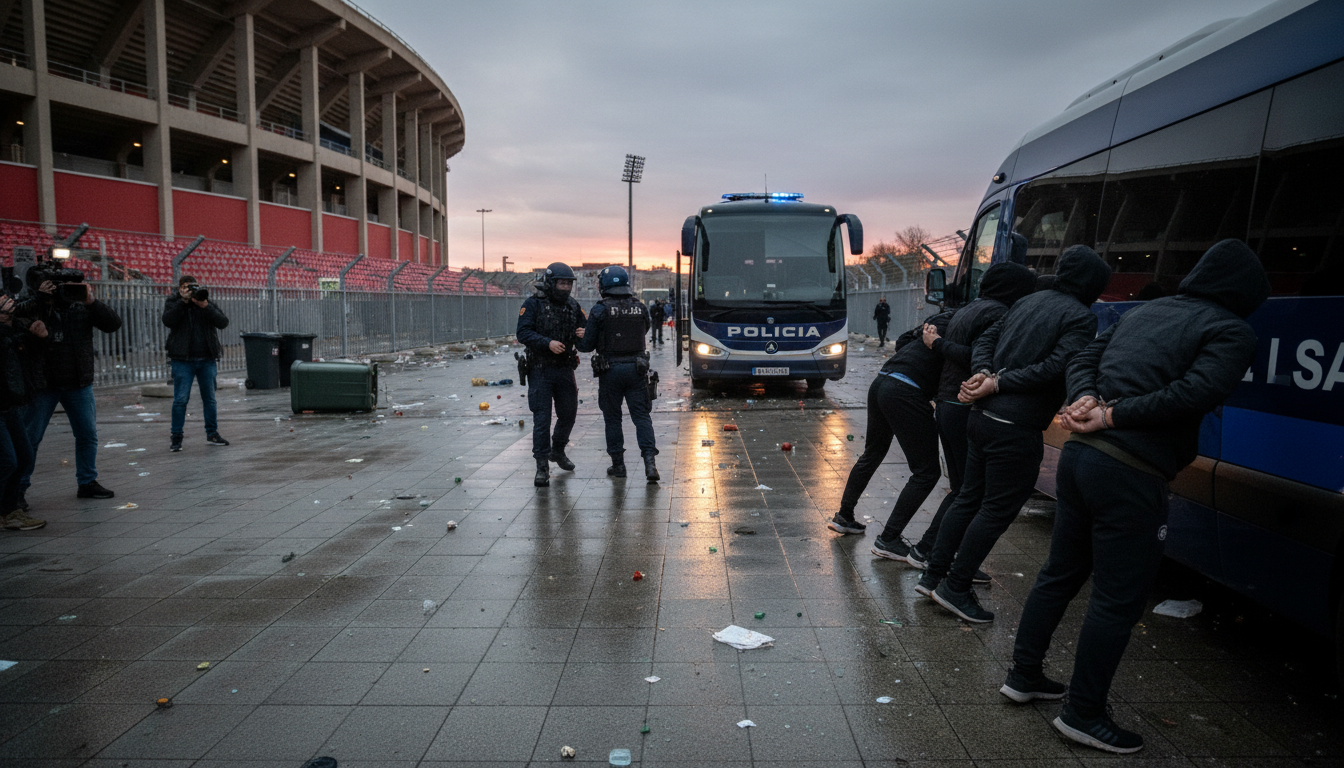
Eight men have been detained in Navarra as part of a police operation tied to the Osasuna-Real Madrid clashes that took place at El Sadar Stadium on February 21. Authorities say the suspects, all residents of different Navarre towns, belong to the Indar Gorri supporters’ group and face charges of public disorder and assault on law enforcement.
Police sources indicate the latest arrests follow earlier detentions made in March and two arrests carried out on the day of the incidents, showing the investigation has been ongoing for months. The regional Brigada Provincial de Información is leading the operation and describes the action as part of a broader effort to identify individuals who attacked officers outside the stadium.
Police Operation and Timeline
The provincial intelligence unit of Navarra’s National Police launched the current phase of the inquiry after reviewing evidence and witness accounts related to the disturbances. Investigators say the wider operation has involved multiple days of activity, with the most recent detentions occurring as officers moved to identify those they believe assaulted members of the police intervention unit.
According to the police, the chain of events began during the match and accelerated after the final whistle, when security staff requested assistance to address an incident involving a spectator who had thrown a bottle into the pitch. That request prompted a security escalation that eventually drew in the National Police’s Unidad de Intervención Policial.
Alleged Role of Indar Gorri Ultras
Authorities assert that the detained individuals are members of Indar Gorri, the organized ultras faction associated with CA Osasuna, and that they actively sought to impede the identification of a spectator. Police say those actions led to confrontations in the stadium’s south stand and outside Gate 23, where a group of about 30 people began hurling heavy objects and rubbish bins at officers.
Investigators have linked the alleged attackers to the violent episodes by combining photographic and video evidence with witness statements and on-the-ground police reports. The charges brought so far focus on public disorder and assaulting officers, pending further judicial processing as the criminal investigation continues.
Events Outside Gate 23
Police reports describe a concentrated outbreak of violence near Gate 23 after a number of supporters left the stands and encouraged others to resist police efforts to identify the person who had thrown a bottle. Officers from the UIP were targeted with projectiles and aggressive physical confrontations that temporarily blocked the exit and required reinforcements to extract the intervention unit.
Three members of the intervention unit reportedly required assistance during the clashes, prompting additional police resources to secure the area and prevent the situation from worsening. Authorities say the aggressive behavior endangered the normal course of the game and the safety of spectators, which justified the deployment of further policing measures.
Club Response and Legal Involvement
Club Atlético Osasuna has publicly announced its intention to intervene in the judicial process to protect the rights of its members and supporters. The club’s decision to appear in the case reflects concerns voiced within sections of the Osasuna community about the circumstances of the police intervention inside the stadium.
Osasuna’s move to become a party in the proceedings signals that the club will seek access to investigative documents and will take a formal role in defending supporters’ rights during court proceedings. The club has not disputed the need to address spectator violence, but it has emphasized its interest in ensuring that any police action is scrutinized through legal channels.
Security at Matches and Coordination with Private Staff
The disturbances began after the club’s private security personnel requested police support when a spectator allegedly threw an object onto the pitch. That request underscores the routine partnership between club security services and state police at top-flight fixtures, and it raises questions about how identification and ejection procedures are managed during high-tension moments.
Police maintain that they entered the stadium to assist in identifying the spectator and to prevent action that could interrupt the match or place fans at risk. The intervention escalated when groups tried to block the identification process, leading officers to use available means to repel attacks, according to the official account.
Judicial Process and Ongoing Investigation
Those arrested face charges related to public disorder and assault on agents of the authority as the case moves through the courts. The investigation remains active, with police continuing to gather material evidence and to determine the role of each detained individual in the incidents that followed the Osasuna-Real Madrid clash.
Further judicial decisions, including whether detained suspects will be held or released pending trial and whether additional arrests will be made, will depend on the evidence compiled and assessments by prosecutors. Authorities have signaled that the operation is part of a methodical effort to hold accountable those responsible for violence linked to the match.
Repercussions for Fan Culture and Stadium Safety
The arrests come amid ongoing debates in Spanish football about how to manage ultras groups, balance fan expression, and maintain safety at stadiums. Incidents like the El Sadar disturbances tend to renew calls for stricter enforcement of stadium rules, better coordination between clubs and police, and clearer protocols for identifying and removing dangerous individuals.
At the same time, supporters’ groups and club officials often push back against broad-brush measures that they say can criminalize entire sections of fans. The legal proceedings following the Osasuna-Real Madrid clashes will likely feed into wider discussions about policing tactics and the responsibilities of clubs to prevent fan violence.
Final paragraph
The police operation in Navarra marks a significant step in the investigation of the February 21 disturbances after the Osasuna-Real Madrid match, and it highlights the complex mix of criminal, sporting and civil-rights issues that arise when clashes break out at football fixtures.