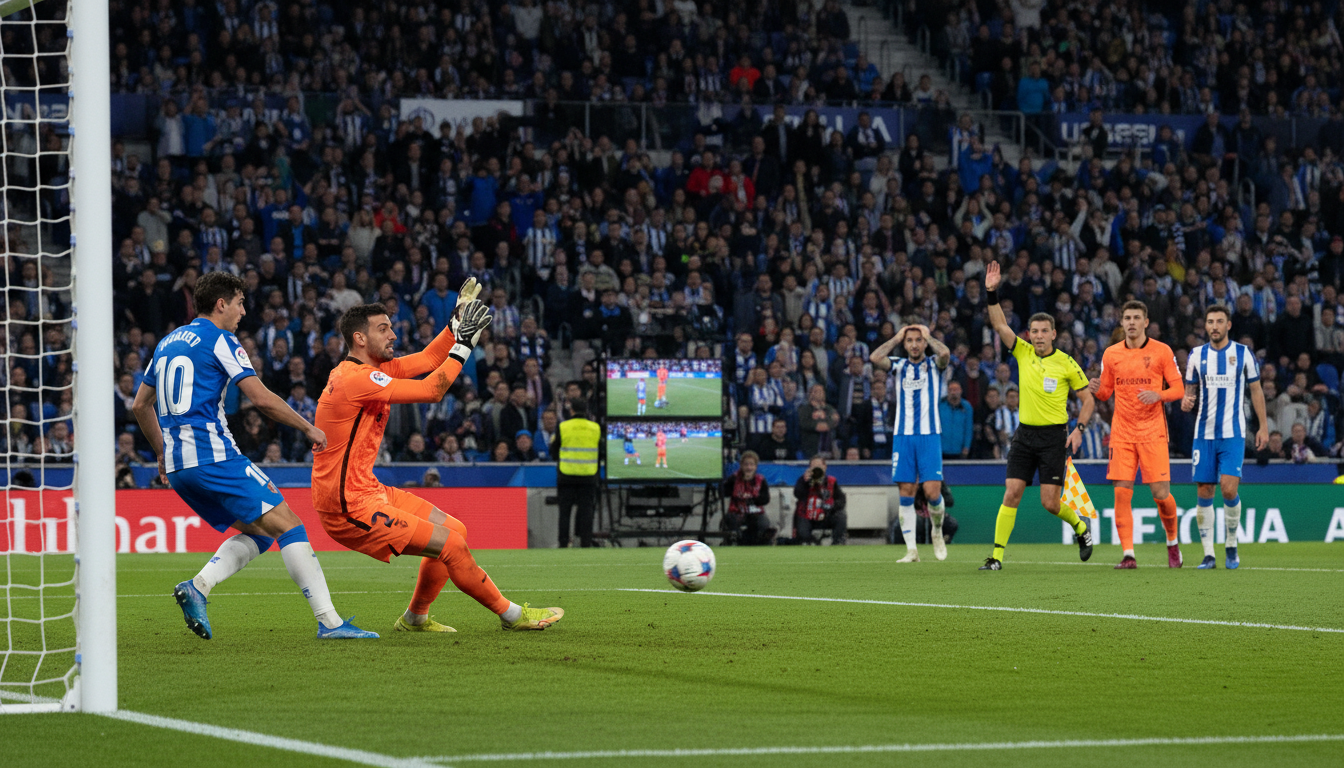
Real Sociedad VAR penalty as Abqar handball leads to spot kick saved by David Soria
Real Sociedad VAR penalty was the decisive intervention of the night as a pitchside review awarded a spot kick to the hosts at Anoeta, only for Getafe goalkeeper David Soria to save. The VAR check followed a Brais Méndez header and a handball call on defender Abqar in the 33rd minute of a tense encounter. Referee Mateo Busquets Ferrrer went to the monitor, judged the arm to be in an unnatural position and pointed to the spot without issuing a card.


Opening decision and match moment
The sequence began with a header from Brais Méndez inside the box that prompted immediate VAR attention. Getafe had already taken the lead earlier through an own goal involving Real Sociedad defender Aihen Gorrotxategi, and the penalty call briefly swung momentum back toward the home side. The review lasted long enough to require Mateo Busquets to consult the pitchside monitor before confirming a penalty for handball.
VAR operator Mario Melero alerted the referee to a potential infringement and asked for an on-field review, following the standard communication protocol used in top-tier matches. On the monitor the officials focused on the point of impact and the position of Abqar’s arm at the moment the ball struck. After examining the footage at different speeds the on-field referee concluded the defender’s arm was in an extended, unnatural position.
How the VAR review unfolded
The exchange between the VAR room and the referee was procedural and linear, reflecting current elite-level practice for clear and obvious errors. The VAR recommended the referee view the footage on the sideline monitor to assess both impact and arm position, and the referee complied. Replays shown at normal speed and at reduced speed were used to determine whether the contact met the threshold for a penalty.
Officials described to the referee that the arm appeared to increase the defender’s body profile in a way that was not necessary to the player’s movement. That assessment is consistent with the framework referees apply when distinguishing deliberate handball from contact caused by the natural position of the arm. After the review Mateo Busquets signaled for a penalty and indicated he would not issue a disciplinary card for the action.
Penalty execution and Soria save
Real Sociedad took the penalty but were unable to convert as David Soria produced a decisive stop from the spot. The save denied the hosts an immediate route back into the game and preserved Getafe’s lead at that stage. Soria’s intervention underlined the significance of goalkeeping in match-defining moments and kept the contest finely balanced.
The goalkeeper’s positioning and anticipation were notable as he committed early and reached the ball to turn it away, drawing audible reaction from the Anoeta crowd. For Real Sociedad the missed penalty represented a costly opportunity to equalize, while for Getafe the stop reinforced defensive resilience amid a period of sustained pressure from the home side.
Referee choices and the no-card decision
The on-field official’s decision to award a penalty without a yellow card reflected his view of intent and the circumstances of the challenge. In making that call Mateo Busquets judged that while the arm was in an unlawful position it did not constitute a reckless or deliberately cynical act that would merit a booking. That interpretation sits within the discretionary remit referees possess when balancing punishment alongside a sanction for the foul itself.
Disciplinary choices in handball incidents have long been a flashpoint in public debate, particularly when protocol produces different outcomes in similar-looking situations. Here the match official applied the sanction he believed matched the action after reviewing the footage, a step that will be scrutinized by coaches and analysts given the high stakes of spot-kick scenarios.
Match context and tactical repercussions
The penalty incident occurred in the first half and influenced both teams’ tactical approaches for the remainder of the game. Real Sociedad, having failed to convert, were forced to search for other avenues to break down a compact Getafe structure. Getafe, buoyed by Soria’s save, had license to sit deeper and rely on quick transitions and set-piece opportunities.
Substitutions and in-game adjustments that followed reflected managers’ attempts to respond to the turning point created by the VAR intervention. For the hosts the need to regain momentum prompted a more aggressive posture in midfield and across the flanks, while the visitors sought to maintain defensive discipline and exploit the counterattack.
Wider implications for VAR and handball interpretation
The decision at Anoeta will add to the broader conversation about VAR usage and the interpretation of handball in the penalty area. Supporters of video review argue incidents like this show VAR can correct on-field errors and apply consistency, while critics point to the subjective elements that still leave room for dispute even after lengthy checks. The balance between technological assistance and referee discretion remains central to that debate.
Match officials and competition organizers are likely to reference this incident in internal evaluations, noting both the clarity of the video evidence and the communication between the VAR room and the on-field referee. For coaches and players, the episode underscores the importance of awareness in defensive positioning and the fine margins that now separate acceptable play from punishable offenses.
The game at Anoeta produced a dramatic moment of modern refereeing that shaped the tactical flow and emotional rhythm of the contest. The penalty award and subsequent save by David Soria will be replayed and analyzed in the days ahead as clubs, pundits and fans interpret the application of the laws in live game conditions.