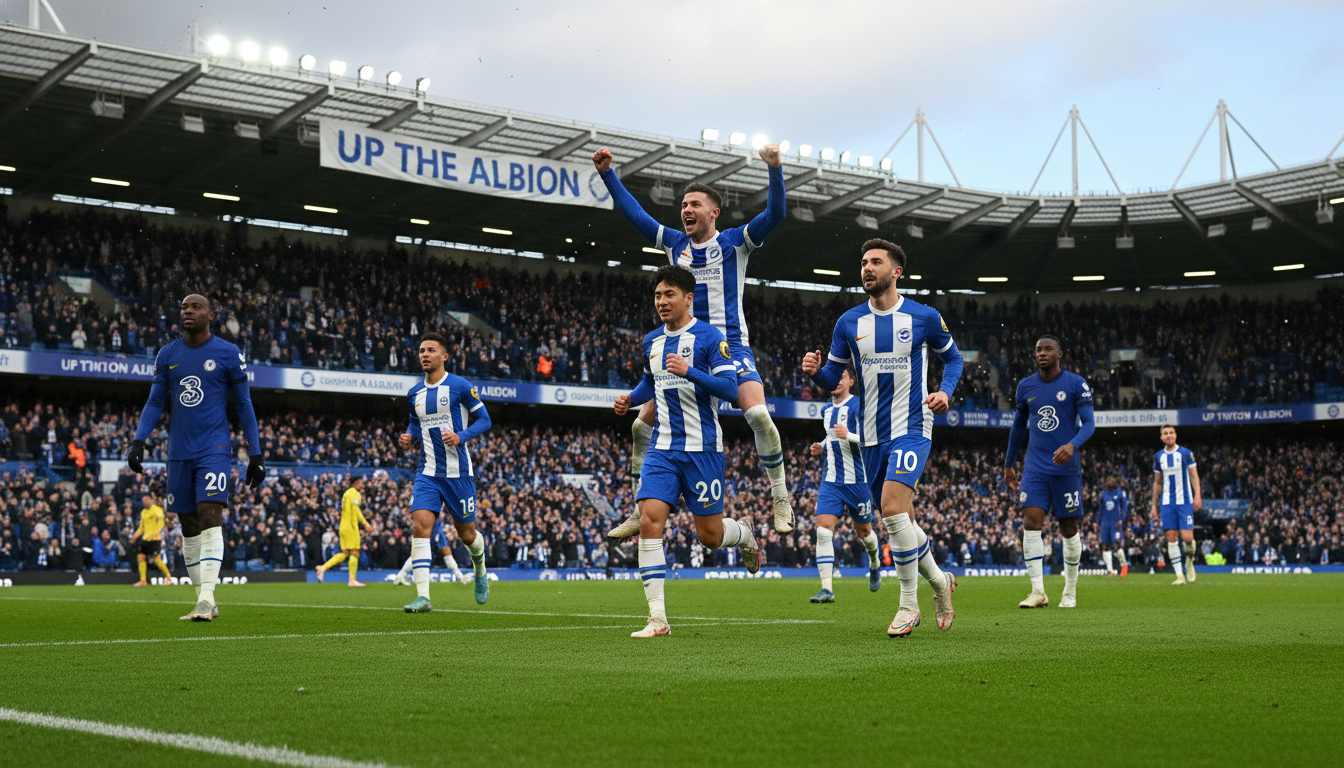
Brighton vs Chelsea: Seagulls Sweep to 3-0 Victory as Blues Slip Out of Top Six
Brighton vs Chelsea: Brighton thumped Chelsea 3-0 at the Amex on April 21, 2026, moving into sixth as the Blues sink to a fifth straight Premier League defeat.


Brighton delivered a commanding performance to beat Chelsea 3-0 at the American Express Stadium on April 21, 2026, a result that propelled the Seagulls into the Premier League top six. The match, decided early and reinforced by clinical second-half finishing, saw Brighton dominate possession and chances while Chelsea produced almost nothing in attack. Brighton’s victory replaces Chelsea in sixth place and leaves the Blues staring at a deteriorating run of form with serious implications for their season.
Brighton dominate from the first whistle
Brighton seized control almost immediately, with the decisive opening goal arriving inside the third minute and setting the tone for the night. Kaoru Mitoma’s volley forced a smart save from former Brighton goalkeeper Robert Sánchez, and the ensuing corner eventually found Ferdi Kadioglu, whose first-time effort deflected in off Wesley Fofana to put the hosts ahead. From that early breakthrough Brighton sustained pressure, probing Chelsea’s backline and continually creating openings across the pitch.
The Seagulls’ ball circulation and positioning repeatedly exposed Chelsea’s defensive gaps, turning the contest into a largely one-sided affair. Brighton’s midfield tempo and wide combinations kept Chelsea on the back foot for long spells, allowing the home side to control the game and hunt additional opportunities. That control translated into clear statistical superiority in expected goals and shot volume throughout the match.
Key moments that defined the contest
Several incidents shaped the match beyond the opening goal, including a goal-line clearance that denied Brighton a second early on and a pair of goals that extinguished any hope of a Chelsea comeback. Trevoh Chalobah’s header off the line prevented an immediate second after Jack Hinshelwood was presented with a glaring chance following a poor Chelsea pass. The reprieve was temporary; Hinshelwood later made no mistake in the 56th minute when he stayed onside, collected Georginio Rutter’s pass and slotted past Sánchez.
Brighton wrapped up the scoring deep into stoppage time when substitute Danny Welbeck redirected Maxim De Cuyper’s centre into the net, sealing a convincing 3-0 margin. Mitoma and Kadioglu came close to increasing the tally earlier in the half, while Brighton’s substitutes provided fresh impetus that kept Chelsea pinned back. Those moments underlined the gulf in both confidence and execution between the sides on the night.
Chelsea’s offensive collapse and statistical alarm bells
Chelsea offered almost nothing in attack, failing to register a single shot on target and producing a meagre 0.38 expected goals (xG) compared with Brighton’s 2.17. The Blues’ first-half xG of 0.04 was particularly stark, representing the lowest figure recorded in any of Enzo Maresca’s 114 Premier League halves as Chelsea head coach. Across the last nine league matches, Chelsea have accumulated just five points, a run of form matched unfavourably only by relegation-threatened Tottenham in that sample.
Beyond the numbers, Chelsea’s forward play lacked cohesion and penetration, with long spells spent chasing the ball rather than constructing meaningful attacks. The defensive errors and turnovers that created Brighton’s chances were symptomatic of wider issues in Chelsea’s buildup play and decision-making. Those problems were compounded by a failure to convert set-piece or counter opportunities when they did arise.
Tactical shifts and Rosenior’s halftime changes
Liam Rosenior’s decision to abandon a 3-4-3 shape at half-time produced a brief improvement in Chelsea’s organization, but it proved insufficient to alter the outcome. The switch temporarily added defensive solidity and clearer lines through the midfield, yet Chelsea were already two goals behind and lacked the attacking structure to mount a credible response. Rosenior’s tactical gamble highlighted both his willingness to adapt and the limited options at his disposal amid a poor run of form.
Brighton’s manager retained faith in an approach that prioritized width, high-energy pressing and quick transitions, and those elements continued to trouble Chelsea after the break. Brighton’s substitutes were also used effectively to maintain tempo and exploit Chelsea’s weariness, with Welbeck’s late goal offering a final illustration of the home side’s superior squad execution. Rosenior must now weigh whether tactical tinkering or personnel changes will best arrest the slide ahead of a congested run-in.
Historical context and Opta-backed trends
Chelsea’s five consecutive league defeats mark only the second time in the club’s history such a sequence has occurred, a negative run previously seen in 1993-94 when the club displayed similar vulnerability. It is also the first instance since November 1912 that Chelsea have suffered five straight league losses without scoring, an unwelcome historical footnote for a club of their stature. Opta data across recent matches further underscore the malaise: Chelsea have collected just five points from their last nine Premier League games, while Tottenham occupy the only worse tally in that timeframe.
Brighton, conversely, have gone five league games unbeaten, their best sequence since a six-game run that bridged two seasons. The statistical gulf between the teams was evident in the xG and shot metrics as well as in the heat maps of territory and chance-creation. Those numbers not only reflect the outcome on the scoreboard but also indicate which side is better placed to sustain momentum through the closing fixtures of the campaign.
Consequences for the top-six and Champions League hopes
Brighton’s victory lifts them into sixth, one place and two points clear of Chelsea, and reignites faint hopes of a top-four surge if other results fall their way. For Chelsea, the defeat is likely terminal for realistic Champions League ambitions this season: they now sit seven points behind fifth-placed Liverpool with only 12 points available from the remaining four fixtures. That gap places enormous pressure on Rosenior’s side to arrest the slump and salvage something from the run-in, with European qualification looking increasingly improbable.
The reshuffle in the standings will intensify scrutiny on Chelsea’s recruitment, tactical approach and board-level decisions as the club confronts a potential period without elite European competition. Brighton meanwhile can consolidate their position and pursue improved finishes, but they will also need to maintain consistency across their remaining fixtures to turn this mid-table surge into a sustained achievement. The wider Premier League landscape may yet shift, but tonight’s result materially altered the trajectories of both clubs.
Brighton’s performance combined early aggression and intelligent game management, and it will be studied by rivals for evidence of how to break down vulnerable defences. Chelsea’s response requires introspection and rapid repair, particularly in attacking creation and defensive composure, if the club is to avoid a damaging slide as the season concludes.
Brighton will travel next week with renewed belief and a clearer route into the European picture, while Chelsea face the immediate task of restoring confidence and competence as they prepare for a crucial sequence of matches.