Washington Huskies national title built on in-state core and patient development
Washington Huskies national title in 2025 was powered by a 100% domestic roster and 20 in-state players, spotlighting a homegrown development model and a shift.

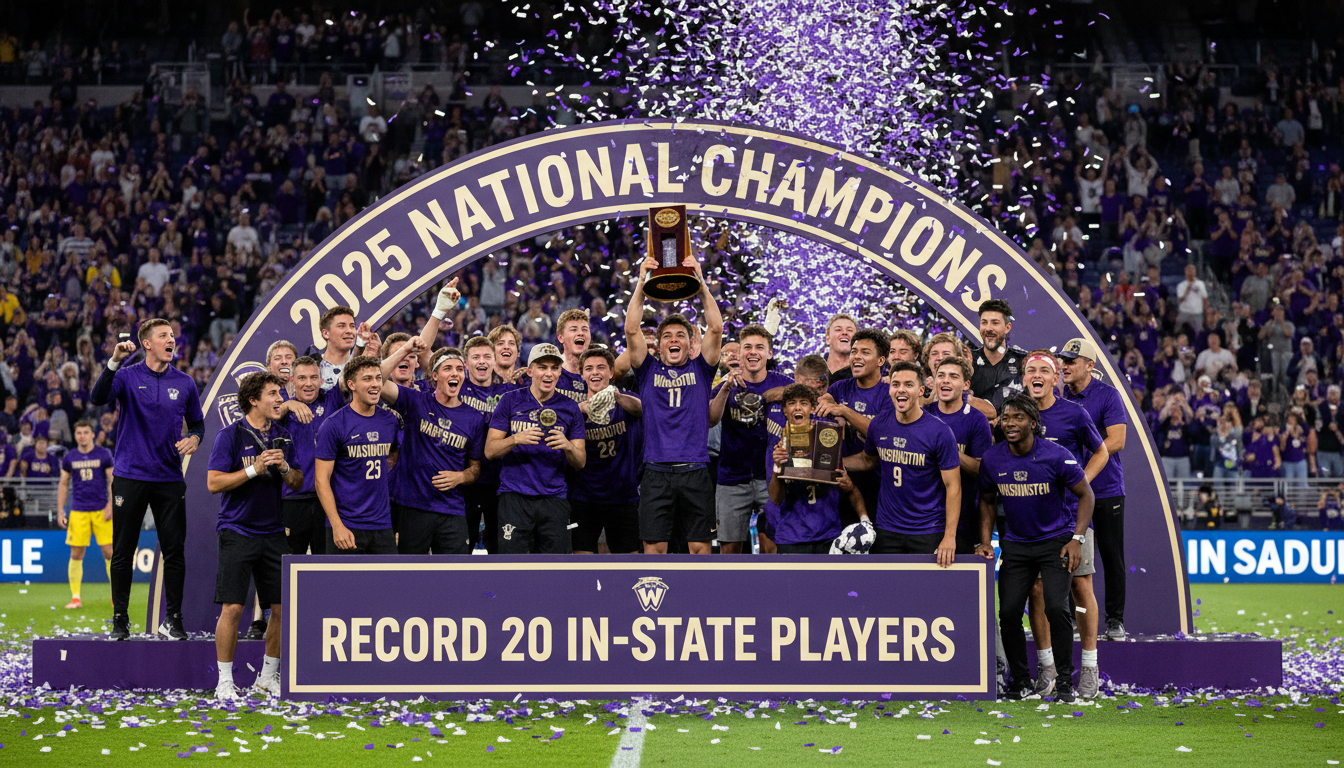
The Washington Huskies national title in December 2025 marked a striking reversal of recent Division I trends, as the program lifted the trophy with a completely domestic roster and a record 20 players developed in-state. That emphasis on local talent — including seven of the starting 11 in the College Cup final who grew up in Washington — underpinned a season that closed with the Huskies capturing their first NCAA championship through players largely raised within the state. The result has drawn attention for both its rarity in the modern internationalized college game and for the program’s patient, development-first approach.
Washington’s roster composition and national rarity
Washington’s 2025 championship roster stood out in a landscape where many leading programs rely heavily on international recruits. The Huskies fielded a 29-man squad composed entirely of players who spent at least one year of youth soccer in the United States, with 20 of those athletes hailing from within Washington state. Those figures set 21st-century records for an NCAA Division I champion in both the percentage and the total count of in-state players.
The starting lineup for the title match further emphasized the local core, with seven starters developed in Washington. That in-state concentration contrasts sharply with recent champions and finalists elsewhere, where international players have often comprised a significant share of rosters and playing time. Washington’s composition signaled a deliberate alternative to the prevailing recruiting orthodoxy.
Coaching philosophy and the long-term development model
Head coach Jamie Clark’s programmatic choices were central to the Huskies’ construction and success. Clark has long emphasized player development, continuity and the cultivation of relationships with local club coaches, traits he traces back to early influences and coaching mentors. That philosophy translated into a willingness to redshirt and patient roster building; five of the starting eleven in the College Cup final were redshirt players who matured within the program over multiple seasons.
Washington’s approach favored measured progression over quick fixes, prioritizing the welfare and development of student-athletes as the route to sustained success. The coaching staff invested in community outreach, camps and clinics to deepen knowledge of local prospects, enabling the program to recruit players it had observed and vetted closely. The result was a roster of players who fit the team’s culture and tactical requirements with fewer unknowns than a broad national or international search might produce.
Historical context and statistical trends in college soccer
The Huskies’ title arrived amid a decade when international athletes grew to about 35 percent of Division I men’s soccer rosters overall. From 2010 to 2025 the share of international players in the college pool rose substantially, altering roster construction for many programs and contributing to a period in which national champions frequently leaned on overseas talent. Notably, the five national titles from 2020 through 2024 were claimed by programs with rosters that featured between 21 and 42 percent international players, whereas a prior 13-season stretch saw champions with overwhelmingly domestic squads.
Washington’s 2025 championship is therefore notable not only for its in-state emphasis but for bucking the broader upward trend in international recruitment. The College Cup field that season also included teams with high domestic percentages, showing that multiple models can coexist; however, the larger decade-long pattern still reflects substantial international influence across the sport.
Recruiting pipeline and the role of Washington youth soccer
A central pillar of Washington’s model was its deep engagement with local club systems and youth coaches. The program cultivated relationships across the state’s clubs, running clinics and camps that allowed staff to evaluate players over time and to build familiarity with prospects’ character and fit. That continuum — from youth club to college squad — made it possible for the Huskies to identify and integrate players who might otherwise have been overlooked in a wider national recruiting sweep.
Several players on the 2025 roster had long-standing ties to the program, including connections going back to team appearances and even roles as ball boys for earlier Husky squads. Those long-term relationships reinforced continuity and cultural alignment, and they illustrate how place-based recruiting can generate competitive advantage when paired with a committed development pathway. The program’s recent 2026 recruiting class, which again emphasized state-based talent, points to an intent to continue this locally rooted strategy.
On-field tactics and the contribution of in-state players
The Huskies’ tactical identity in 2025 reflected the physical and technical traits developed within their in-state pipeline. Familiarity among players, born of shared club experiences and parallel developmental frameworks, contributed to cohesion in buildup play and defensive organization. That continuity helped Washington execute game plans with consistency and resilience through the postseason, particularly in high-pressure moments of the College Cup.
Individual contributions from locally developed starters were decisive in key matches, where understanding between teammates sped transitions and reduced breakdowns under pressure. The team’s balance between seasoned upperclassmen — some originally redshirted — and emerging local talent created depth and flexibility, allowing the coaching staff to navigate injuries and tactical adjustments without sacrificing identity.
Implications for college soccer recruiting strategy
Washington’s championship raises questions about the balance between local development and global recruitment across Division I programs. For schools in states with robust youth ecosystems, the Huskies’ success demonstrates that investing in homegrown pipelines and long-term player development can yield elite-level results. That model requires patience, strong community ties and coaching continuity, characteristics not immediately replicable by programs that frequently reload their rosters.
At the same time, the broader trend of international recruitment remains entrenched for many programs seeking immediate impact or specific positional profiles. The 2025 College Cup field included teams with varying international mixes, underscoring that there is no single route to competitiveness. Washington’s title may encourage other programs to re-evaluate the return on investment in local scouting and development, but systemic factors — from NCAA transfer dynamics to scouting resources — will shape how widely any shift takes hold.
Program trajectory and expectations after the title
The Huskies enter the post-championship period with momentum and a reinforced identity that is likely to influence both recruiting and regional interest in the sport. Winning a national title with a roster built largely from in-state talent created a tangible pathway for young Washington players who aspire to play collegiately without leaving the region. That local resonance may bolster participation and investment in youth coaching across the state.
Internally, the coaching staff faces the task of sustaining competitive standards while managing roster turnover and the expectations that accompany a championship. The program’s commitment to patient development suggests continuity rather than radical roster overhaul; however, success will hinge on retaining the cultural elements that produced the title and on continuing to translate in-state talent into on-field performance.
The Washington Huskies national title in 2025 stands as a compelling case study in the potential of place-based recruiting and long-term player development within collegiate soccer. As college programs and youth systems assess their own strategies, the Huskies’ achievement offers both a blueprint and a challenge: build deep local ties, commit to patience, and prioritize development, and a national championship can be won with players grown and nurtured close to home.